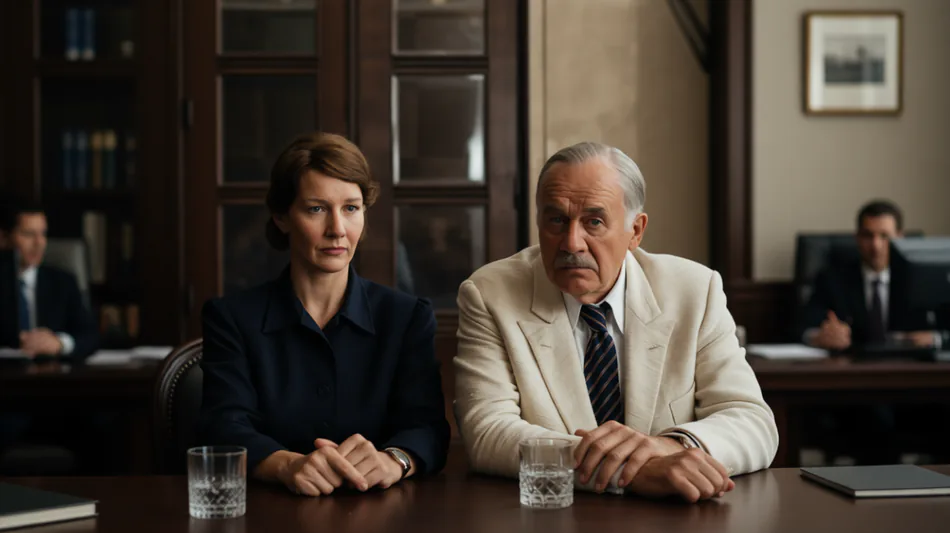
IFFI Opening Film 'Fatherland' Addresses Global Divisions Through Post-War Lens

 Texas Sports Betting Status: No Legal Options Amid Legislative Push for 2027 Referendum

 Geri Halliwell-Horner Embraces Queen Camilla at Commonwealth Writing Competition

 Meta Quest 3 and 3S Gain Access to Over 150 3D Movies

 Sarah Bajada Shares Message on Pregnancy Loss

 ALIX LASERS shareholders remove Michael Sobitsch as managing director in view of the circumstances

 Euroseas Q3 Net Profit Falls to $91.4 Million Amid Fleet Reduction
Renowned Polish film producer Ewa Puszczyńska stated that 'Fatherland,' the opening film of the 57th International Film Festival of India (IFFI), resonates with today's divided world despite its 1947 German setting. Speaking in Goa, she highlighted the film’s exploration of cultural identity and family dynamics amid historical upheaval.
PANAJI: Polish film producer Ewa Puszczyńska said the black-and-white historical drama 'Fatherland,' chosen as the opening film for the 57th International Film Festival of India (IFFI), reflects contemporary global divisions despite being set in post-World War II Germany.
Speaking on the red carpet ahead of the festival's opening ceremony in Goa on Friday, Puszczyńska emphasized that the film’s themes of belonging, cultural identity, and family relationships remain relevant to a world marked by inequality and conflict.
"Even if the story is set in 1947 Germany, after the war, with a divided Europe, I think it resonates very much with the contemporary world," she said. She noted that the narrative mirrors current divisions between East and West, North and South, as well as economic disparities within societies.
The film explores the meaning of home and belonging, examining how language, culture, and geography shape individual identity. It also delves into parent-child relationships and the impact of major historical events on ordinary people. Puszczyńska described the film’s quiet storytelling and emphasis on dialogue as a contrast to what she termed the "noisy and chaotic contemporary world."
"I think this film is also about dialogue, building bridges and overcoming divisions," she added.
'Fatherland' is a multinational co-production that brought together producers from various countries, with Poland emerging as the principal producing country due to Puszczyńska’s previous collaborations with director Paweł Pawlikowski on films such as 'Ida' and 'Cold War.' Although the story is set in Germany, features German actors, and is primarily in the German language, it was shot entirely in Poland.
Puszczyńska expressed pride in the film’s ability to address modern concerns through a historical lens. The nine-day-long IFFI will showcase 159 international films from 86 countries alongside 76 Indian movies.
H.Silva--PC