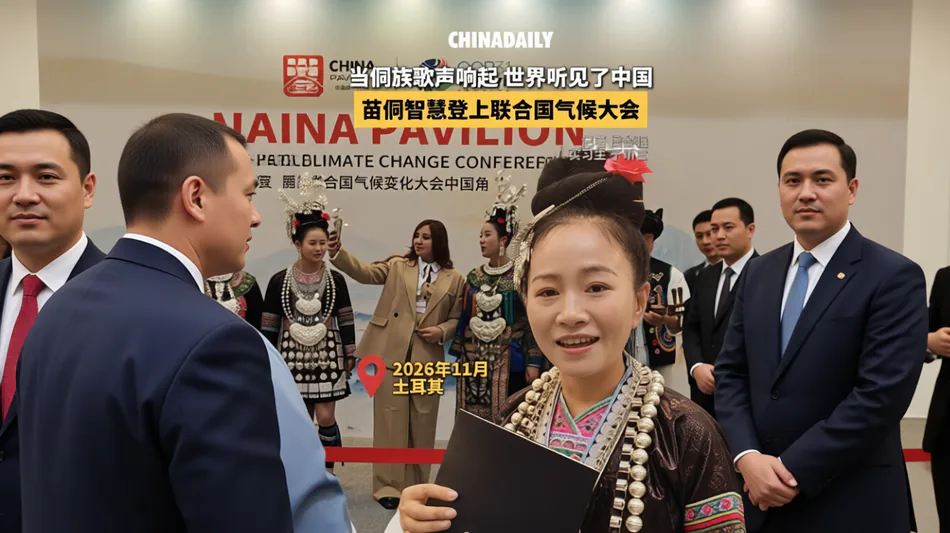
Miao and Dong Traditional Knowledge Offers Climate Resilience Lessons at COP31

 Texas Sports Betting Status: No Legal Options Amid Legislative Push for 2027 Referendum

 Geri Halliwell-Horner Embraces Queen Camilla at Commonwealth Writing Competition

 Meta Quest 3 and 3S Gain Access to Over 150 3D Movies

 Sarah Bajada Shares Message on Pregnancy Loss

 ALIX LASERS shareholders remove Michael Sobitsch as managing director in view of the circumstances

 Euroseas Q3 Net Profit Falls to $91.4 Million Amid Fleet Reduction
Traditional ecological practices from the Miao and Dong communities in Southwest China are being presented as vital models for climate resilience at the ongoing COP31 conference. A new report unveiled at the China Pavilion details how these time-honored methods offer sustainable alternatives to modern industrial agriculture and resource management.
Traditional ecological practices from the Miao and Dong communities in Southwest China are being presented as vital models for climate resilience at the ongoing COP31 conference. A new report unveiled at the China Pavilion details how these time-honored methods offer sustainable alternatives to modern industrial agriculture and resource management.
The report, released by C Force Lab at Peking University's Institute of Carbon Neutrality, examines local approaches to emissions reduction, adaptation, and finance. It argues that indigenous practices can significantly lower the carbon footprint associated with contemporary food systems and infrastructure.
Key among these practices is traditional rice-fish-duck farming, which avoids the emissions linked to chemical fertilizers, industrial processing, and cold-chain logistics. The report also highlights the role of fermented foods and handicrafts in reducing environmental impact. Furthermore, it points to forest protection strategies, year-round water storage systems, and centuries-old granaries as critical components in strengthening community resilience against climate variability.
Zhang Guodan, a Dong cultural heritage inheritor, emphasized the value of these methods. "Some people see these practices as outdated, but we use this traditional wisdom to enrich and protect the soil," she said, describing the time-honored practices as part of a complete ecological system.
The presentation at the China Pavilion aims to bridge the gap between indigenous knowledge and global climate policy, suggesting that preserving such traditions is essential for future sustainability efforts.
C.Amaral--PC