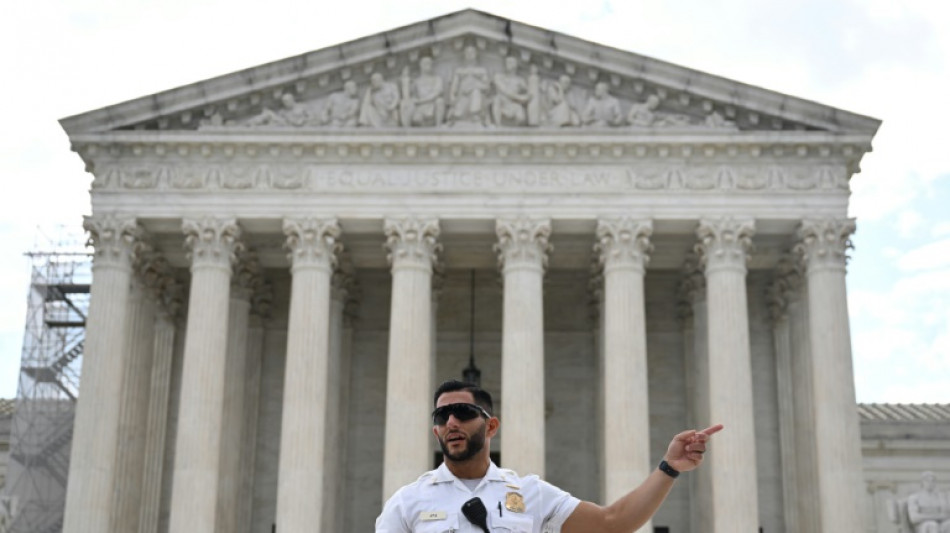
US Supreme Court bans the use of race in university admissions / Photo: Jim WATSON - AFP

 US judge weighing Trump's White House ban on media outlets

 At UN, OpenAI's Altman calls 'for extreme care' in AI
 Hamilton gives thumbs up to Gulf GPs despite Iran conflict

 Leclerc admits going 'too far' in Hamilton shunt in Italy

 Row engulfs Dolly Parton's estate as manager accuses nephew of making threats

 Mandela Digital Extends Early Access Programme to 11 February 2027 Following Strong Response

 US seeks 11th Presidents Cup win in a row over global foes

 McDonald's to boost franchisees as inflation weighs on consumers

 Trump invites Putin to G20 summit in Miami

 Archaelogical 'breakthrough' could confirm origins of Paris

 ILO financial crisis takes centre stage in leadership race
 Stocks dip, oil soars despite Trump hailing "productive" Iran talks

 China's Xi to get rare airport welcome from Trump

 Turkey reassures investors over investment fund crisis

 Saka says England still have 'scar' from World Cup semi-final loss

 アレックス・ボディ氏とシュテファン・ハウプト教授、ルーマニアの伝説的な美術コレクションをめぐり提携に合意

 亞歷克斯·博迪與史蒂芬·豪普特教授就羅馬尼亞傳奇藝術收藏達成合作協議

 Алекс Боди и проф. д-р Стефан Хаупт договорились о сотрудничестве в рамках легендарной коллекции произведений искусства в Румынии

 French foreign minister says Palestinians 'must' hold polls

 Fresh Russian strikes on Ukraine's infrastructure kill seven

 Eriksen to return to Denmark after parting ways with Wolfsburg

 Brad Pitt says working with dog co-star was 'really moving'

 Golan will remain Syrian, vows President al-Sharaa at UN

 Blueberry Strengthens MENA Presence with CMA Category 5 License and Dubai Office Launch

 Russia probes bear attacks, as official says town under 'siege'

The US Supreme Court on Thursday banned the use of race and ethnicity in university admissions, dealing a major blow to a decades-old practice that boosted educational opportunities for African-Americans and other minorities.
"The student must be treated based on his or her experiences as an individual -- not on the basis of race," Chief Justice John Roberts wrote in the majority opinion.
The justices broke six to three along conservative-liberal lines in the decision, which came after years of conservative antipathy to "affirmative action" policies that have sought diversity in school admissions and business and government hiring.
The court said that universities were free to consider an individual applicant's personal experience -- whether, for example, they grew up experiencing racism -- in weighing their application over applicants more academically qualified.
But deciding primarily based on whether the applicant is white, Black or other is itself racial discrimination, Roberts wrote.
"Our constitutional history does not tolerate that choice," he said.
The court sided with an activist group, Students for Fair Admissions, that sued the oldest private and public institutions of higher education in the country -- elite Harvard University and the University of North Carolina (UNC) -- over their admissions policies.
The group claimed that race-conscious admissions policies discriminated against equally or better-qualified Asian Americans competing to enter the two universities.
Harvard and UNC, like a number of other competitive US schools, consider an applicant's race or ethnicity as a factor to ensure a diverse student body and representation of minorities.
Such affirmative action policies arose from the Civil Rights Movement in the 1960s aiming to help address the legacy of discrimination in higher education against African Americans.
Thursday's ruling was a victory for conservatives, some who have argued that affirmative action is fundamentally unfair.
Others have said the policy has outlived its need because educational opportunities have vastly improved for Blacks and other minorities.
But the ruling was a major setback to progressives, one year after the court overturned the landmark 1973 "Roe v. Wade" decision guaranteeing a woman's right to abortion.
The end to federally guaranteed abortion rights almost immediately led to half of the 50 states banning or severely curtailing the practice.
The affirmative action ruling could have the same effect of many states and institutions halting programs designed to give disadvantaged minorities extra consideration in the competitive college admissions process.
Leading the dissenters, Justice Sonia Sotomayor said the decision "rolls back decades of precedent and momentous progress."
"In so holding, the Court cements a superficial rule of colorblindness as a constitutional principle in an endemically segregated society," she wrote.
M.Carneiro--PC