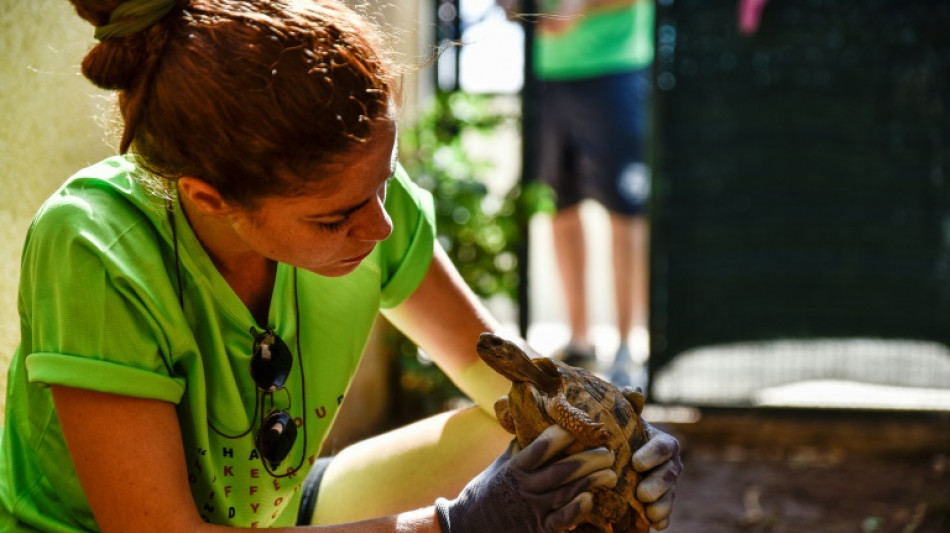
Injured tortoises make slow recovery from Greece fires / Photo: Spyros BAKALIS - AFP

 Thanksgiving storms disrupt thousands of US flights
 T.J. Lang criticises Aaron Rodgers over comments about Mike McCarthy

 Qatar Tourism and Uber Sign Five-Year Mobility Partnership

 U2 pays tribute to Dolly Parton during Thanksgiving Eve NFL show
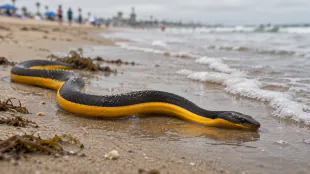 Rare yellow-bellied sea snake found on Southern California beach

 Second-generation Mini Cooper SE set for India launch with 402km range

 Filmasia 2026: 16 Films Across Prague, Brno, and České Budějovice

 Kojey Radical Launches Burger Collaboration at Dallas Burger Joint in Shoreditch

 Kelly Stafford Reflects on Matthew's Lions Thanksgiving Era Ahead of Rams' Netflix Debut

In an animal shelter near Athens, veterinarian Kleopatra Gkika gently smears soothing cream on the leg of a tortoise, one of hundreds singed in Greece's devastating summer wildfires.
The healing process is going well, the vet noted.
The burnt skin has fallen off and the tortoise can soon be released back into its natural habitat.
Even though, there may not be much of that habitat left, Gkika mused.
In July and August, Greece was affected by a series of successive wildfires around the country that left at least 26 people dead.
The area around the shelter in Kalyvia Thorikou, some 60 kilometres (37 miles) southeast of Athens, was among the first to be hit.
A few weeks later, the pristine forest of Dadia in northeastern Greece, which contains a natural park, went up in flames.
The fires eventually engulfed nearly 94,000 hectares of the forest in the largest blaze ever recorded on European soil.
Deflecting criticism, the conservative government of Prime Minister Kyriakos Mitsotakis -- which won re-election in June by a landslide -- has blamed the disaster on climate change.
Some 400 tortoises overall were rescued from blaze sites surrounding Athens and on the nearby island of Evia.
- 'Nothing left' -
They were brought to Anima, a non-profit first aid centre for wildlife, and to a zoo near the capital.
"Some tortoises had burns on their legs or on their shell. Others had breathing difficulties because of smoke inhalation," said Vassilis Sfakianopoulos, the founder of "Save your hood", a volunteer group that normally cleans up litter.
This summer, the group rescued the tortoises as well as snakes, cats and other animals trapped in the inferno.
"The intensity of the fires was such that there was nothing left. Shrubs turned to charcoal," added Celine Sissler-Bienvenu of the International Fund for Animal Welfare (IFAW) charity, which carried out a mission to Greece.
With thousands of people in Greece forced to flee for their safety from the fires, the wildlife was largely forgotten, she said.
But tortoises are resilient animals.
"Tortoises will reduce their metabolism. They can go without eating for several weeks," Sissler-Bienvenu noted.
"And at the first rain, they will come out to eat."
At the Kalyvia shelter, the first thing an injured tortoise requires is immersion in a water basin for rehydration.
When an injury is not immediately apparent, vets attempt to detect possible internal injury through smell, Gkika said.
- Racing against time -
Tortoises ready to be released into the wild have a blue chalk cross mark on their shell.
Around a hundred were already relocated in September.
The team know they are racing against the clock to release them from captivity as soon as possible, said Sissler-Bienvnu.
For animals such as these, which are wild and not social at all, placing them together in an enclosure constitutes additional stress," she told AFP.
In particular, males will continuously seek to mate and need to be kept apart from the females lest they injure -- or even kill them.
Tortoises are also extremely attached to their home area, where they are familiar with hiding places and water sources, and may stop eating if moved elsewhere, Sissler-Bienvenu said.
A 38-year-old engineer, Sfakianopoulos said he is enraged at the sight of the suffering reptiles.
"I find it extremely unfair that no-one in Greece has been taking care of wildlife since the financial crisis," he said, referring to the decade-long crunch that brought the country to its knees.
But in confronting disaster, "you find hope", he said.
"It makes you grow and change and you have a real impact on the environment."
S.Caetano--PC