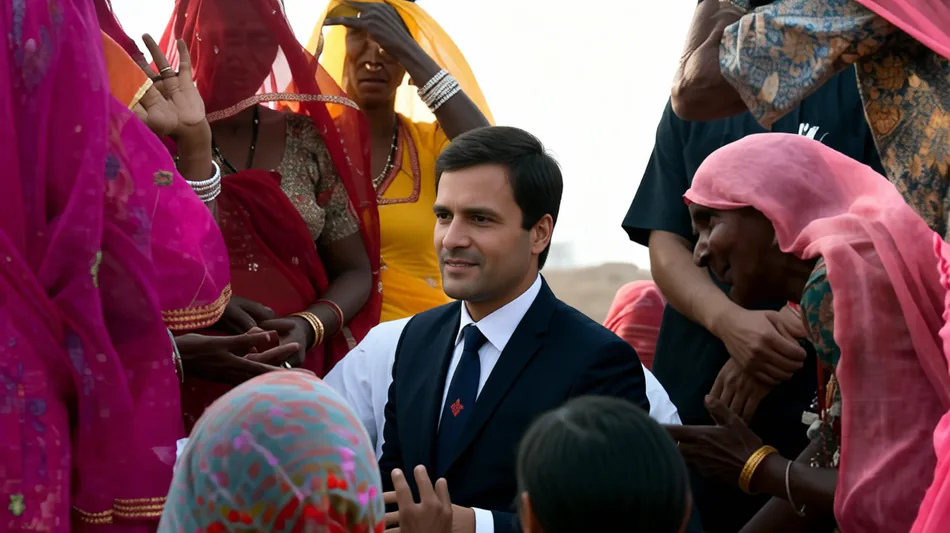
Youth Congress Challenges Meta's Automated Blocking of Rahul Gandhi Posts in Delhi High Court

 Rare yellow-bellied sea snake found on Southern California beach

 Second-generation Mini Cooper SE set for India launch with 402km range

 Filmasia 2026: 16 Films Across Prague, Brno, and České Budějovice

 Kojey Radical Launches Burger Collaboration at Dallas Burger Joint in Shoreditch

 Kelly Stafford Reflects on Matthew's Lions Thanksgiving Era Ahead of Rams' Netflix Debut

 World Experiences First Six Consecutive Days Above 2C Preindustrial Threshold
The Indian Youth Congress (IYC) has approached the Delhi High Court to challenge Rule 4(4) of the Information Technology Rules, 2021, alleging that social media giant Meta employs automated tools to restrict content featuring Leader of the Opposition Rahul Gandhi. The petition cites specific instances where posts were made unavailable in India due to Gandhi's name or photograph being used as identifiers.
The Indian Youth Congress (IYC) has filed a petition in the Delhi High Court seeking to strike down Rule 4(4) of the Information Technology (IT) Rules, 2021, alleging that Meta Platforms Inc. utilizes automated systems to block content featuring Leader of the Opposition Rahul Gandhi. The legal challenge contends that the social media company uses Gandhi’s name and image as keywords to restrict posts on Instagram and Facebook within India.
The petition, filed by IYC national secretary and head of its social media department Manu Jain on November 25, lists several instances where content was made "unavailable in India" between September 29 and November 23. The affected material includes a birthday greeting from one party worker to another, a wedding invitation presented to Gandhi, a tribute to former Prime Minister Rajiv Gandhi, and a report on Gandhi’s lecture at the University of Chicago.
According to the petition, which was reviewed by MediaNama, the common element across all these instances was the presence of Gandhi’s photograph or name. The document names the Ministry of Electronics and Information Technology (MeitY), the Ministry of Home Affairs (MHA), and Meta as respondents.
The IYC’s legal argument centers on the "keyword theory," positing that Meta’s automated detection systems are flagging content based on Gandhi’s identifiers. The petition requests the court to compel both Meta and the government to disclose their specific criteria for blocking content. Notably, the challenge does not contest the rule’s application to the automated detection of rape or child sexual abuse material, which Rule 4(4) also mandates platforms to address.
The petition highlights a discrepancy in how takedown notices are processed. It argues that if MeitY (Respondent No. 1) is correct in its stance, Meta (Respondent No. 3) acted "on its own accord" and was therefore bound by Rule 4(8) to provide prior notice, reasons, and an opportunity to dispute the action. The document points to conflicting positions regarding a May 10 incident where Instagram blocked a reel and a photo on Gandhi’s own account before restoring them the same day. At that time, MeitY sources stated the ministry "had nothing to do with this action" and blamed Meta’s internal systems.
Meta has consistently cited "legal requirements" in its takedown notices. The petition notes that Meta described an October 30 restriction of content from LiveLaw as being implemented "under Rule 4(4)." Additionally, Reuters reported that Meta informed Congress politicians on November 24 that it was bound by local laws. Meta has not publicly responded to the current petition.
The case raises questions about the extent of government influence over Meta’s automated systems. The Indian government confirms that Meta’s systems are connected to the Sahyog portal, which agencies use to send takedown requests. A fact-check unit from the Press Information Bureau stated on August 20 that "the API integration with Meta took place in 2025 at the request of Meta." The unit described claims that Meta had automated blocking to meet a three-hour deadline as "misleading," though it did not specify what the API integration allows agencies to do.
The Indian Express previously reported that directions sent through this system lead Meta to remove content "without a separate human review," a claim neither Meta nor the government has confirmed. The IYC petition argues that the volume of requests, the API link, and the three-hour deadline collectively "leave no scope for any human examination of individual items."
Under Rule 4(4), platforms like Meta must use automated tools to block information "exactly identical in content" to material already removed under Rule 3(1)(d). MeitY amended this rule on February 10, making such automation mandatory from February 20. Previously, platforms were only required to "endeavour" to use these tools. Rule 3(1)(d) covers takedowns ordered by courts or government officers of the rank of Joint Secretary or Deputy Inspector General of Police, with each intimation needing to name a specific URL.
The IYC contends that Rule 4(4) creates a blocking regime outside Section 69A of the IT Act, lacking the safeguards established by the Supreme Court in Shreya Singhal v. Union of India. Those safeguards include a reasoned written order and a hearing for the person who posted the content. Under Rule 4(4), only users attempting to view a blocked post see a notice, while the original poster receives none.
LiveLaw has also challenged the rule and associated advisories, with the Delhi High Court issuing a notice in that case on November 19. MeitY issued an advisory to Meta on October 10, asking it to act "with immediate effect" on content "having potential to affect public order." The advisory asked Meta to ensure "lawful civic and public discourse is not unnecessarily restricted."
MediaNama sent questions to Meta on November 26 regarding these allegations. On October 29, the outlet also asked Meta and MeitY whether any government body has API or direct technical access to restrict content and whether Meta blocks posts by keyword or hashtag. Neither party has responded to these inquiries.
A.Motta--PC


