One dead as new quake shakes west Afghanistan / Photo: John SAEKI - AFP

 Breytenbach confirms recommending Sibiya for Johannesburg post

 Celebrities mark Thanksgiving in turkey-themed photo gallery

 German fashion model Veruschka dies in Berlin at 87

 Thanksgiving storms disrupt thousands of US flights
 T.J. Lang criticises Aaron Rodgers over comments about Mike McCarthy

 Qatar Tourism and Uber Sign Five-Year Mobility Partnership

 U2 pays tribute to Dolly Parton during Thanksgiving Eve NFL show

 Rare yellow-bellied sea snake found on Southern California beach

 Second-generation Mini Cooper SE set for India launch with 402km range

 Filmasia 2026: 16 Films Across Prague, Brno, and České Budějovice

 Kojey Radical Launches Burger Collaboration at Dallas Burger Joint in Shoreditch

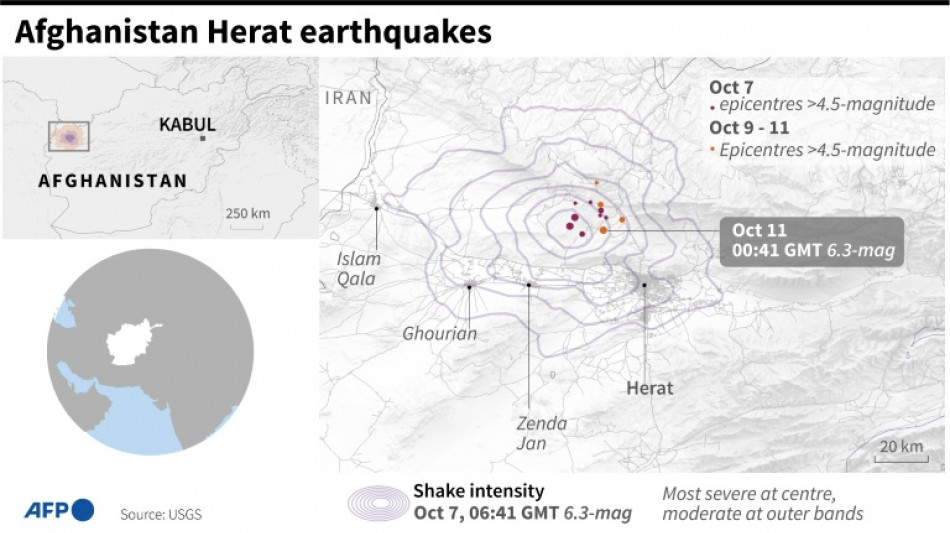
A magnitude 6.3 earthquake struck western Afghanistan on Wednesday, claiming at least one life and causing panic among residents already traumatised by a series of tremors that killed around 2,000 people at the weekend.
The dawn quake hit around 30 kilometres (19 miles) north of the provincial capital of Herat, where thousands were spending a fourth night in the open after Saturday's quakes flattened their villages.
"It's horrible, the whole of Herat is terrified," said 32-year-old Abdul Qudos.
"We are so scared that even when we see the trees moving (in the wind), we think it's another earthquake coming."
At least one person was killed and 120 injured by the latest quake, said Abdul Zahir Noorzai, ambulance manager for Herat Regional Hospital.
"The people in these (rural) areas were living outside their homes which are already destroyed" but were hit by fresh falling debris from unstable ruins, he told AFP.
The quake was followed by aftershocks measuring 5.0 and 4.1, but an AFP reporter said damage in Herat city -- home to more than half a million -- was minimal.
Many residents have camped in tents, cars and gardens since Saturday's magnitude 6.3 quake and a series of powerful aftershocks.
"Our children are so scared that they stay awake until the morning. They don't sleep," said 40-year-old Aziz Ahmad.
At Herat Regional Hospital, patients were being treated in an outdoor courtyard. Ambulances were arriving Wednesday morning, but most injuries appeared to be minor.
Afghanistan is frequently hit by deadly earthquakes, but the weekend disaster was the worst to strike the war-ravaged country in more than 25 years.
- Casualties in flux -
Volunteers have been digging for survivors and bodies from the earlier quakes which totally destroyed at least six villages in rural Zenda Jan district and affected more than 12,000 people, the UN says.
Local and national officials have given conflicting counts of the number of dead and injured, but the disaster ministry has said 2,053 people died.
"We can't give exact numbers for dead and wounded as it is in flux," said disaster management ministry spokesman Mullah Janan Sayeq.
Providing shelter on a large scale will be a challenge for Afghanistan's Taliban authorities, who seized power in August 2021, and have fractious relations with international aid organisations.
"Not a single house is left, not even a room where we could stay at night," said 40-year-old Mohammad Naeem, who told AFP he lost 12 relatives, including his mother, after Saturday's earthquakes.
"We can't live here anymore. You can see, our family got martyred here. How could we live here?"
Most homes in rural Afghanistan are made of mud and built around wooden support poles, with little in the way of steel or concrete reinforcement.
Multi-generational extended families generally live under the same roof, meaning serious earthquakes can devastate communities.
Afghanistan is already suffering a dire humanitarian crisis, with the widespread withdrawal of foreign aid following the Taliban's return to power.
Herat province, on the border with Iran, is home to around 1.9 million people, and its rural communities have been suffering from a years-long drought.
E.Borba--PC