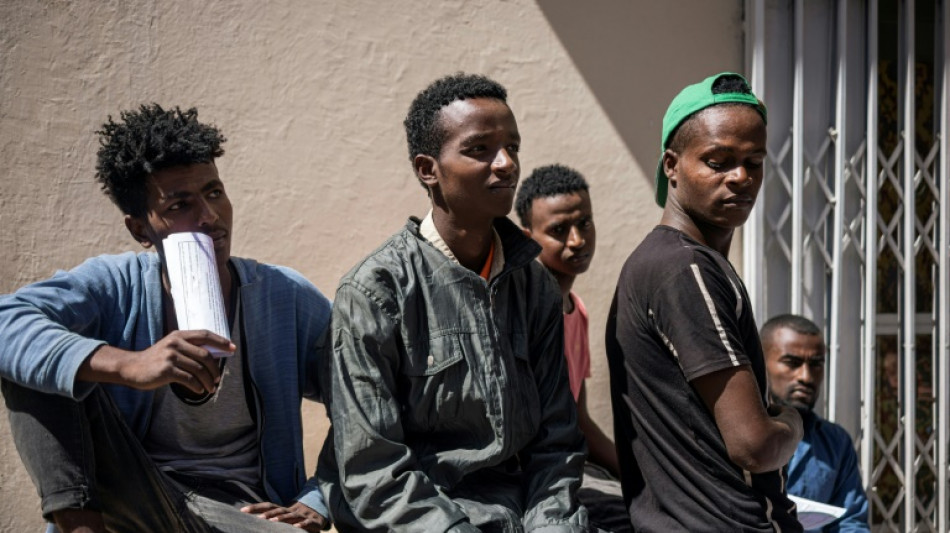
Seeking Saudi opportunity, Ethiopian migrants 'trapped between life and death' / Photo: Michele Spatari - AFP/File

 India's 'Tree Father' plants for a greener future
 Hopping mad: New health warning stirs up Belgian brewers

 Canadian capital to rename 'Trump Ave'

 Pope heads to France on first state visit in 18 years

 Bacteria suspected in deaths of hundreds of baby whales off Argentina

 US 'must choose' whether to end war: Iran president to Fox News

 UN approves resolution on dealing with rising sea levels

 Yalcouye makes dream debut as Ivory Coast beat Ghana in AFCON qualifier

 Chicago's White Sox and Cubs book MLB playoff berths

 Last-gasp Gakpo strike snatches Dutch draw to sour Klopp debut

 Global stocks mostly fall as oil prices and bond yields rise

 Israel's Netanyahu denounces enemies, allies in fiery UN speech

 Hollywood stars among arrests in NY anti-Netanyahu protest

 Losing start in AFCON qualifying for 78-year-old coach Le Roy

 Italy bans burqas in schools, caps numbers of foreign students per class

 Israel policies threaten 'life and existence' of Palestinians, Abbas says

 Paolini steers Italy past China in BJK

 Zidane admits emotion on eve of first game as France coach

 Breetzke and Maharaj sink Australia in first one-day international

 Zelensky broke confidentiality with North Korea POWs disclosure: South's president

 Former Liverpool star Carroll reveals he was sexually assaulted
 Dominican Republic calls for Haiti force to be strengthened

 Dolly Parton's nephew ordered to stay away from estate staff, properties

 Early exit for Philippine darling Eala at Singapore Open

 Hurricane Polo triggers huge waves in coastal Mexican city

Ethiopian migrants who crossed the sea in pursuit of a better life have one goal in mind as they hide in the Saudi mountains: avoid border guards, and their deadly shots.
Only when night falls on this part of southern Saudi Arabia do the undocumented migrants dare venture into nearby villages to scavenge for food, returning with scraps they hope will keep them alive until smugglers can find them a job.
"Every day we are scared of dying. We beg people in the village to give us flour and bread, and then we go back into the mountains," said Mohammed, 30, who spoke to AFP by phone from a makeshift shelter near Saudi Arabia's southern border with Yemen.
"People here are very scared to help us find job opportunities since it's illegal, so we consider ourselves trapped between life and death."
Hundreds of thousands of African migrants each year brave the perilous "Eastern Route" across the Red Sea and through war-scarred Yemen to reach Saudi Arabia, a desperate ploy to pull their families out of grinding poverty.
Every phase of the journey is treacherous, but there are growing fears the final stretch over the Yemeni highlands into southern Saudi Arabia has become more lethal than ever.
In August, Human Rights Watch accused Saudi border guards of killing "at least hundreds" of Ethiopians trying to cross into the Gulf kingdom between March 2022 and June 2023, using explosive weapons in some cases.
Riyadh dismissed the group's findings as "unfounded and not based on reliable sources".
AFP has interviewed six migrants and four smugglers, all of whom asked to be identified by first names only over security concerns.
These interviews indicate that even when Ethiopians like Mohammed reach Saudi soil, it is far from certain they will find work and turn their lives around.
- Shooting 'as if we're garbage' -
Mohammed was still a teenager when he first made the journey from Ethiopia to Saudi Arabia, travelling over land to Djibouti before hiding in a fishing boat for the sea crossing.
Huthi rebels had not yet seized the Yemeni capital Sanaa, a move which in 2014 would plunge the country into war, meaning Mohammed had a fairly straightforward trip over the border to Saudi Arabia, where his smuggler found him a job as a shepherd.
Three years ago, however, Mohammed lost that job and was forced to return to his home village in Ethiopia's Oromia region, where he encountered the same situation that had prompted him to leave in the first place: no money, no prospects.
Last year he raised the funds –- roughly $2,500 –- for a second passage to Saudi Arabia, but this time the trip was more harrowing, especially when he got to the Saudi-Yemeni border.
"Every two metres (yards) you find dead Ethiopians," he said.
"Saudis open fire on Ethiopians as if we are not human beings, as if we are garbage."
Saudi state media in August quoted a government source saying that such claims were baseless and that Saudi authorities were committed to upholding human rights.
The government source also said Riyadh had provided care to "people who were subjected to gunshot wounds by armed groups to push them to enter the kingdom by force" –- an apparent reference to the Huthis, who have denied collaborating with smugglers.
The number of migrants reaching Saudi Arabia appears to have declined in recent months, several smugglers told AFP, though it is unclear whether that is because fewer Ethiopians are embarking on the journey.
"There are at least 200 arriving every day," said a smuggler, also named Mohammed. "Before, the numbers were bigger."
- Dreams on hold -
A smuggler's assistant named Abdi said that when Ethiopians reach southern Saudi Arabia, those with any remaining cash are taken to apartment buildings rented out by smugglers.
Under the watchful eye of armed guards, they sleep more than 10 to a room as smugglers try to find them work and arrange for food to be delivered each day.
The conditions might be bleak, but migrants who arrive empty-handed are worse off, Abdi said, in most cases left to their own devices.
Those who find employment may be relatively lucky but face difficulties too.
Sara, a 23-year-old Ethiopian, has secured a job as a nanny for a family in Riyadh that she said treats and pays her well.
But she described a grim existence: without papers, the fear of leaving her employer's compound means she has effectively worked non-stop for four years.
Her dreams of starting a family of her own are on hold.
"Of course I am not happy with my life here. How can I be?" she asked.
If all goes according to plan, though, she may soon have relatives close by.
With her savings, she recently paid a combined $5,000 for smuggling fees for her brother and his son, who are now in southern Saudi Arabia, dodging the authorities and looking for work.
X.Brito--PC