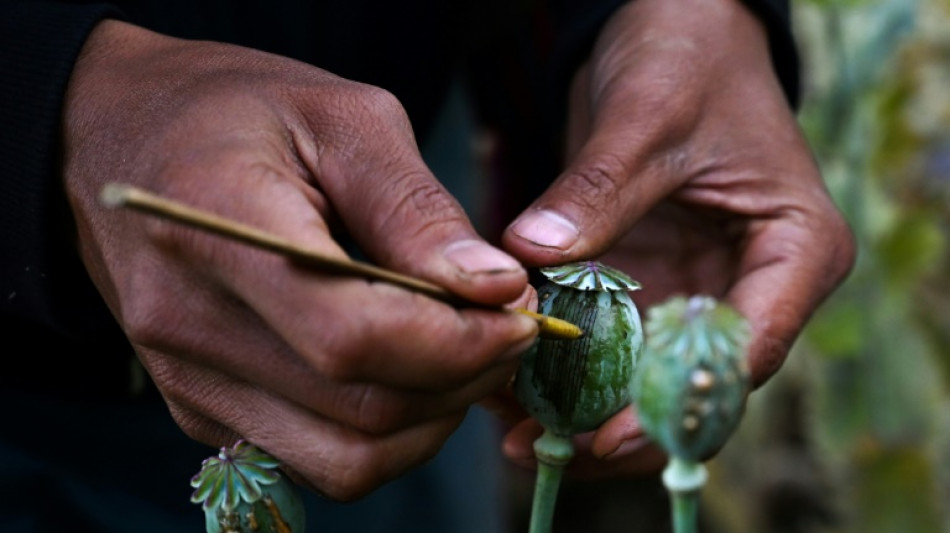
Myanmar overtakes Afghanistan as world's biggest opium producer: UN / Photo: Ye Aung THU - AFP

 India's 'Tree Father' plants for a greener future
 Hopping mad: New health warning stirs up Belgian brewers
 Canadian capital to rename 'Trump Ave'

 Pope heads to France on first state visit in 18 years

 Bacteria suspected in deaths of hundreds of baby whales off Argentina

 US 'must choose' whether to end war: Iran president to Fox News

 UN approves resolution on dealing with rising sea levels

 Yalcouye makes dream debut as Ivory Coast beat Ghana in AFCON qualifier
 Chicago's White Sox and Cubs book MLB playoff berths

 Last-gasp Gakpo strike snatches Dutch draw to sour Klopp debut

 Global stocks mostly fall as oil prices and bond yields rise

 Israel's Netanyahu denounces enemies, allies in fiery UN speech

 Hollywood stars among arrests in NY anti-Netanyahu protest

 Losing start in AFCON qualifying for 78-year-old coach Le Roy
 Italy bans burqas in schools, caps numbers of foreign students per class

 Israel policies threaten 'life and existence' of Palestinians, Abbas says

 Paolini steers Italy past China in BJK

 Zidane admits emotion on eve of first game as France coach

 Breetzke and Maharaj sink Australia in first one-day international

 Zelensky broke confidentiality with North Korea POWs disclosure: South's president

 Former Liverpool star Carroll reveals he was sexually assaulted
 Dominican Republic calls for Haiti force to be strengthened

 Dolly Parton's nephew ordered to stay away from estate staff, properties

 Early exit for Philippine darling Eala at Singapore Open

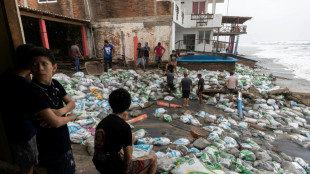 Hurricane Polo triggers huge waves in coastal Mexican city

Myanmar became the world's biggest producer of opium in 2023, overtaking Afghanistan after the Taliban government's crackdown on the trade, according to a United Nations report released on Tuesday.
Myanmar produced an estimated 1,080 metric tonnes of opium -- essential for producing heroin -- this year, according to the latest report by the United Nations Office for Drugs and Crime (UNODC).
The figures come after opium production in Afghanistan slumped an estimated 95 percent to around 330 tonnes following the Taliban's ban on poppy cultivation in April last year, according to UNODC.
The "Golden Triangle" border region between Myanmar, Laos and Thailand has long been a hotbed of illegal drug production and trafficking, particularly of methamphetamine and opium.
The total estimated value of Myanmar's "opiate economy" rose to between $1 billion and $2.4 billion -- the equivalent of 1.7 to 4.1 percent of the country's 2022 GDP, UNODC said.
Last year, an estimated 790 metric tonnes of opium were produced in Myanmar, it said.
Myanmar's legal economy has been gutted by conflict and instability since the military seized power in 2021, driving many farmers to grow poppy.
Poor access to markets and state infrastructure as well as rampant inflation "appears to have played a significant role in farmers' decisions in late 2022 to cultivate more poppy", the report said.
Estimated opium production for 2022-23 was at its highest level for more than 20 years, UNODC said.
UNODC also said poppy cultivation in Myanmar was becoming more sophisticated, with increased investment and better practices -- including improved irrigation and possible use of fertilisers -- pushing up crop yields.
Afghanistan, the world's biggest producer for some years, has seen cultivation collapse after the Taliban authorities vowed to end illegal drug production.
Poppy crops accounted for almost a third of the country's total agricultural production by value last year, but the area used for poppy shrank from 233,000 hectares in late 2022 to 10,800 in 2023.
- Rampant violence -
In Myanmar, the main cultivating area is Shan state, the northern part of which has been convulsed by fighting in recent weeks after an alliance of ethnic minority armed groups launched an offensive against the junta and its allies.
Shan accounted for about 88 percent of the 41,300 hectares (102,054 acres) of opium poppy areas nationwide, the UN report said.
In eastern Shan, the average estimated yield of opium per hectare increased from 19.8 kilograms in the 2022 survey to 29.4 kilograms in 2023, it said.
Shan state occupies almost a quarter of Myanmar's land mass and is dotted with ravines and jungle-clad hills.
A giddying array of ethnic armed organisations that can call on tens of thousands of well-armed fighters control swathes of the state, which the UN says is also Southeast Asia's primary source of methamphetamine.
Some administer autonomous enclaves granted to them by previous juntas, which analysts say are home to casinos, brothels and weapons factories.
The UN said cultivation had also increased in northern Kachin state and in Chin state on the border with India.
Analysts say the military, which ousted an elected government and seized power in 2021, is not serious about ending the multi-billion dollar trade.
In a rare admission earlier this year, the head of Myanmar's Central Committee on Drug Abuse Control said its efforts to crush the trade were having no impact.
T.Vitorino--PC