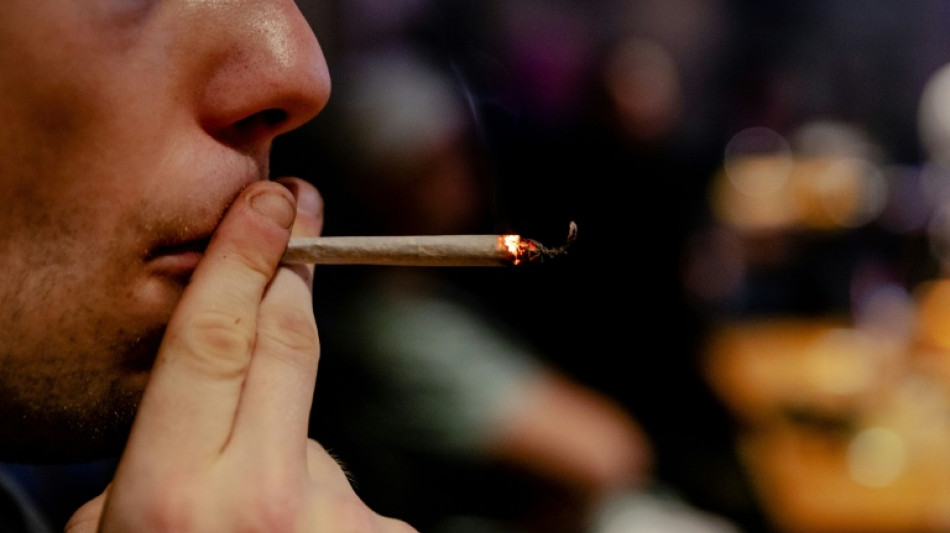
Dutch dope trial: what's the deal? / Photo: Robin van Lonkhuijsen - ANP/AFP

 India's 'Tree Father' plants for a greener future
 Hopping mad: New health warning stirs up Belgian brewers

 Canadian capital to rename 'Trump Ave'

 Pope heads to France on first state visit in 18 years

 Bacteria suspected in deaths of hundreds of baby whales off Argentina

 US 'must choose' whether to end war: Iran president to Fox News

 UN approves resolution on dealing with rising sea levels

 Yalcouye makes dream debut as Ivory Coast beat Ghana in AFCON qualifier

 Chicago's White Sox and Cubs book MLB playoff berths

 Last-gasp Gakpo strike snatches Dutch draw to sour Klopp debut

 Global stocks mostly fall as oil prices and bond yields rise

 Israel's Netanyahu denounces enemies, allies in fiery UN speech

 Hollywood stars among arrests in NY anti-Netanyahu protest

 Losing start in AFCON qualifying for 78-year-old coach Le Roy

 Italy bans burqas in schools, caps numbers of foreign students per class

 Israel policies threaten 'life and existence' of Palestinians, Abbas says

 Paolini steers Italy past China in BJK

 Zidane admits emotion on eve of first game as France coach

 Breetzke and Maharaj sink Australia in first one-day international

 Zelensky broke confidentiality with North Korea POWs disclosure: South's president

 Former Liverpool star Carroll reveals he was sexually assaulted

 Dominican Republic calls for Haiti force to be strengthened

 Dolly Parton's nephew ordered to stay away from estate staff, properties

 Early exit for Philippine darling Eala at Singapore Open

 Hurricane Polo triggers huge waves in coastal Mexican city

On December 15, cannabis will for the first time be grown, sold, and consumed legally in the Netherlands as part of a four-year trial across the country.
Here's a potted history of the eagerly awaited experiment:
- Wait, it's not already legal? -
This is one of the biggest misconceptions about the Netherlands, whose capital Amsterdam has for decades been considered the world's top draw for cannabis smokers.
In fact, cannabis is not legal but "gedoogd" ("tolerated"). Selling and using cannabis is illegal "but the authorities choose not to pursue or prosecute lawbreakers," according to the government's website.
It is however completely illegal (and not tolerated) to cultivate cannabis in the Netherlands or supply it to the famous "coffee shops" where it can be smoked.
- Why change the system? -
The "toleration" policy was adopted in the 1970s to differentiate between hard and soft drugs but has led to a bizarre legal grey area that the experiment hopes to clear up.
The law has driven the supply of cannabis to the country's 570 coffee shops underground, with local authorities complaining of related petty crime and anti-social behaviour.
- So what's happening? -
The legislation is being temporarily suspended to allow growers and suppliers to operate legally in 11 municipalities, supplied by 10 growers.
All coffee shops in the municipalities have to take part, so that the same rules apply to everyone and consumers know they are getting the same quality of product everywhere.
Other rules remain the same: a maximum of five grammes per person per day, a ban on selling to underaged smokers, no hard drugs, and no alcohol on the premises.
Only people living in the Netherlands can partake. The municipality of Amsterdam East has also applied to participate.
Coffee shops will be able to stock more than the current maximum of 500 grammes on the premises -- "as a general rule... up to one week's stock," according to officials.
- What are the benefits? -
The weed will be carefully tracked and tested, so consumers will know exactly how strong the cannabis is. This is measured by the levels of THC and CBD, the substance that produces the effects.
Potentially dangerous heavy metals and aflatoxin -- which occurs naturally in cannabis -- will also be monitored.
The product itself is expected to be of very high quality. Coffee shop owner Rick Brand told AFP in October it was impossible to know what exactly he was selling under the old rules.
"What we've been receiving until now sometimes contains pesticide, but also foreign agents to increase weight. Actually, we don't really know," he said.
Authorities are hoping for a drop in petty crime and anti-social behaviour. Coffee shop owners are looking forward to operating with legal clarity.
- What happens next? -
Independent researchers will monitor the experiment throughout its four-year duration.
The aim is two-fold: to see if it is possible to regulate the supply chain of cannabis to coffee shops, and to see whether this reduces petty crime and anti-social behaviour.
The government "will decide on the future of Dutch coffeeshop policy on the basis of these outcomes and other factors," according to its website, with a view to eventual decriminalisation.
One unknown hanging over this policy -- and all policies -- is the Geert Wilders factor, after the far-right leader won elections last month.
His PVV Freedom Party wants to scrap the "tolerance" policy for good, close coffee shops, and push for a "drug-free Netherlands."
They were ranked bottom of the parties to vote for in the last election by "cannabis-kieswijzer.nl", a website that assesses political parties by their cannabis-friendly policies.
E.Raimundo--PC