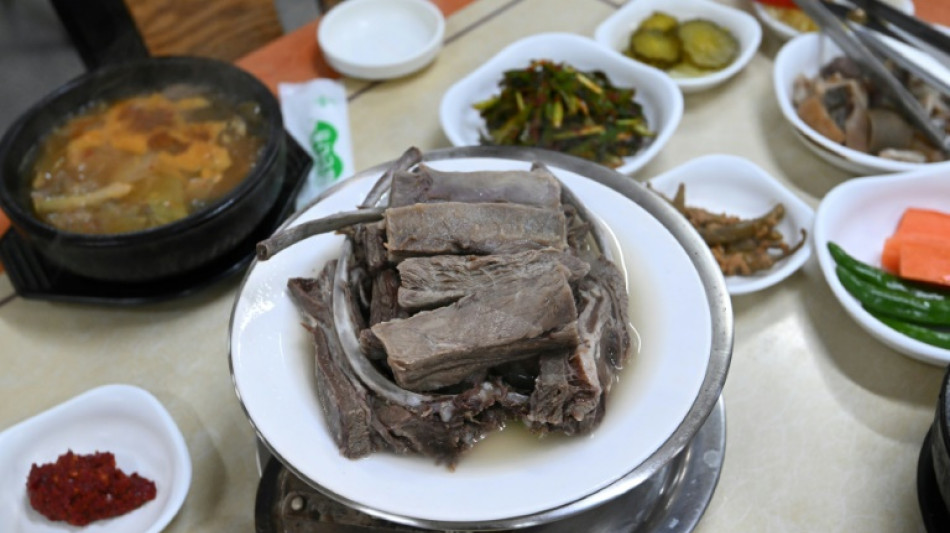
'Cows are living animals too': vendors, customers oppose S. Korea dog meat ban / Photo: Jung Yeon-je - AFP

 Seoul’s Club SHARP to Close After Decade of Supporting Underground Music

 Alavita Founder Anne Harles Outlines Organic Expansion Strategy

 Florida woman charged after deputies report finding cocaine and sales ledger

 Heat end Knicks’ NBA Cup defence with 108-105 victory

 Black Friday laptop promotions cover Apple, Lenovo, HP and gaming models
 Black Friday fashion sales bring discounts of up to 80 percent

 Shark reduces prices on top-rated stick and robot vacuums

 Anthony Lee’s Journey from Fashion to Art Education at HoMA

 Black Friday discounts arrive on tested Yeti coolers and drinkware

 UK survey records sharp rise in young adults reporting no sexual experience

 Audi RS 3 long-term test leads debate over the ideal everyday performance car

 Ontario family seeks return of Chevrolet Bolt after charging cable shock

 Canada launches $6.5 billion strategy to transform forestry sector

 Calgary Catholic schools report strong results and growing classroom complexity

 Bombay HC Orders Bank of Baroda to Pay Rs 1.5 Crore to Octogenarian After Unilateral FD Deduction

 Danny Trejo Claims Legal Threats Prevented Him From Quitting Ben Shapiro ICE Film

 Workday weighs South African public-sector demand while keeping data in EU

 iOCO acquires procurement software specialist Intellection

 RunCzech Advent Running Challenge Offers Prague Half Marathon Entries

 EasyEquities says small group of client accounts targeted in attack

 Regulator examines E9Pay after hacking losses reach 2.5 billion won

 North Korea and Russia agree to expand joint economic projects
 Seoul monitors reports of possible Kim Jong-un visit to China

 Lee joins launch of 2.4-gigawatt AI data centre project in Gangwon
When Choi Tae-yeon opened her restaurant 20 years ago, dog meat was a good business in South Korea. Now, she says she might have to close up shop, with a new ban on the former delicacy.
Nestled in an alleyway in the Chilseong market in the city of Daegu, her restaurant serves dishes traditionally believed in South Korea to be good for one's stamina -- mostly dog meat, either steamed or boiled in broth.
Once commonplace in Korean cuisine, with up to a million dogs killed for the trade every year, according to activists, dog meat has seen a sharp fall in popularity over the last few years, as young South Koreans turn to canines for companionship not consumption.
"Things have changed drastically," Choi told AFP at her restaurant on Wednesday.
"In the past, when the business was good, vendors used to sell as many as 30, 40 dogs a day," she said. "Now, we sell one to two dogs on average."
Eating dog meat is effectively taboo among younger, urban South Koreans, and pressure on the government to outlaw the practice from animal rights activists has been mounting.
On Tuesday, lawmakers passed a bill essentially banning the long controversial industry, prohibiting the breeding, selling and slaughtering of dogs for their meat.
It will come into effect following a three-year grace period after a final approval from President Yoon Suk Yeol -- a self-professed animal lover.
Breaking the law will be punishable by up to three years in prison or 30 million won ($23,000) in fines.
"I'm not happy with the decision to ban it by law," Choi said, who lamented that she had no choice but to accept the change.
"Making a living has become easier than in the past, and so people have grown to love animals," she said.
In December, local media reported that pet strollers outsold buggies for babies last year for the first time, pointing to both South Korea's demographic crisis -- it has one of the lowest birth rates in the world -- and growing love of pets.
"Young people, who have mostly lived without going through any hardships, are extremely fond of dogs," said Choi.
But for the businesswoman, her restaurant -- a family pursuit she had planned to hand down to her son -- defines her life.
Choi had tried everything to make a living, from selling small side dishes and street food, to noodles at the market, before she settled on her restaurant, expanding her business as she found success.
"It's very troubling because things ended up like this," she said, her eyes tearing up.
- Harassment by activists -
In recent years, as the tide of public opinion began to turn, Choi says the dog meat vendors at the market have been subject to constant harassment by activists, who staged protests in front of their restaurants and cursed at them.
"It was a bit harsh. They didn't treat us who sell bosintang (dog meat soup) as humans," she told AFP.
Years of intense protests led to a drop in the number of customers, she said, adding that she was thinking of serving pork rib soup in the future, once the law goes into effect.
The alleyway, which once bustled with restaurants serving bosintang was visibly empty Wednesday, with many of the shopfronts empty.
Still, Choi said she had seen more customers the day after the passage of the dog meat prohibition bill than she had on an average day in recent months.
"I like having dog meat when I drink because I don't get a hangover the next day," said an elderly customer at another dog meat restaurant, who gave only his surname Jang.
Jang said that although he does not eat dog meat often, he had come to the restaurant prompted by the thought of not being able to eat it ever again, in three years when the ban comes into force.
Another customer in his 70s, who gave only his surname Choi, said that although he is OK with not being able to eat the controversial meat in the future, he opposed the bill.
"Chicken, pigs, cows are all living animals -- I oppose only banning dog meat," he said.
L.Torres--PC