Latin America's experience shows limits of all-out war on gangs / Photo: STRINGER - AFP

 Welcome aboard the Costa Serena, the Asian Games floating hotel

 Asian markets mixed after recent oil surge
 Cash for nature protection: hotelier's offer to Principe islanders
 US miner KoBold bets on AI to gain edge in DR Congo mineral hunt
 Internet disrupted in Ethiopia as conflict rages
 Asian markets mixed after oil gains
 'Genius' Ohashi bids for third Asian Games gold after world record
 India's 'Tree Father' plants for a greener future
 Hopping mad: New health warning stirs up Belgian brewers
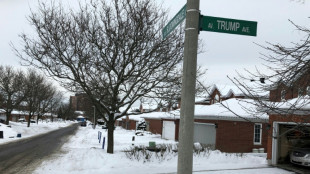 Canadian capital to rename 'Trump Ave'
 Pope heads to France on first state visit in 18 years
 Bacteria suspected in deaths of hundreds of baby whales off Argentina
 US 'must choose' whether to end war: Iran president to Fox News
 UN approves resolution on dealing with rising sea levels

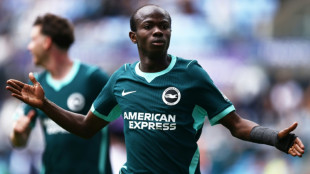 Yalcouye makes dream debut as Ivory Coast beat Ghana in AFCON qualifier
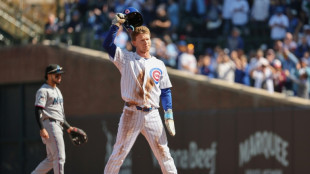 Chicago's White Sox and Cubs book MLB playoff berths

 Last-gasp Gakpo strike snatches Dutch draw to sour Klopp debut

 Global stocks mostly fall as oil prices and bond yields rise

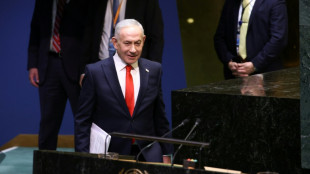 Israel's Netanyahu denounces enemies, allies in fiery UN speech
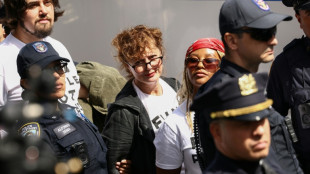 Hollywood stars among arrests in NY anti-Netanyahu protest
 Losing start in AFCON qualifying for 78-year-old coach Le Roy
 Italy bans burqas in schools, caps numbers of foreign students per class

 Israel policies threaten 'life and existence' of Palestinians, Abbas says

 Paolini steers Italy past China in BJK

 Zidane admits emotion on eve of first game as France coach
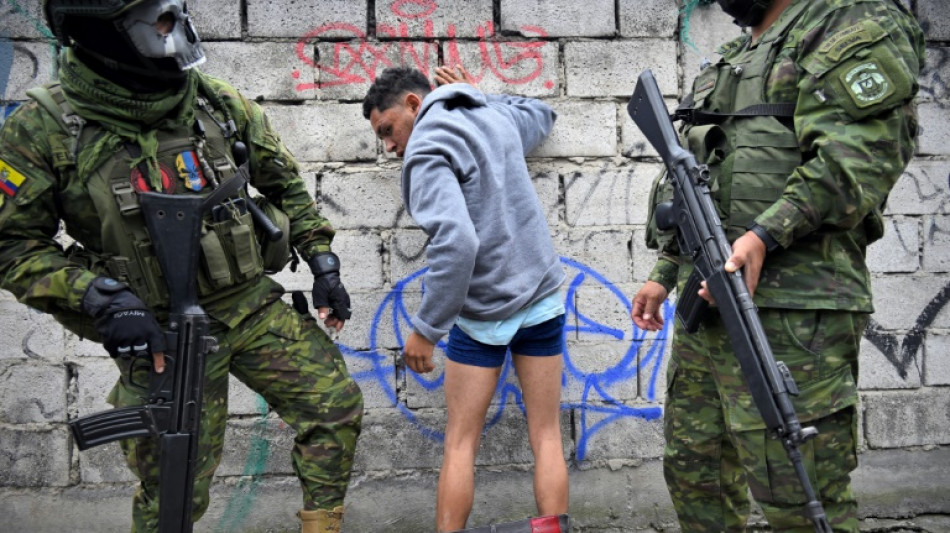
As Ecuador wages war against criminal gangs, experts warn that similar security crackdowns have produced mixed results elsewhere in Latin America -- and sometimes even led to worse violence.
President Daniel Noboa has deployed more than 22,000 soldiers to put down a campaign of terror launched by criminal gangs in response to a government crackdown on organized crime.
"Governments resort to this kind of response because they want immediate solutions," said Mathew Charles of the Colombian Organized Crime Observatory.
Noboa had already hardened his rhetoric in favor of militarization during his election campaign, after the murder of a candidate, the InSight Crime think tank noted.
But his government "lacks an exit strategy" in its war on gangs, it said.
In recent years, the South American country has been plunged into crisis as drug cartels use its ports to ship cocaine to the United States and Europe.
Ecuador's 36-year-old president, in office since November, announced in early January the construction of two high-security prisons, modeled on jails in Mexico and El Salvador.
The crisis requires urgent action by the armed forces, but "obviously it will not be enough," Ecuador's former president Rafael Correa told AFP on Friday, calling for economic, intelligence-gathering and other measures.
- El Salvador model -
Under El Salvador's President Nayib Bukele, more than 73,000 alleged gang members have been imprisoned in a security crackdown that has generated both criticism from human rights activists and envy from other leaders.
"Politicians elsewhere in the region are seeking to replicate the El Salvador security model," the International Crisis Group think tank said in a report in May, pointing to measures taken by Honduran President Xiomara Castro.
But Charles warned that an "iron fist" alone would not bring lasting change.
"If we're looking for long-term solutions we need to implement these security policies with social investment programs as well," he said.
Criminals "always have weapons" and will "respond with more violence," Charles added.
"Sending people to prison is not the answer because we've seen that in prisons, it's the gangs who are in control," he added.
Colombian President Gustavo Petro said this week in response to a US offer of assistance for Ecuador that the rise of international gangs in the Americas was due to the "wrong anti-drug policy."
His government acknowledged, in a report on coca plantations published in 2022, that the goals of Colombia's fight against drugs "have not been achieved" despite "enormous efforts undertaken for more than half a century."
Despite military support from the United States to fight cartels and guerrillas, Colombia was the leading producer of cocaine in 2022, according to the United Nations.
"Latin American countries must adopt powerful youth empowerment policies that include connectivity, culture and higher education," Petro wrote on social media platform X, formerly Twitter.
- 'Long-term strategy' -
Mexico, plagued by widespread cartel-related bloodshed, has also taken a step back from the militarized "war on drugs" launched in 2006 by then-president Felipe Calderon.
A spiral of violence has seen more than 420,000 people murdered since then.
The attempt to neutralize cartel leaders gave rise to younger gang bosses, "sometimes without strategic vision" and even more violent, according to Erubiel Tirado, a security expert at the Ibero-American University.
The military campaign led to a fragmentation of drug cartels and increased fighting between them, said Tirado.
Since taking office in 2018, Mexican President Andres Manuel Lopez Obrador has championed a "hugs not bullets" strategy to tackle violent crime at its roots by combating poverty and inequality with social programs, rather than with the army.
Mexico's murder rate rose to a record of 29 per 100,000 inhabitants in 2020, before declining to 25 per 100,000 inhabitants in 2022.
Latin America is paying the price for widespread corruption and social inequality, Charles said.
"What we need is a comprehensive program on public safety, anti-corruption and social investment but that requires a long-term strategy," he said.
F.Cardoso--PC