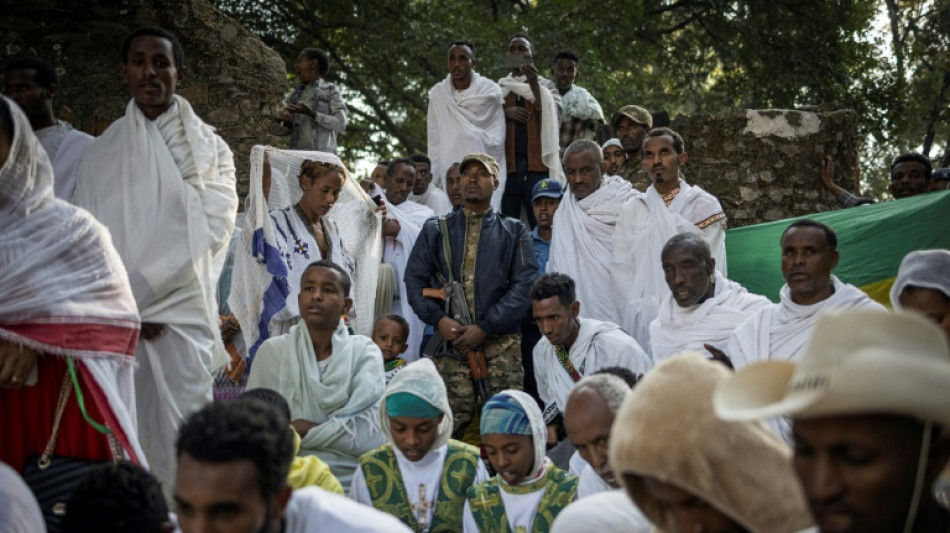
Ethiopian regional conflict makes Orthodox epiphany 'sad' / Photo: Michele Spatari - AFP

 Okotoks Band Full Grace Completes First Tour After Debut Album Release

 Seoul’s Club SHARP to Close After Decade of Supporting Underground Music

 Alavita Founder Anne Harles Outlines Organic Expansion Strategy

 Florida woman charged after deputies report finding cocaine and sales ledger

 Heat end Knicks’ NBA Cup defence with 108-105 victory

 Black Friday laptop promotions cover Apple, Lenovo, HP and gaming models
Festivities for the Orthodox Christian celebration of epiphany have been muted this year in Gondar, in the northwest Ethiopian region of Amhara where conflict has raged for months.
"How can you celebrate when many people are dying?" said a tuktuk driver, who wished to remain anonymous.
Up to 250,000 people have taken part in previous celebrations of Timkat, as epiphany is known in the Amhara language.
Throughout Ethiopia, where around 35 percent of the population of more than 120 million is orthodox, the celebration of Jesus Christ's baptism by John the Baptist is a major event.
The Ethiopian Orthodox Church is one of the oldest churches in the world.
In Gondar, the festivities culminate with a collective dip in the baths at the castle of the emperor Fasilides, who founded the city that became the imperial capital in the 17th century.
The celebrations attract both locals and tourists.
But on Friday, the festival was low-key in comparison to previous years.
Barely a thousand worshippers took part in the procession of the city's 44 churches that sees eight sacred arches carried to the Fasilides Baths.
"This year, because of the political tension, it wasn't colourful," lamented Dereje Mengesha, 27, a lecturer at Gondar University.
"I have celebrated Timkat for many years, but today the number of people attending the celebration has significantly decreased."
Those tensions have seen the federal government in Amhara clash with the local "Fano", a nationalist militia that claims to be fighting for their regional rights.
- 'People are dying every day' -
The Fano feel betrayed by the federal government over a peace deal signed in November 2022 with dissidents in the neighbouring region of Tigray.
The militia had spent two years fighting alongside federal forces against their Tigray enemies.
But an attempt last April by the federal government to disarm the Fano and other Amhara forces sparked violence.
Just last week, the Fano launched an incursion into the city of 500,000 situated around 650 kilometres (400 miles) from the capital Addis Ababa
"People are dying every day. People in Gondar are grieving," said the tuktuk driver.
And while colourfully-dressed procession participants sung joyfully, there was visibly less emotion on the faces of those watching.
"There are very few people, it's to show their opposition to the government," said one man who wished to remain anonymous.
Ethiopia is a deeply religious country but "lots of people are not happy, that's why they are not out," he added.
- 'Gondar has wept' -
A handful of foreign tourists had ignored Western warnings to avoid the conflict-blighted region to attend Timkat.
"I always wanted to celebrate Timkat" in Gondar, said Menbere Sintaheyu, who brought her daughter from Canada for the occasion, with both dressed in traditional white dresses.
"I want to show her where she is from."
"The country situation is not good," said Sintaheyu. "I am happy... but the mood is different."
The numbers had swelled by Saturday morning when prayers, preaching and benedictions were performed at the baths.
Dozens of children and young men then jumped into the cold water, splashing the crowds on the sides.
The most pious men and women had spent a cold night by the baths in solemn prayer as priests chanted.
The religious ceremonies then began before dawn by candlelight.
Eyob, an Ethiopian living in Vancouver, was "disappointed".
"It's the first time in 20 years I am back in Gondar and I was expecting something else," he said.
"My sister was here last year. I saw some video and it was amazing."
Student Mekowanint Fasil, 22, was born and raised in Gondar.
"What you see is very sad," he moaned, choking back tears.
"The children of Gondar did not come from afar like before. Gondar has wept just like I am weeping now."
M.A.Vaz--PC