'Destroyed the peace': Historic Laos town grapples with tourism boom / Photo: TANG CHHIN SOTHY, TANG CHHIN SOTHY - AFP

 Williams boss hails Chadwick as F1 inspiration for women

 World No.1 Sinner delays return with China Open withdrawal

 South Lebanon children return to school destroyed by Israel strike

 Jewish group urges Berlin far-left vote winners to tackle antisemitism

 European stock markets climb as oil prices drop

 Trump accuser E. Jean Carroll finally has her damages

 Germany's Havertz, Musiala ruled out of Greece match with injury

 Ireland's Gaza stance spills from Eurovision into football

 Welcome aboard the Costa Serena, the Asian Games floating hotel

 Asian markets mixed after recent oil surge
 Cash for nature protection: hotelier's offer to Principe islanders
 US miner KoBold bets on AI to gain edge in DR Congo mineral hunt

 Internet disrupted in Ethiopia as conflict rages

 Asian markets mixed after oil gains

 'Genius' Ohashi bids for third Asian Games gold after world record

 India's 'Tree Father' plants for a greener future
 Hopping mad: New health warning stirs up Belgian brewers

 Canadian capital to rename 'Trump Ave'

 Pope heads to France on first state visit in 18 years

 Bacteria suspected in deaths of hundreds of baby whales off Argentina

 Scheffler and Burns give US 3-2 Presidents Cup lead

 Hollywood stars among 100 arrested in NY anti-Netanyahu protest

 Klopp denied on Germany debut as Portugal win in Nations League

 Rich nations should foot climate bill, says Nepal minister

 Wellalage and Mendis star as Sri Lanka level England series in thriller

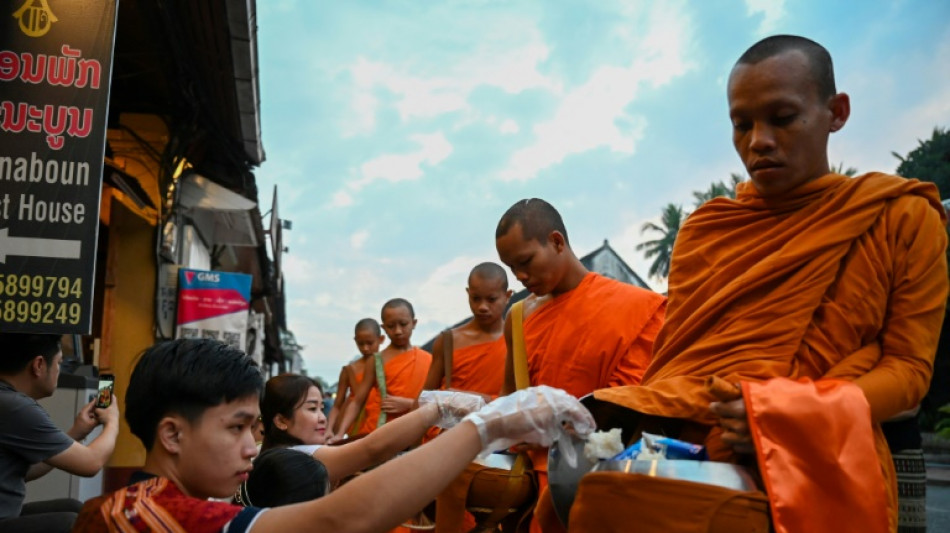
As dawn broke over Luang Prabang, saffron-robed monks trod the streets receiving alms -- but a cacophonous influx of camera-clutching tourists shattered the peace of the ancient Laotian town.
The UNESCO World Heritage site welcomed almost 800,000 visitors in the first nine months of last year, with state media reporting the province hopes to attract almost three million by the end of 2024.
Tourists inject much-needed money into Laos' shaky economy but present locals with a dilemma, as foreign tour groups dominate and change cultural activities in the sleepy provincial city.
The starkest example can be seen every morning along Kounxoau Road, where monks pad barefoot to collect donations of food.
What was once a simple act of communion and support between Buddhist locals and the monks has long been a draw for tourists.
Now the monks have to make their way through hundreds of visitors on plastic stools offering alms as tour guides thrust mobile phones into their faces.
For decades, Luang Prabang has seen large numbers of tourists come from all over the world to witness the morning alms-giving, but locals say the ceremony now resembles a photo shoot.
"They are taking more photos rather than buying anything," complained one 30-year-old vendor.
It is a tricky balancing act, as vendors -- who sell alms baskets containing lumps of sticky rice for 50,000 kip ($2.40) -– both need and resent the visitors.
"If there are not enough tourists then we make a loss," she said, but admitted the dilemma.
"The more tourists have come, the more our way of life is changing. Now this is more chaotic," the vendor said.
Speaking to foreign journalists is not without risk in communist Laos, and the vendor, like others who spoke to AFP for this story, did so on condition of anonymity.
- 'A rising star' -
Luang Prabang, the country's old royal capital, is changing as foreign investment arrives alongside the tourism spike, oiled by the opening of Laos' new Chinese-funded high-speed railway.
Outside the town, the arrival of a train from the Chinese border sees a flurry of activity at the town's hulking new railway station as tour guides sweep up their charges.
The station opened last year and no public buses link it to the town, but white minivans idle six rows deep on the battered paved road, while the station displays -- all in Chinese -- make the target market clear.
Tourist Zhang Ying, part of a newly arrived tour group from Chongqing, told AFP she had always wanted to visit.
"This country is a rising star, and probably will develop well in the future, especially with Xi Jinping's Belt and Road helping their economy," said the 70-year-old, referring to the Chinese president's massive scheme of foreign infrastructure investment.
China financed the $6 billion high-speed railway, which links the Chinese city of Kunming to the Laotian capital Vientiane -- just one of multiple projects that have put Laos deep in debt to Beijing.
While their leaders promised that the train would benefit the country, locals told AFP they see little of the promised income generated by the railway.
Revenue stays within the China tour groups, whose members sleep in Chinese-owned hotels and eat in Chinese-run restaurants, and are ferried by private cars.
Taxi driver Vathong, 37, said the kind of tourist who came had changed from when he was young -- Europeans have been overtaken by Asian visitors.
The tour groups have also pushed another change: the once-quiet sunset boat trips on the Mekong have become raucous parties, blaring pop music as customers sing karaoke into the night.
One man, who owned three boats, said they were in theory allowed music for only an hour -- but customers often wanted more.
"It has changed the style," he told AFP. "It has destroyed the peace."
- 'A sea of people' -
Back at the alms-giving, the street was still full, with Chinese, Korean, Japanese and a number of European languages heard as visitors engaged with the ceremony.
Chinese visitor Shi Qii said she arrived early and was surprised at how busy it became.
"There were no people on the street when we first woke up, and suddenly it became a sea of people," she said.
As she spoke, a younger Laotian woman chased tourists back and forth, shooing a man who was pressing his camera phone into a Buddhist novice's face.
"All the time I have to tell the tourists not to get too close," she told AFP.
"I like that many tourists come, but I don't like when many tourists take too many pictures and shout demands."
P.Sousa--PC