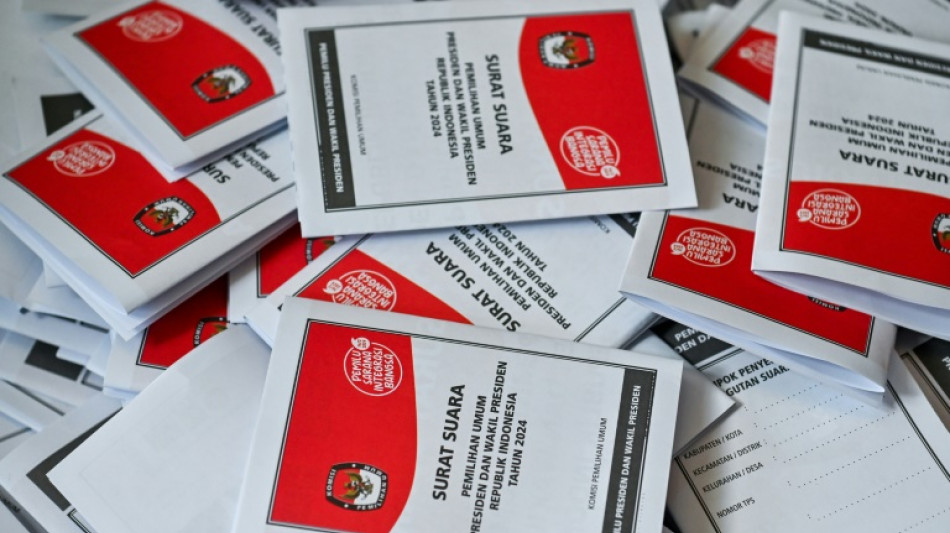
Vote-buying shadows Indonesian election / Photo: Chaideer MAHYUDDIN - AFP

 Williams boss hails Chadwick as F1 inspiration for women

 World No.1 Sinner delays return with China Open withdrawal

 South Lebanon children return to school destroyed by Israel strike

 Jewish group urges Berlin far-left vote winners to tackle antisemitism

 European stock markets climb as oil prices drop

 Trump accuser E. Jean Carroll finally has her damages

 Germany's Havertz, Musiala ruled out of Greece match with injury
 Ireland's Gaza stance spills from Eurovision into football

 Welcome aboard the Costa Serena, the Asian Games floating hotel
 Asian markets mixed after recent oil surge
 Cash for nature protection: hotelier's offer to Principe islanders
 US miner KoBold bets on AI to gain edge in DR Congo mineral hunt

 Internet disrupted in Ethiopia as conflict rages

 Asian markets mixed after oil gains

 'Genius' Ohashi bids for third Asian Games gold after world record
 India's 'Tree Father' plants for a greener future
 Hopping mad: New health warning stirs up Belgian brewers

 Canadian capital to rename 'Trump Ave'
 Pope heads to France on first state visit in 18 years
 Bacteria suspected in deaths of hundreds of baby whales off Argentina

 Scheffler and Burns give US 3-2 Presidents Cup lead
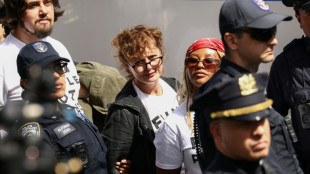 Hollywood stars among 100 arrested in NY anti-Netanyahu protest

 Klopp denied on Germany debut as Portugal win in Nations League

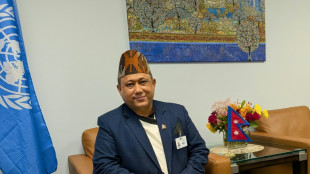 Rich nations should foot climate bill, says Nepal minister

 Wellalage and Mendis star as Sri Lanka level England series in thriller

When Indonesian housewife Suharti was returning home from a shopping trip, a gathering of political party workers handed her 100,000 rupiah ($6.3) and a T-shirt -- and asked her to vote for their candidate next week.
"They told me to vote for this certain candidate but I still don't know who I'm going to vote for," the 53-year-old told AFP.
"Once I'm inside the voting booth, I'll vote according to what my heart tells me to."
Voters, candidates and campaign volunteers have told AFP they saw free goodies and envelopes stuffed with cash being handed out ahead of the February 14 presidential, parliamentary and regional polls.
About 205 million Indonesians are registered to vote in the world's third-biggest democracy, and the country's election monitoring body, Bawaslu, has urged people to report any vote-buying.
But corruption remains a problem, and Transparency International in its 2023 report said the country's anti-graft commission had been "severely disempowered".
Parliament is widely viewed as one of Indonesia's most graft-hit institutions, and the Indonesia Corruption Watch (ICW) monitor says at least 56 candidates previously convicted of graft are running for seats in this year's legislative vote.
- Hundreds of envelopes -
One man who only gave his name as Andri told AFP he had been asked by several candidates running for a seat in parliament for help distributing money and groceries to lure voters.
He said he had been approached because of his role in a Jakarta football fan club.
He accepted the task.
"I usually started (distributing money) to people closest to me first, and then to people in my neighbourhood," the 37-year-old said.
"I distributed hundreds or even thousands of envelopes, depending on how much the candidates gave me."
Despite warnings from official bodies that bribes are illegal, the practice persists.
"It still happens because our regulations provide loopholes and law enforcement is not comprehensive enough," ICW researcher Seira Tamara told AFP.
Election frontrunner Prabowo Subianto has openly addressed the issue, urging people to take gifts but vote for their favourite candidate.
"If somebody promises you money, just accept it, that's your money, the people's money. But please vote according to your heart," he recently told supporters.
Violations start at the recruitment stage where candidates must spend to earn their candidacy, said Tamara.
One woman who ran for a seat in parliament in 2019 told AFP on condition of anonymity she spent 250 million rupiah ($15,795) to buy votes, but still lost.
"Now I am changing my method, I visit houses door-to-door and promote myself and my programmes," she said.
- 'Not effective' -
Andri of the football fan club said that out of several candidates he helped in 2019, only one won and entered parliament.
"It is not effective in my opinion, definitely not a guarantee you will win," he said.
"You don't know who they are going to vote inside the polling booth."
Regardless, vote-buying and accepting cash both perpetuate corruption regardless of who wins, with advertising and bribery costs encouraging candidates to return favours once elected.
"This is a vicious cycle," Tamara said.
"The policies they make after... will not be for the public interest, but for the interest of their investors."
"As long as there are people willing to accept the money", vote-buying will persist, she said.
Ukon Furkon Sukanda, a 39-year-old legislative candidate, is optimistic younger voters will be harder to bribe.
"People who vote in exchange for money will slowly disappear and be replaced. It will become a contest of ideas," he said.
E.Paulino--PC