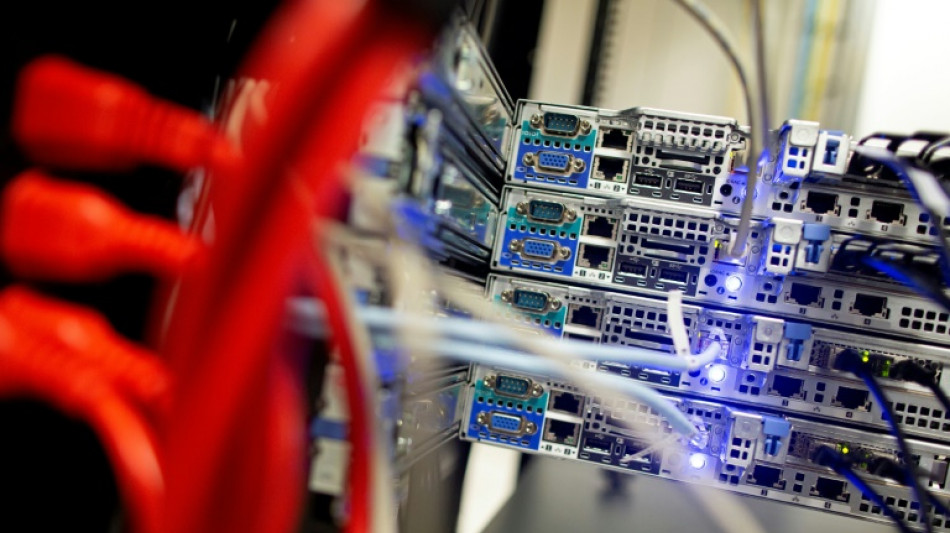
'World's most harmful': What is the LockBit cybercrime gang? / Photo: PAUL FAITH - AFP/File

 Antonelli 'mad' about crash in Azerbaijan qualifying

 'Perfect lap' gives Russell pole for Azerbaijan GP as Antonelli crashes out

 UN Security Council condemns Houthi attacks on Saudi Arabia

 China swimmer makes Asian Games history as Thai wins 100m sprint

 Top French literary prize drops best-selling novel over AI claims

 US 'must choose' whether to end war: Iran president

 Pope warns against losing humanity in AI-driven 'paradise of machines'

 Pope warns against losing humanity in 'paradise of machines'

 From FBI warning to literary acclaim: the Russian journalist who took on Putin

 China swimmer in Asian Games first as North Korea lifters reign

 French literary prize removes novel from longlist after AI claims

 China's Zhang wins record seventh Asian Games swimming gold

 Verstappen edges Russell in final practice in Azerbaijan

 English, Spanish, Italian, German football leagues call for FIFA reform

 Pope arrives in France on first official visit in 18 years

 Pope arrives in France on first state visit in 18 years

 Heavy fighting, internet disruption as Ethiopia conflict rages

 From transit to consumption: drug use surges in Mozambique
 Chicago teams, Guardians and Padres all book MLB playoff berths

 Bijan Robinson destroys Packers in 35-14 win for Falcons

 Harimoto hails new era as Japan dethrone table tennis kings China

 India rape cases turn focus back onto women's safety

 Rebellious Afghan taxi drivers defy ban on music

 Brazil candidates mount digital armies for fierce online campaign

 Nepal PM says floods 'a warning to the world' about climate change

An international law enforcement operation has taken down dozens of servers and disrupted LockBit, "the world's most harmful cyber crime group" according to British authorities.
LockBit and its affiliates caused billions of dollars in damage and extracted tens of millions in ransom from their victims. Their targets have included banks, mail services and even a children's hospital.
How does LockBit operate?
Rather than conduct an entire criminal operation itself, LockBit developed the malicious software -- "ransomware" -- that enables attackers to lock victims out of their computers and networks.
Victims were then told to pay ransom in cryptocurrency in exchange for regaining access to their data. Those who did not pay risked having their data dumped on the dark web.
The "LockBit" ransomware was first observed in 2020, and made money through up-front payments and subscription fees for the software, or from a cut of the ransom, according to the US Cybersecurity & Infrastructure Security Agency (CISA).
The model is known as "Ransomware as a Service", or RaaS.
LockBit usually conducted itself as a professional enterprise, seeking feedback from customers -- called "affiliates" -- and rolling out ransomware improvements.
"LockBit operates like a business. They run -- or ran -- a tight ship, which has enabled them to outlast many other ransomware operations," Brett Callow, a threat analyst at the cybersecurity firm Emsisoft, told AFP.
LockBit is believed to have operated out of multiple locations, and cybersecurity experts say its members were Russian speakers.
How lucrative is ransomware?
In 2023, extortions by ransomware groups exceeded $1 billion in cryptocurrency for the first time, according to data published this month by blockchain firm Chainalysis.
LockBit has targeted more than 2,000 victims worldwide, receiving more than $120 million in ransom, the US Department of Justice said Tuesday.
These potentially huge payouts have emboldened cybercriminals.
"Awash with money, the ransomware ecosystem surged in 2023 and continued to evolve its tactics," the cybersecurity firm MalwareBytes said in a report published this month.
"The number of known attacks increased 68 percent, average ransom demands climbed precipitously, and the largest ransom demand of the year was a staggering $80 million."
That demand came after a LockBit attack severely disrupted Britain's post operator Royal Mail for weeks.
Who are LockBit's victims?
LockBit ransomware has been used against a wide variety of targets, from small businesses and individuals to huge corporations.
It was used "for more than twice as many attacks as its nearest competitor in 2023", according to MalwareBytes.
The group has gained notoriety and attention from law enforcement agencies after high-profile attacks such as the one on Royal Mail.
Last November, it was blamed for an attack on the US arm of the Industrial and Commercial Bank of China (ICBC) -- one of the biggest financial institutions in the world -- as well as US aerospace giant Boeing.
In 2022, a LockBit affiliate attacked the Hospital for Sick Children in Toronto, Canada, disrupting lab and imaging results. LockBit reportedly apologised for that attack.
"Although LockBit developers have created rules stipulating that their ransomware will not be used against critical infrastructure, it is clear that LockBit affiliates largely disregard these rules," Stacey Cook, an analyst at the cybersecurity firm Dragos, wrote in a report published last year.
"LockBit developers do not appear to be overly concerned with holding their affiliates accountable."
Who is fighting back, and how?
LockBit's growing visibility and its affiliates' increasing attacks meant law enforcement agencies ramped up their efforts to win this cat-and-mouse game.
An alliance of agencies from 10 nations, led by Britain's National Crime Agency, on Tuesday said they had disrupted LockBit at "every level" in an effort codenamed "Operation Cronos".
Europol said 34 servers in Europe, Australia, the United States and Britain were taken down and 200 Lockbit-linked cryptocurrency accounts were frozen.
The NCA said the action had compromised LockBit's "entire criminal enterprise".
"This likely spells the end of LockBit as a brand. The operation has been compromised and other cybercriminals will not want to do business with them," Emsisoft's Callow told AFP.
But in recent years, cybersecurity experts have detected ransomware groups that suspended operations following law enforcement action only to re-emerge under different names.
"Our work does not stop here. LockBit may seek to rebuild their criminal enterprise," NCA Director General Graeme Biggar said in a statement.
"However, we know who they are, and how they operate. We are tenacious and we will not stop in our efforts to target this group and anyone associated with them."
Nogueira--PC