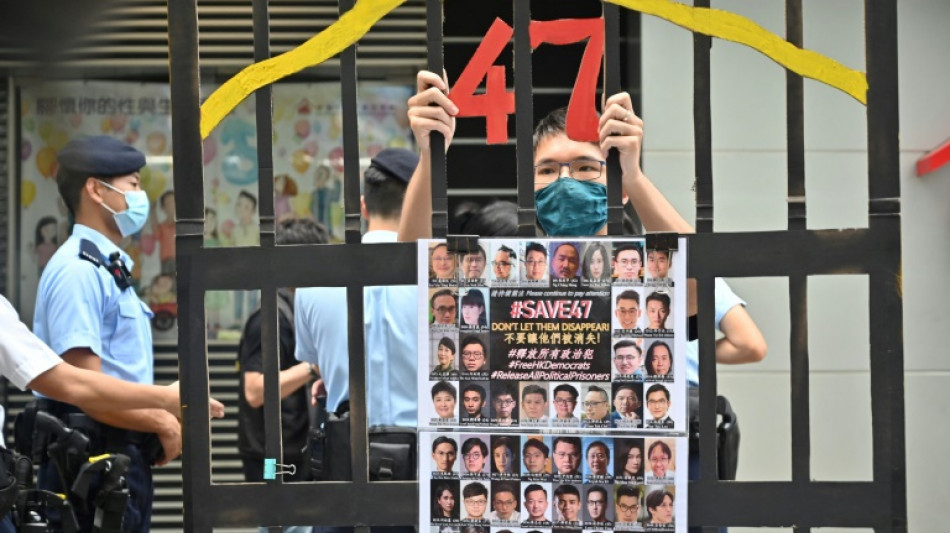
Hong Kong activists fade from view as national security case drags

 'More confrontational': Iran's new hardline security leadership
 UK summons Israeli envoy over West Bank settlement project

 Trump vows 'tremendous' economic costs on Iran partners
 Germany, France, UN condemn far-right Israeli minister's 'inhumane' Gaza remarks
 Prince Harry and Meghan moving back to UK: British press
 Lee, Baena guide Atletico to opening Liga win over Malaga

 Ecuador intel chief, five Americans killed in Kenya helicopter crash
 Robinson and Tongue share match ball after dismissing Pakistan
 Israel army admits firing on car in death of five-year-old Hind Rajab
 Honduras places 80% of country on El Nino drought alert

 Some of Meta's safety tools were 'designed to fail': witness
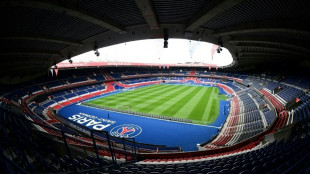 PSG Ligue 1 opener moved over state of Parc des Princes pitch

 UK PM launches bid to help homeless, donating part of his wages
 Golden Shoe winner Kane hopes for Ballon d'Or after 'best season ever'

 Kyiv's ex-defence chief makes risky bet by venturing into electoral grounds
 Coventry have survival inspiration says Lampard

 Reijnders leaves Man City for Saudi's Al Qadsiah
 Trump says will meet North Korea's Kim later this year

 Stocks waver, dollar drops as US Treasury moves to lower bond yields

 France recalls rare disease drug Tavneos after deaths

 Arsenal agree to sign Villa defender Konsa: reports
 Evacuation orders lifted in Belgian wildfire zone
 UK media skewered for 'hounding' black academic
 More than 7,300 excess deaths in France's historically hot summer so far
 US socialists score shock Florida win as Trump picks stumble
Hong Kong's most prominent democracy activists have disappeared from view as their prosecution under a security law drags into its second year, with lawyers and family members warning the defendants are losing faith in the courts.
The 47 activists make up a swathe of the city's depleted democracy movement, from veteran former lawmakers to young firebrands and community organisers as well as academics and unionists.
Charged with subversion, the majority have been held in custody for more than a year and the few granted bail must adhere to strict speech curbs.
Most of what has occurred during pre-trial hearings is blanketed by reporting restrictions, even though the defendants want them lifted. And their trial is not expected to begin until at least 2023.
"The prosecution and the court are making the defendants invisible in plain sight," legal scholar Eric Lai of Georgetown University told AFP.
Using the national security law Beijing imposed in 2020 following huge democracy protests, authorities targeted the activists for organising an unofficial poll to choose opposition candidates.
Some observers have voiced alarm about how lengthy pre-trial proceedings under the law have generated precedent-setting decisions without public scrutiny.
The hearings, Lai said, have produced "very substantial evaluations that are rarely seen in ordinary criminal cases" including detailed discussions over the security law's stricter bail terms, the admissibility of evidence as well as shifting prosecution charges.
"(Court) procedures should be more open and transparent so the public can see how the court handled the cases and what it did to protect the integrity of trial."
- Changing legal landscape -
Hong Kong faces scrutiny over whether its internationally respected common law legal system can be maintained as China cracks down on dissent with the security law, which has ensnared some 170 people.
Last month, two of Britain's most senior judges pulled out of sitting on Hong Kong's top court citing the law's impact on freedoms, though nine other foreign judges confirmed they would stay.
The prosecution of the 47 activists is seen as a legal litmus test.
While Hong Kong allows the public to attend pre-trial hearings, reporting is largely limited to names, hearing dates and what a judge rules –- unless that judge lifts restrictions.
The rules are in place to protect a defendant from potential prejudice, especially if a jury may be involved in their trial.
But so far, all national security cases to reach trial stage have been heard by handpicked judges, not juries.
The 47 activists want the reporting restrictions lifted but their requests have been opposed by the prosecution and denied by the courts.
Independent legal scholar Wong Kai-yeung said it was unusual for judges both in Hong Kong and under the English common law to deny such requests.
"Here it was they, the defendants to be put on trial, who actively sought publicity of the proceedings," he told AFP.
"It is their trial. They have the autonomy to make the informed decision to not accept arrangements brought in in the name of their protection."
- 'Frustrated and defeated' -
Those facing trial are in custody or barred from speaking to the press as part of their bail conditions.
But four barristers with knowledge of the proceedings told AFP that defendants were growing exasperated, believing prosecutors have filed vague charges and are dragging their feet, knowing their actions will not face public scrutiny or backlash.
All requested anonymity to speak freely.
"Some defendants feel they are being played by the court, the prosecution and the whole procedure," said one barrister. "They think it's a sham."
"There has been general distrust of the impartiality of the proceedings," another said. "It's fair to say some defendants do not believe they will get a fair trial in this case."
The barristers themselves also described a sense of frustration with proceedings -– two accused prosecutors of "moving the goalposts" by failing to disclose key evidence and frequently changing the charges.
Hong Kong's Department of Justice said it took "strong exception" to such criticisms.
"Any allegation that the prosecution is 'taking advantage' of the reporting restrictions is based on a misconception of the rationale underlying such restrictions, if not based on malice," it said.
The judiciary said it would not comment on individual cases.
Chan Po-ying, an activist and the wife of former lawmaker Leung Kwok-hung, said the media blackout had "dialled up the pressure" on defendants.
"When public attention starts to wane, it could make them feel frustrated and defeated."
Emilia Wong, the partner of detained activist Ventus Lau, said the defendants were "exhausted" and feeling silenced.
"This is what authorities want -- to minimise the defendants' influence."
Nogueira--PC