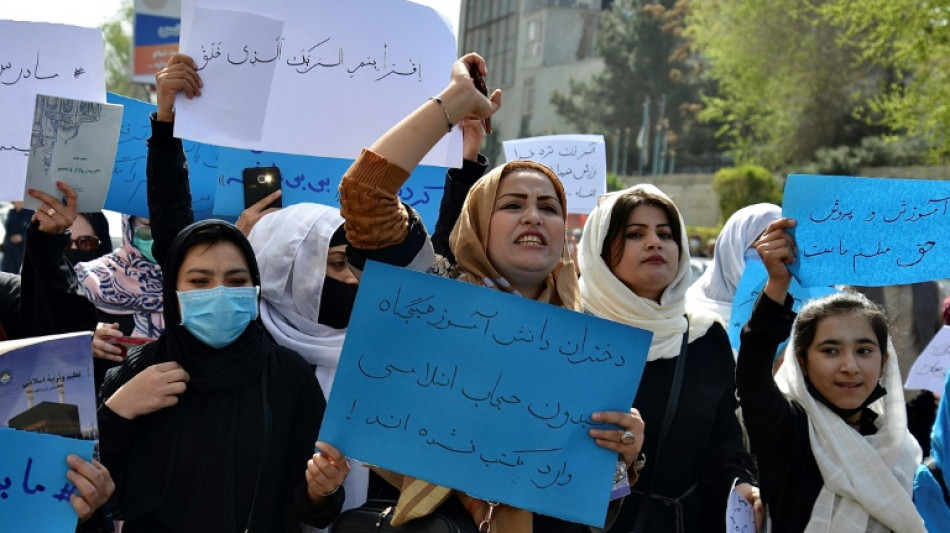
Girls' education ban reveals deep rifts within Taliban / Photo: Ahmad SAHEL ARMAN - AFP/File

 William and Harry: Britain's warring royal brothers
 UN holds second informal poll for next leader
 In US mining hub, black lung rates soar

 Champions Arsenal embrace being 'hunted' as Premier League returns
 World No.2 Rybakina retires from Cincinnati clash with Swiatek
 'I heard you missed me': Melania Trump jokes about month out of spotlight

 Amazon Prime Video to invest $2 bn in Latin America productions

 Panama Canal to reduce shipping over El Nino-fueled drought

 Maradona trial on hold over possible medical evidence mix-up

 'Green dilemma': China's solar boom hurt birds, says study
 Pegula hangs on to dispatch Anisimova, reach Cincinnati semi-finals

 US charges woman with IS-inspired plot to blow up New York State Capitol
 What a record-breaking El Nino could mean for the world

 Duplantis edges Karalis to win Lausanne Diamond League pole vault

 Alcaraz to return for US Open title defence

 China's rapid solar expansion hurt bird diversity: study
 President Paul Biya back in Cameroon after 73 days away
 Newcastle boss Jaissle unfazed by lack of respect

 US Open purse to top $100 mn as Grand Slams form player council

 Hull aim to silence critics after unexpected promotion to Premier League
 Pakistan hit back against England after Cox and Root fifties

 Walmart reports mixed results as gas prices drag on US sales growth

 Wang downs Sindhu to break Indian hearts at badminton worlds

 As Europe's rivers recede, shippers scramble to limit damage
 Alonso won't confirm Fernandez will remain at Chelsea after Man City link
The Taliban prohibition on girls' education shows the movement's ultra-conservatives retain tight control of the Islamist group, and exposes a power struggle that puts at risk crucial aid for Afghanistan's desperate population, experts say.
The ban has triggered international outrage and even left many in the Taliban movement baffled by the decision.
"The order was devastating," a senior Taliban member told AFP. "The supreme leader himself interfered."
All Taliban officials who spoke to AFP on the subject did so on condition of anonymity, due to the sensitivity of the topic.
Secondary schools for girls were ordered to shut last month, just hours after being reopened for the first time since the Taliban's return to power in August.
The shocking U-turn came after a secret meeting of the group's leadership in the city of Kandahar, the Taliban's de facto power centre.
Officials have never justified the ban, apart from saying the education of girls must be according to "Islamic principles"
But one senior Taliban official told AFP that Supreme Leader Hibatullah Akhundzada and some other senior figures were "ultra-conservative on this issue" and dominated the discussion.
Two groups -- the urban and the ultra-conservatives -- have emerged in the movement, he said.
"The ultra-conservatives have won this round," he added, referring to a group of clerics including Chief Justice Abdul Hakim Sharai, Minister for Religious Affairs Noor Mohammad Saqeb and Minister for Promotion of Virtue and Prevention of Vice Mohammad Khalid Hanafi.
- Reimposing Kandahar's influence -
The clerics feel excluded from government decisions and voicing their opposition to girls' education is one way to restore their influence, said Ashley Jackson, a London-based researcher who has worked extensively on Afghanistan.
She told AFP the "outsized influence of this out-of-touch minority" has prevented the country from moving ahead with something the vast majority of Afghans favour -- including much of the leadership.
"It shows that Kandahar remains the centre of gravity for Taliban politics," said International Crisis Group analyst Graeme Smith.
A senior Taliban member said the hardliners were trying to appease thousands of fighters who hail from the deeply conservative countryside.
"For them, even if a woman steps out of her home it is immoral. So, imagine what it means to educate her," he said.
The Taliban member said Akhundzada was against "modern, secular education" as he associated it with life under former Western-backed presidents Hamid Karzai and Ashraf Ghani.
"That's his worldview."
The Taliban returned to power last year as US-led forces ended an occupation in place since an invasion ousted the hardliners in 2001.
In the 20 years between the Taliban's two reigns, girls were allowed to go to school and women were able to seek employment in all sectors, though the country remained socially conservative.
Activist and Islamic scholar Tafsir Siyaposh noted girls in Afghanistan have always studied in single-sex classes and followed an Islamic curriculum, so the ban shows the Taliban just wanted to "oppress the rights of women by giving excuses".
- Blow to foreign aid -
A Taliban source in Pakistan confirmed differences at the leadership level on the issue, but said the movement was in no danger of fragmenting.
"There is a debate on this issue ... but we are trying to overcome our shortcomings," he said.
Still, analysts say the ban was a blow to Taliban efforts to gain international recognition and to raise aid to address Afghanistan's humanitarian crisis.
Jackson said neither Akhundzada nor those closest to him "fully understood or appreciated" the consequences of their edict for an international community that has linked official recognition to the group's respect for women's rights.
Even some senior Taliban officials agree.
"We are telling them (the ultra-conservatives) that running a country is different from running a madrassa," said one Taliban official from Kandahar, using the term for an Islamic school.
"Everything was going smooth until this harsh order came. And it came from our leader so we have to follow it -- but we are trying to change it," he said.
The ban reduces the willingness of governments to cooperate with the Taliban said the ICG's Smith.
"It raises the question of who exactly they should speak with inside the Taliban."
P.Cavaco--PC