Germany tries Syrian doctor for crimes against humanity

 Germans vote in elections threatening fresh blow to Merz

 US fears rapid escalation in Mideast after Houthis attack Riyadh

 Japan triathlete Hojo wins first gold of Asian Games

 IOC president impressed by 'beautiful' Asian Games wooden huts

 First Asian Games gold goes to Japan as China's 13-year-old Yu lights up pool

 Data centre command hub keeps AI up and running

 Pope Leo in France: the issues on the table

 Packing for a pope: behind the scenes on foreign trips

 Republicans find transgender issues a powerful political weapon in midterm campaigning

 German state elections threaten new shock waves for Merz

 Chile's Bachelet quits race to be next UN chief

 Raphinha treble fires perfect Barca to win at Sevilla

 Thiam makes winning heptathlon return at Decastar meet

 Czechs beat USA to qualify for Davis Cup finals

 Dortmund sink Stuttgart to climb to Bundesliga summit

 Trump says will not tolerate attempts to slow AI growth

 'It has to stop': runners protest women's murders in S.Africa district

 Fire erupts near Riyadh airport as Houthis claim strikes

 Cuba works to restore power after another blackout

 England thrash Sri Lanka again to return to top of T20 rankings

 Arsenal thrashed by Brighton, sorry Spurs lose again
 South Korea, Austria qualify for Davis Cup finals

 Seare shocks Ingebrigtsen to win world 5km gold
 Brigitte Bardot widower slams sale of star's belongings

 Aston Villa compound Tottenham's misery despite late rally

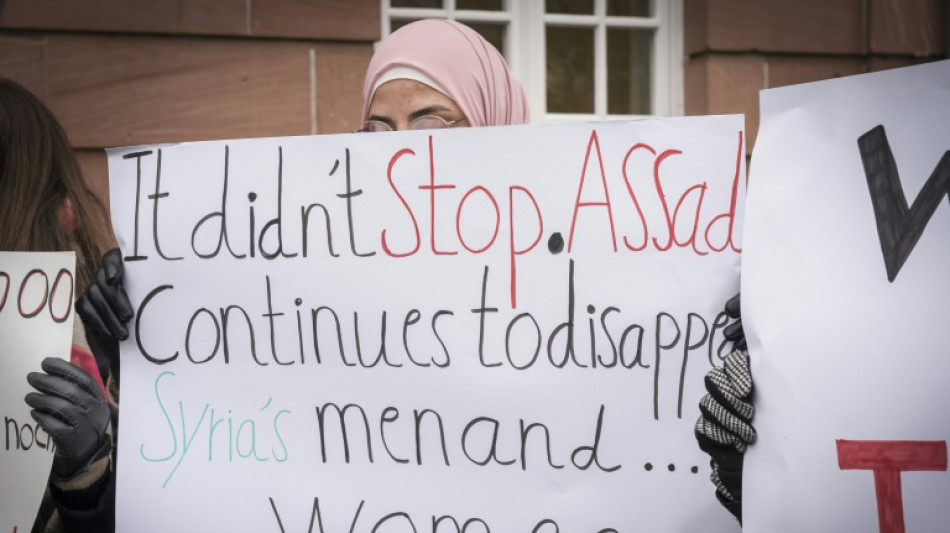
German prosecutors accused a Syrian doctor Wednesday of torturing detainees and killing one of them while working in military hospitals in his war-torn homeland, on the first day of a landmark crimes against humanity trial in Frankfurt.
The accused, 36-year-old Alaa Mousa, arrived in Germany in 2015 where he continued to practise medicine until his arrest.
The trial at Frankfurt's higher regional court is the second of its kind in Germany, and adds to other European efforts to hold loyalists of President Bashar al-Assad's regime to account for alleged war-era atrocities.
Mousa faces 18 counts of torturing detainees at military hospitals in Homs and Damascus in 2011-12, including setting fire to a teenage boy's genitals.
He also faces one count of murder, for having allegedly administered a lethal injection to a prisoner who resisted being beaten.
The accused helped to perpetrate "a systematic attack on the civilian population," said federal prosecutor Anna Zabeck as she read out the charge sheet.
He "tortured detainees by inflicting substantial bodily harm on them", she told the court.
The defendant, who wore a blue suit and an FFP2 face mask in court, kept his head down while the charges were being read out.
He has denied the allegations.
His trial comes after another German court last week sentenced a former Syrian colonel to life in jail for overseeing the murder of 27 people and the torture of 4,000 others at a Damascus detention centre a decade ago.
That verdict, hailed by victims as "historic", marked the culmination of the first trial globally over state-sponsored torture in Syria.
- Universal jurisdiction -
The proceedings in Germany are made possible by the legal principle of "universal jurisdiction" -- which allows countries to try people for crimes of exceptional gravity, including war crimes and genocide, even if they were committed in a different country.
Other cases involving the Syrian conflict have also sprung up in France, Norway, Sweden and Austria.
"Over the past decade, a large amount of evidence about atrocities in Syria has been collected, and now... those efforts are starting to bear fruit," said Balkees Jarrah of Human Rights Watch.
Mousa, a married father of two, addressed the court in fairly fluent German during the opening hearing, providing details about his education and employment history.
He said he had worked "in several military hospitals" in Syria.
He also told judges he belonged to Syria's Christian minority.
Mousa is expected to address the accusations against him in later hearings.
- 'Absolute power' -
Mousa left Syria for Germany in mid-2015, arriving not as a refugee but on a visa for skilled workers.
He worked in several places as an orthopaedic doctor, including the central spa town of Bad Wildungen, before being arrested in June 2020 after Syrian witnesses came forward.
Federal prosecutors say Mousa worked in military hospital 608 in the Syrian city of Homs and military hospital 601 in the capital Damascus, where injured detainees were brought after being arrested for opposing Assad's regime.
But instead of being treated, many were tortured "and not infrequently killed" in such hospitals, as part of Assad's brutal repression of the opposition, prosecutors allege.
In one case, Mousa is accused of having poured flammable liquid on a prisoner's wounds before setting them on fire and kicking him in the face so hard that three of his teeth had to be replaced.
Mousa is also alleged to have given a fatal injection to an inmate who was trying to fend off a beating, which prosecutors say was to demonstrate his "absolute power" over the prisoners.
- 'Sexualised violence' -
Rene Bahns, a lawyer for the civil parties in the case, representing victims' rights, told AFP the examples highlighted "the use of sexualised violence" in the Syrian torture system.
On another occasion, Mousa was called to a prison in Homs where an inmate was suffering an epileptic attack. Prosecutors say the accused punched him in the face, hit him with a plastic pipe and kicked him in the head.
The man died a few days later, shortly after taking a tablet given to him by Mousa, though the cause of death is unclear.
Other inmates were kicked and beaten, sometimes with medical tools, according to prosecutors.
The war in Syria has killed close to half a million people since it broke out in 2011.
Germany has taken in some 800,000 Syrian refugees.
G.M.Castelo--PC
