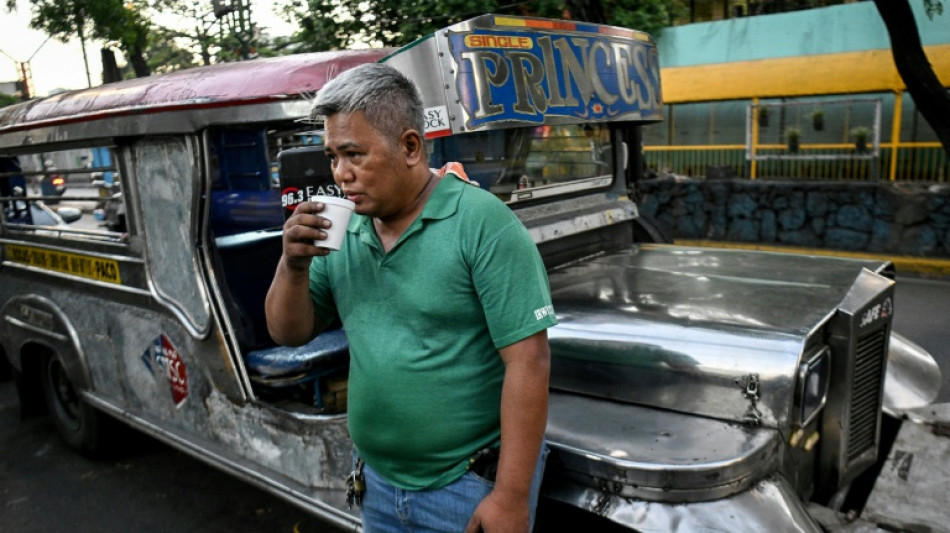
Manila's jeepney drivers struggle as Mideast war sends diesel cost soaring / Photo: Ted ALJIBE - AFP

 'Glad it's over': Kim powers to Games gold and military exemption

 After 11 World Cups, football finally comes home for one Indian fan

 Marc Marquez wins sprint at Japan MotoGP, Martin grabs pole

 Alcaraz fends off Arnaldi to reach Japan Open quarters

 Antonelli tops times in final practice at Bahrain GP
 Gauff digs deep to beat Osorio in China Open second round

 Fresh protests to hit Spain after housing measures defeated

 'He's here with me': Japan cycle queen dedicates gold to late brother

 Japan Olympic chief says 'lot more' athletes at Games than expected
 Asian carmakers besting US rivals at home, China poised to strike
 Widgets & Web Offers All-Inclusive Investor Relations Websites for Public Companies, IPOs and SPACs

 Adams named new US captain to 2030 World Cup
 China a better influence in Latin America than US: poll

 Judge pauses construction of border project in Texas national park

 Belgium's De Bruyne fires double to sink Turkey, France held by Italy
 US jobs data boosts stocks as oil prices dip

 US Supreme Court to hear high-stakes climate case
 Trump expected to name intel chief Clayton as AI czar: reports

 Argentina unveils passports-for-investment scheme

 Brazil election debate chaos sparks censorship row

 England's Carse charged by cricket body over nightclub incident

 Amazon vows $1 bn for data center towns, decries 'myths'
 Oil prices drop on G7 fuel release, US jobs data boosts stocks

 G7 agrees deal to ease global energy supply concerns

 Spain's government dealt blow as lawmakers reject housing bills

The sun was not quite up as Eric Helera unlocked the doors of his jeepney, wiped down its two long passenger benches, and checked his brake fluid before another day ferrying Manila commuters.
The makeshift minibus named Princess is part of a smoke-belching, colourfully decorated fleet that forms the backbone of a Philippine transportation sector being hammered by surging fuel prices driven by the US-Israeli war with Iran.
Like most jeepneys, Princess runs on diesel, the cost of which has hit historic highs in the archipelago nation since the partial closure of the Strait of Hormuz.
Helera, 43, is driving shorter routes but longer days in response, routinely working 18 hours to ensure he has something left over after buying fuel and covering "the boundary", the amount he owes the jeepney's owner each day.
"The margins are really thin now because of the skyrocketing diesel prices," he told AFP while sipping instant coffee from a paper cup outside his neighbourhood grocery.
"Sometimes I earn less than 500 pesos (about $8) a day," he said of shifts that can stretch until midnight.
Before the Middle East war, he could comfortably clear the same amount by lunchtime.
"There's been a huge adjustment at home," he said of life in the two-story Manila house he shares with his wife, seven children, and two other families.
"My children … need money for school projects and stuff like that, and we don't have it now," Helera told AFP journalists who spent part of the day travelling with him.
A "full breakfast with rice" was now a luxury to be enjoyed on only top earning days, he said.
"I need 10 passengers or more for each trip. Below that, and I don't earn anything," he calculated, adding the jeepney ran at its full 16-person capacity only half a dozen times a day.
Fuel hikes he called the "most severe" he had ever seen had forced him to drop longer routes where the passenger load could not justify the cost of diesel.
On Tuesday, the price jumped again by around 16 percent, with prices up to 134.30 pesos per litre at some pumps, the highest in the country's history.
Jeepney driver unions have been demanding fare increases to help cover the burden, with one last week organising a "strike" that few drivers could afford to join.
A fare hike authorised by the country's transport regulator, meanwhile, was quashed by President Ferdinand Marcos a day after it was announced.
"I'm on the side of the jeepney drivers," salesclerk Trixie Brumuela said of potentially pricier rides.
"Fuel prices rose but fares didn't, so they're losing money," the 35-year-old told AFP outside one of Manila's ubiquitous jeepney terminals, while conceding she was struggling to make ends meet herself.
"I told myself to stop spending on anything apart from my basic needs. I resolved to stop buying other stuff," she said.
Near another terminal, college freshman Juliana Tonelete told AFP that while she sympathised with the plight of drivers, her own financial situation took priority.
"I think their reaction is valid given higher pump prices, but as a commuter, as a student with a limited budget, it's difficult," she said.
Helera said the cost of fuel had forced some fellow drivers to abandon the job entirely.
"Some went back to their home provinces, others looked for other lines of work.... I'm also considering that option, because we no longer earn anything."
He worried his own options, however, were limited.
"Maybe construction. I only went to high school."
And while a government cash handout expected on Wednesday -- the first for embattled jeepney drivers -- would be welcome, "5,000 pesos … won't carry you that far," Helera said.
"It's sad," he added, as his jeepney slowly filled with evening commuters.
"It feels as though you want to give up, but you also know you can't surrender because you have a family."
Helera noted with a sigh that he had yet to reach the "boundary" after nearly 11 hours on the road.
"It's been a slow day," he said.
"I'll need to drive into the night."
S.Pimentel--PC



