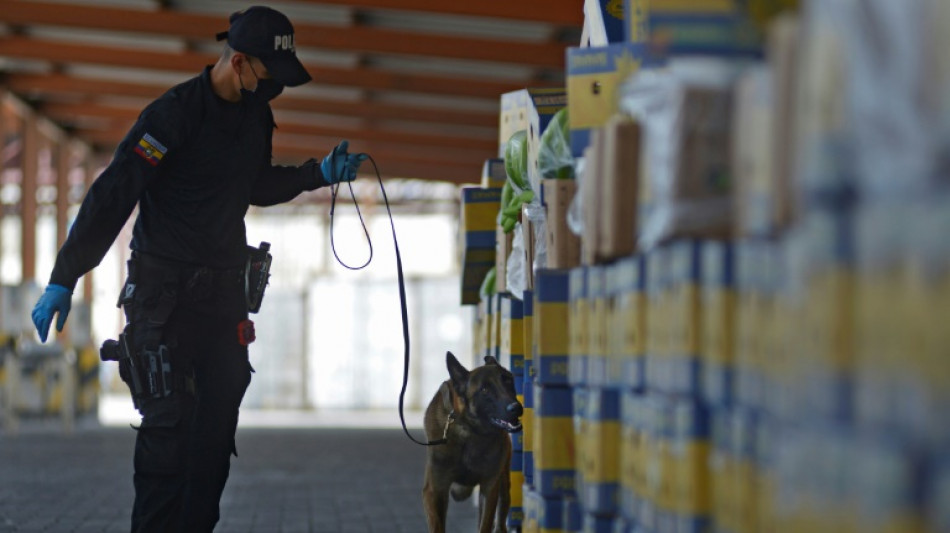
Hidden in bananas and tea, cocaine departs Ecuador port by the ton / Photo: Marcos Pin - AFP

 Man Utd agree deal for Brighton midfielder Baleba: reports

 Werro wins Lausanne 800m, well off world record pace

 China mulls bid to host 2028 UN climate talks: sources
 Jones becomes third Englishman to join Inter this summer

 Mexican governor wanted on US drug charges returns to job

 Bolivia's Paz forced to fire economy minister in mid-crisis

 A-Rod ups T-Wolves stake in $4.5bn ownership change
 UK court orders Prince Harry, others to pay Daily Mail initial £9.5mn

 'Grateful' ex-world champion Alaphilippe retires from cycling

 US, Canada work to wrap up trade deal ahead of looming deadline

 Malaysia's JDT claim unbeaten run world record

 At least 2 teens seriously wounded in sword attack at Swedish school

 Popular forest near Paris to reopen after wildfire
 UN holds second informal poll of secretary-general candidates
 Shakhtar Donetsk to play Champions League home games at Chelsea

 Arsenal sign Villa centre-back Konsa as champions bolster defence
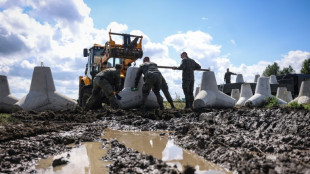 The 'hedgehogs' leading Poland's defences on Russian border

 England thrash Pakistan by an innings and 103 runs in first Test

 Fury says Joshua fight 'doesn't look like it's going to happen'
 Argentina's Paredes suspended 10 matches by FIFA for World Cup fight

 Watkins and Martinez could join Villa exodus says Emery

 UK court orders Prince Harry, others to pay Daily Mail £9.5mn

 Aligned Launches $ALIGN, the Native Token of Its Full Ethereum Stack

 Bitcoin jumps, stocks bounce as traders weigh US Treasury action

 Man City boss Maresca hit with Doku injury blow

Trying to prevent drug traffickers from hiding cocaine in cargo containers at Ecuador's main port of Guayaquil is becoming an increasingly expensive headache for police and exporters alike.
The ingenuity of criminal gangs means tons of cocaine leave the port hidden in food containers.
Surrounded by a poor neighborhood, the Guayaquil port is a hive of activity, where trained dogs sniff here and there while police officers cut into bananas, pineapples and even tea drums looking for drugs.
Customs agents in Guayaquil manually check a fifth of the containers to ensure that export companies are not a front for the mafia.
Two German Shepherds, Wolf and Jessi, help the officers but they can only work for 10 minutes at a time to be effective.
"We can't tire them out too much, otherwise we won't find any drugs," Richard Riera, head of the National Police Ports and Airports Information Unit, told AFP.
Thanks to the dogs, liquid drugs hidden by traffickers inside tea drums were recently detected after passing through the scanner without incident.
- 'Titanic task' -
Drug traffickers "prefer the port because this is where the majority of exports to Europe and the United States leave," said Riera.
Situated between Colombia and Peru -- the world's two largest producers of cocaine -- Ecuador seized a record 210 tons of the powder in 2021, of which 96 tons were discovered in Guayaquil.
A third of seizures were destined for Europe while another 11 percent were headed for the United States, according to the police.
"Our country ceased being a collection center to become instead a platform for drug distribution on an international scale," said national anti-narcotics chief Giovanni Ponce.
Drug related violence is increasing in surrounding Guayas state where 78 percent of 404 murders so far this year were linked to drug trafficking, Ponce told the Teleamazonas news channel.
Outside the port, in the city's streets, organized crime keeps the local population in a state of terror with bodies decapitated or hanging from bridges.
In the first quarter of this year, police seized 15.8 tons of drugs in Guayaquil port alone, four times more than in the same period of 2021.
But checking 2.4 million containers a year "is a titanic task," said Riera.
The port has 12 privately owned terminals and handles 85 percent of Ecuador's non-oil exports -- around 25 million metric tons of produce a year.
Officials say they need more security guards and more unintrusive scanners that don't damage bananas and shrimp, the country's flagship exports, but there is only one of these in the whole of Ecuador.
- Huge cost to exporters -
Exporters have been left frustrated by the number of containers being infiltrated with drugs.
Criminal gangs break the locks, take out the legal cargo and replace it with cocaine bricks.
"Often they go all the way to the point of origin" in the factory, said Javier Lancha de Micheo, owner of the private Contecon terminal.
The company has had to install security cameras in the terminal and introduce security checks on people and vehicles entering the premises.
The worst affected are banana exports.
Those containers are often breached on the roadside as well as in the port itself.
"We're the main victims because we move 7,000 banana containers a week," said Richard Salazar, executive director of the Banana Marketing and Export Association.
Companies spend $200 per container on security measures such as satellite surveillance and private contractors.
But whenever drugs are discovered, authorities seize the entire container as evidence, to the detriment of its owners.
"No one takes responsibility for the loss. Each container is worth $12,000," added Salazar, who says the industry has pleaded for help.
"We have asked for and demanded an integrated security policy in Ecuador... as an additional option to the private efforts that every exporter is already carrying out."
P.Mira--PC