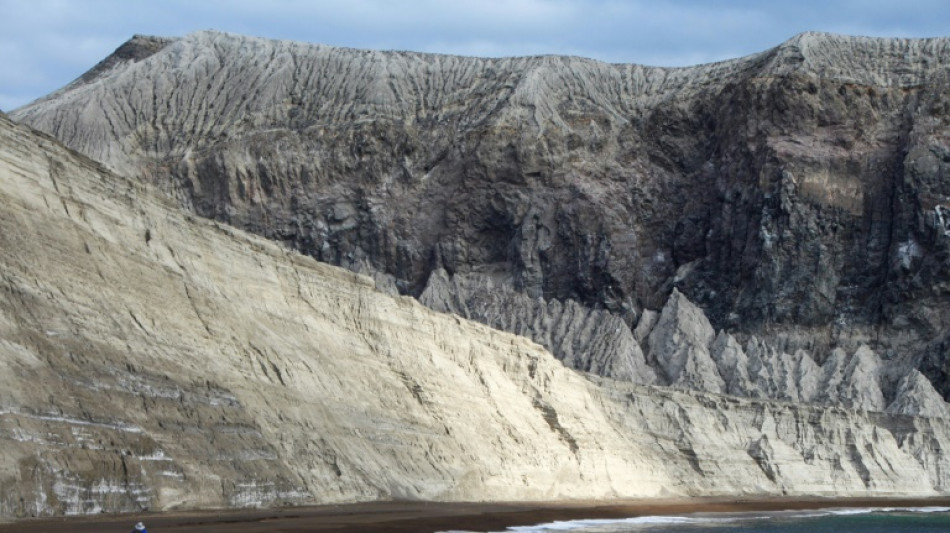
Scientists scour 'Mexico's Galapagos' for quake, volcano clues / Photo: DOUWE VAN HINSBERGEN - UNIVERSITY OF UTRECH/AFP

 Bangladesh all out for 64 in 2nd Test after Starc masterclass

 Odyssey effect: stars sell Greece to a new wave of US tourists
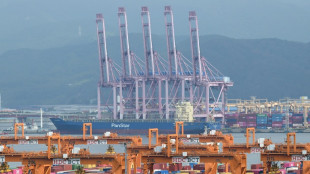 South Korea to send first container ship through Arctic route
 Starc takes 5-11 to leave Bangladesh reeling in 2nd Test

 Injured Rune withdraws from US Open
 Nakashima knocks out Fritz to reach Cincinnati semi-finals

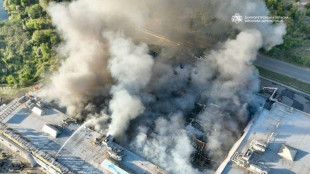 Ukraine says 'cynical' Russian strike on shopping centre killed 16

 TikTok to pay $400 mn settlement in US children's privacy case

 MLS fines Messi for striking an opponent

 Gouiri double fires Marseille past Strasbourg in Ligue 1 opener

 Mavericks buy out Thompson, now reportedly bound for Heat

 England v Pakistan first Test: Three talking points

 US, Canada push to seal trade deal as deadline nears

 One dead, three wounded after sword attack at Swedish high school

 Ukraine says 'cynical' Russian strike on shopping centre killed 15

 US Supreme Court allows White House ballroom construction for now

 Root hails emerging fast bowlers as England thrash Pakistan

 Brazil's Lula urges tariffs resolution in call with Trump

 Ukraine says 'cynical' Russian strike on shopping centre killed 14

 Heatwave-hit Europe logs over 30,000 excess summer deaths: first figures

 Give LIV Golf 'one more shot,' says DeChambeau

 Duplantis hits the high notes for athletics anthem

 Malaysia's JDT claims unbeaten run world record

 Bolivian economy minister fired after Congress vote
 Russell roars to Dutch GP sprint pole, Antonelli fifth
Could a volcanic eruption off Mexico's coast unleash a tsunami like the one that devastated Tonga? What really causes tectonic plates to shift and trigger earthquakes? Scientists visited a remote archipelago in search of answers.
Located in the Pacific Ocean several hundred kilometers from the Mexican coast, the Revillagigedo Islands are known as "Mexico's Galapagos" due to their isolation and biodiversity.
One of the archipelago's volcanos, Barcena, last erupted spectacularly in 1953, and another Evermann, in 1993. Both remain active today.
Located on a mid-ocean ridge, the four islands, which were added to the UNESCO World Heritage list in 2016, are uninhabited apart from navy personnel, and access is tightly restricted.
Getting there takes about 24 hours or more by boat and few civilians visit apart from scuba drivers lured by giant manta rays, humpback whales, dolphins and sharks.
Last month, an international team of 10 scientists carried out a week-long mission whose aims included trying to determine if -- or more likely when -- there will be another volcanic eruption.
"What we're trying to find is how explosive these volcanos can be and how dangerous," said the group's leader, Douwe van Hinsbergen, a professor at Utrecht University in the Netherlands.
- Challenging convention -
The worry is that something similar to the cataclysmic eruption of the Hunga Tonga–Hunga Ha'apai volcano in January could send a tsunami hurtling towards Mexico's Pacific Coast.
"Whenever there are active island volcanos, there are always possibilities of generating tsunamis," said Pablo Davila Harris, a geologist at Mexico's Institute for Scientific and Technological Research of San Luis Potosi.
"What we volcanologists are looking for is when the next eruption is going to happen," using modeling based on previous volcanic activity, he added.
The team also hopes that its analysis of minerals brought up by past eruptions will help to understand the motion of tectonic plates, which cause earthquakes and volcanic activity.
"Plates move over mantle. Is the mantle pushing the plates? Is the mantle doing nothing?" van Hinsbergen said.
According to conventional theory, convection -- the mantle's motion caused by the transfer of heat from the Earth's core to the outer layer -- causes tectonic plates to move and grind against each other.
Van Hinsbergen's hypothesis is that the mantle is in fact "a big lake of rock that is essentially not convecting," which he said would require a complete rethink.
"If that is true, then everything that we see, at least on timescales of tens of millions of years and shorter, is driven by gravity pulling plates down. And that would make the whole system a lot simpler," he said.
The mission received funding from a Dutch program for -- in van Hinsbergen's words -- "ideas that are almost certainly wrong but if they're not they will have big implications."
The samples collected have been taken to Europe for analysis and the results are expected to be known later this year.
A.Magalhes--PC