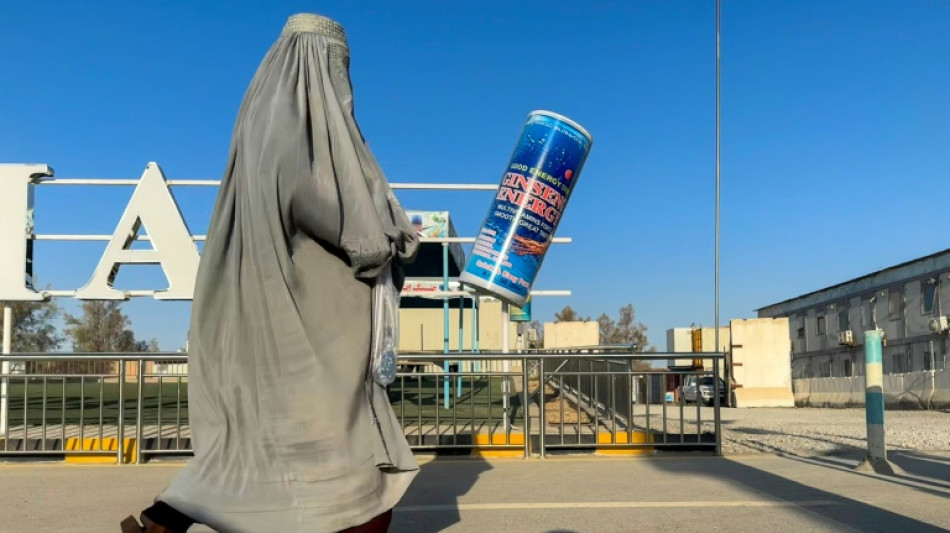
Energy drink craze peps and pacifies weary Afghans / Photo: Wakil Kohsar - AFP

 Verstappen edges Russell in final practice in Azerbaijan

 English, Spanish, Italian, German football leagues call for FIFA reform

 Pope arrives in France on first official visit in 18 years
 Pope arrives in France on first state visit in 18 years
 Heavy fighting, internet disruption as Ethiopia conflict rages
 From transit to consumption: drug use surges in Mozambique
 Chicago teams, Guardians and Padres all book MLB playoff berths
 Bijan Robinson destroys Packers in 35-14 win for Falcons
 Harimoto hails new era as Japan dethrone table tennis kings China

 India rape cases turn focus back onto women's safety
 Rebellious Afghan taxi drivers defy ban on music
 Brazil candidates mount digital armies for fierce online campaign
 Nepal PM says floods 'a warning to the world' about climate change
 Trump hosts Xi for state dinner as pomp masks tensions
 Scheffler and Burns give US 3-2 Presidents Cup lead
 Hollywood stars among 100 arrested in NY anti-Netanyahu protest
 Klopp denied on Germany debut as Portugal win in Nations League

 Rich nations should foot climate bill, says Nepal minister
 Wellalage and Mendis star as Sri Lanka level England series in thriller

 Felix gives Portugal win over Wales as Ronaldo misfires
 Wellalage and Mendis star as Sri Lanka level England ODI series
 Guyana urges Venezuela at UN to respect ICJ's ruling on Essequibo region

 Argentina coach says Messi deserves to go out on own terms
 Xi sets red lines for Trump despite lavish White House welcome

 Cowboys, Ravens happy with footing for first Rio NFL clash
A production line in a warehouse in western Afghanistan churns out 24 energy drinks every second, feeding a thirst for the tonic used to mask life's hardships and lift wilting spirits.
The Taliban government has purged many signs of Western influence but a stimulant drink craze that arrived with US soldiers remains, and has even sprouted a thriving domestic industry.
Alcohol is outlawed in Afghanistan but caffeine-rich energy drinks are consumed by all, from secret police to children, and advertised on billboards more than even Taliban state propaganda.
Many homegrown brand names evoke the bygone war: "Commando", "Attack", and "Predator".
"It's obvious that there are more struggles and hardships of life among the youth here," said Milad Ghaznavi at a Herat city supermarket aisle that boasted 40 varieties of the beverage.
"Energy drinks have become kind of a habit and a craving for people," Ghaznavi told AFP.
"They consume anything that comforts them," said the 19-year-old, who claimed he had been "addicted" but gave them up for health reasons.
- 'We drink energy' -
Energy drinks, which are high in caffeine and sugar and often more available than drinking water at roadside kiosks, are seen by many Afghans as a way to supplement an insufficient diet.
Nearly 90 percent of people in poverty-stricken Afghanistan are consuming inadequate food, according to the World Food Programme (WFP).
Most recent data from March reveals 86 percent of households are relying on less-preferred and cheaper food, with more than a third reducing meals and more than half reducing portions.
Gulzar, a labourer, fuels his 14-hour work days with four cans of "Hit".
"We work here, we sweat, so when we are tired we drink energy," said the 40-year-old, who goes by one name.
"If you don't drink you are tired, you have a headache, you are weary."
But drinking that many energy drinks comes with a cost.
- Health impacts -
Gulzar's diet contains over 100 grams of sugar -- twice the intake the World Health Organization recommends -- as well as a caffeine hit equivalent to six espressos, which he compares to a smoking habit.
Excessive caffeine consumption can cause high blood pressure, heart palpitations, anxiety and insomnia, according to the US Food and Drug Administration.
But Gulzar says he has no choice.
"Afghanistan is below impoverished," he said. "If we had the means we wouldn't use this."
Local brands cost only around 30 Afghani ($0.40) while imported Red Bull or Monster, two of the most popular global names, are unaffordable to most.
The poorest Afghans, who rely on dwindling foreign aid, are unable to buy energy drinks and instead subsist on bread with caffeinated green tea.
- 'Business is good' -
Energy drinks were invented in Japan in 1962 but exploded in popularity during the 2000s into a global sector worth nearly $40 billion this year, according to research firm Future Market Insights.
In the industrial hub of western Herat, the Pamir Cola company says it produces over a million cans daily.
Still, Pamir Cola says it is a minor player in an industry it estimates produces two cans a day for each of Afghanistan's 40 million citizens.
The figure is impossible to verify because of the drought of data on Afghan commerce.
Workers at the company funnel sugar and citric acid into the bowels of a machine pumping out product every moment the electricity is on.
Pamir Cola says it manufactures to EU standards in a largely unregulated Afghan market left to its own devices.
While Red Bull affiliates with glamorous extreme sports and Monster with motorsports, Zahir Shah Bahaduri, who runs Pamir Cola with his two brothers, is under no illusions.
"For the people of Afghanistan who do hard labour duties and don't have good food, the best way for them is to drink energy drinks," said the 45-year-old.
"I think business is good and will probably get better."
By the side of a Kabul highway, enterprising vendors stack energy drinks high as the traffic roars past.
"It removes their tiredness," said 36-year-old Ahmad Gulab, who sometimes sells to customers by the crate. "It's their joy in life."
P.Cavaco--PC