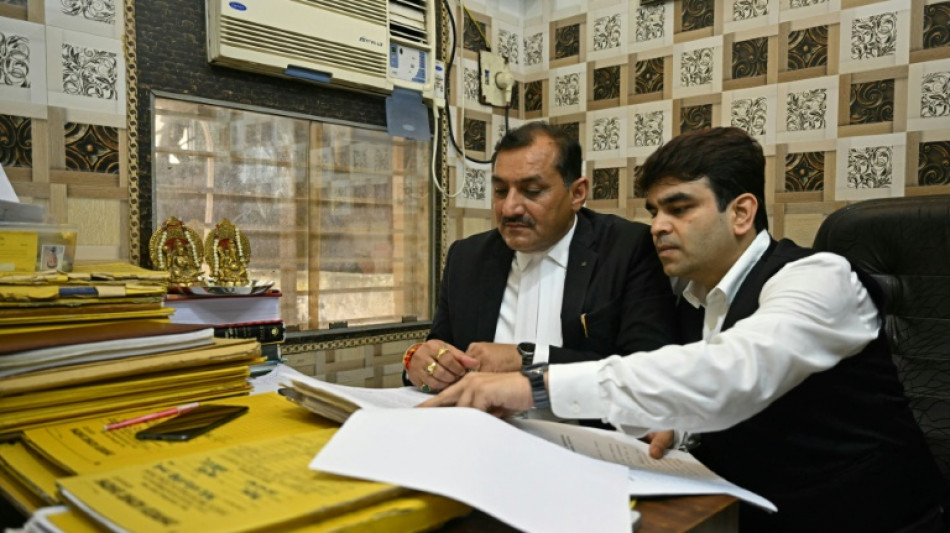
Long wait for justice in India's backlogged courts / Photo: Money SHARMA - AFP

 Cash for nature protection: hotelier's offer to Principe islanders
 US miner KoBold bets on AI to gain edge in DR Congo mineral hunt

 Internet disrupted in Ethiopia as conflict rages

 Asian markets mixed after oil gains

 'Genius' Ohashi bids for third Asian Games gold after world record
 India's 'Tree Father' plants for a greener future
 Hopping mad: New health warning stirs up Belgian brewers

 Canadian capital to rename 'Trump Ave'
 Pope heads to France on first state visit in 18 years

 Bacteria suspected in deaths of hundreds of baby whales off Argentina

 US 'must choose' whether to end war: Iran president to Fox News

 UN approves resolution on dealing with rising sea levels

 Yalcouye makes dream debut as Ivory Coast beat Ghana in AFCON qualifier
 Chicago's White Sox and Cubs book MLB playoff berths

 Last-gasp Gakpo strike snatches Dutch draw to sour Klopp debut

 Global stocks mostly fall as oil prices and bond yields rise

 Israel's Netanyahu denounces enemies, allies in fiery UN speech
 Hollywood stars among arrests in NY anti-Netanyahu protest

 Losing start in AFCON qualifying for 78-year-old coach Le Roy

 Italy bans burqas in schools, caps numbers of foreign students per class

 Israel policies threaten 'life and existence' of Palestinians, Abbas says

 Paolini steers Italy past China in BJK

 Zidane admits emotion on eve of first game as France coach

 Breetzke and Maharaj sink Australia in first one-day international
 Zelensky broke confidentiality with North Korea POWs disclosure: South's president

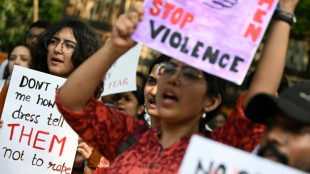
Sonia waited 32 years to see her rapists convicted, a glacially slow legal process all too common in India where half a million cases have been pending for longer than two decades.
The violence inflicted on her was horrific and the trauma was compounded by years of painful stop-start trials, beginning in 1992 and ending only last month with six men jailed for life.
"My heart is full of pain," said Sonia, 52, who as a young woman, was bound gagged and raped in her home city of Ajmer in the northern state of Rajasthan.
"I could not do anything," said Sonia, whose name has been changed to protect her identity. "This should not happen to any girl."
In the world's most populous nation, a staggering 533,000 cases have been languishing in court for between 20 and 30 years, according to justice ministry figures.
More than three-quarters of them are criminal cases.
Last year, the Supreme Court warned victims may become "disillusioned when the legal process moves at a snail's pace", expressing their "anguish" at some cases taking as long as 65 years.
Nearly 3,000 cases nationwide have been pending for at least half a century.
- 'Justice denied' -
Sonia, against many expectations, eventually got justice.
In her case, part of a wider rape and blackmail trial, 18 men were charged.
But only a handful were initially in detention. Defence lawyers demanded the trial restart each time another arrest was made.
As the years wore on, trial lawyers came and went. Evidence was trawled over again and again.
Virendra Singh Rathore, who was at least the tenth public prosecutor to have handled the case, said it was "traumatic" for survivors.
"They would ask us, why we are bothering them, and, why the accused were not being punished," he said.
On August 20, a court in Ajmer sentenced six men to life imprisonment, ending a complex case that had seen years of twists and turns, several convictions and subsequent acquittals.
Rathore said the lives of the survivors would have been very different had justice been swifter.
"Others, who have had to endure such crimes, would have had the courage to come forward," he said.
"For the common man, justice delayed is basically justice denied -- or completely absent."
- 'Overburdened' -
The justice ministry has ordered hugely backlogged courts to prioritise the "speedy trial of specific cases of heinous nature", but their caseloads are overwhelming.
At least 44 million cases are pending across the country of 1.4 billion people.
That judicial jam could take decades -- if not centuries -- to clear at current speeds, even without a continuing pileup of fresh cases.
Procedures are bogged down in rigid rules rooted in the British colonial era.
There has been little investment in digital systems to streamline and organise hearings, while a meagre ratio of judges -- just 21 per million of population in India -- means procedures are notoriously slow.
New Delhi-based lawyer Mishika Singh, who founded the Neev Foundation to improve legal access for the city's poor, warns those seeking justice in an "overburdened" system to be ready to wait.
"We tell them very clearly that even to get an interim order, it can easily take a year to two years," she said.
"For the final decision to come, it can take three to four years, easily."
- 'Never-ending saga' -
Neelam Krishnamoorthy's two children, aged 13 and 17, were among the 59 killed in a blaze in a Delhi cinema in 1997.
After an epic legal fight, cinema owners Sushil and Gopal Ansal were sentenced in 2007 for negligence to two years in jail.
But that was challenged on appeal, and reduced to a fine.
Another case of tampering with evidence saw them sentenced to seven years in 2021, but a court in July set the pair free due to their age.
Today, 27 years since her children died, Krishnamoorthy is fighting an appeal case demanding they serve jail time.
"When I went to the court initially, I thought it was what I saw in films: you go to court, you have four or five hearings and justice is delivered," she said.
"I was in for a rude shock. This is a never-ending saga."
Krishnamoorthy accused the judicial system of only acting swiftly when a case captured public attention.
"They intervene if there is a public outrage," she said. "Don't other victims of crime like us need justice?"
N.Esteves--PC