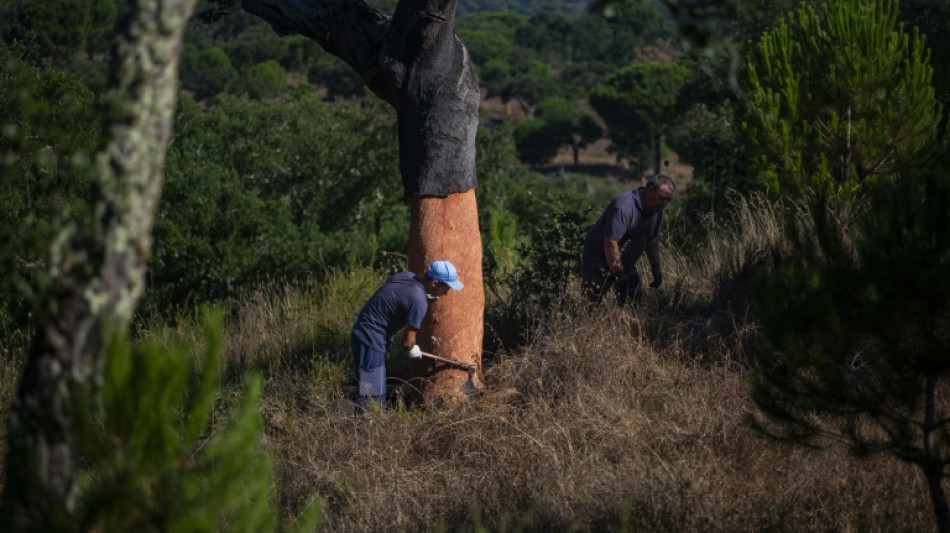
Portugal looks to put new twist on cork industry / Photo: CARLOS COSTA - AFP

 Bijan Robinson destroys Packers in 35-14 win for Falcons

 Harimoto hails new era as Japan dethrone table tennis kings China

 India rape cases turn focus back onto women's safety
 Rebellious Afghan taxi drivers defy ban on music

 Brazil candidates mount digital armies for fierce online campaign
 Nepal PM says floods 'a warning to the world' about climate change

 Trump hosts Xi for state dinner as pomp masks tensions
 Scheffler and Burns give US 3-2 Presidents Cup lead

 Hollywood stars among 100 arrested in NY anti-Netanyahu protest

 Klopp denied on Germany debut as Portugal win in Nations League

 Rich nations should foot climate bill, says Nepal minister

 Wellalage and Mendis star as Sri Lanka level England series in thriller

 Felix gives Portugal win over Wales as Ronaldo misfires

 Wellalage and Mendis star as Sri Lanka level England ODI series

 Guyana urges Venezuela at UN to respect ICJ's ruling on Essequibo region

 Argentina coach says Messi deserves to go out on own terms

 Xi sets red lines for Trump despite lavish White House welcome

 Cowboys, Ravens happy with footing for first Rio NFL clash

 Starbucks to close 250 more cafes in North America

 French actress Marina Vlady dies at 88

 CNN, MS NOW, Politico allowed back in White House after judge's order

 Morocco's ruling coalition dominates low-turnout parliament election

 Napoli hoping to build new stadium, says owner

 What's behind the Pakistani strikes on Afghanistan?
 Hundreds protest for return of Nobel peace laureate Machado to Venezuela

Portugal, the world's leading cork producer, is finding new uses for the material, from footwear to furniture, as demand for wine bottle stoppers wanes.
Producers highlight the environmentally friendly properties of cork, which is lightweight, recyclable, waterproof and fire-resistant, to encourage its use in diverse settings.
Cork is obtained by stripping the bark of cork oak trees every nine years in a careful process that allows the tree to regenerate and grow, making the industry naturally sustainable.
The material has "a negative carbon footprint because it comes from a tree that captures CO2 day and night", Antonio Rios de Amorim, the CEO of the world's largest cork producer Corticeira Amorim, told AFP.
The push to diversify comes as global sales of wine decline, reducing demand for cork wine stoppers which have long faced competition from cheaper plastic stoppers and screw tops.
"Periods of slowdown must be used to question what we do," said Amorim, whose ancestors founded Corticeira Amorim 154 years ago in the northern village of Mozelos, about 30 kilometres (18 miles) south of second city Porto.
- Booster rockets, metro seats -
Thanks to cork's cell-like structure, the material is elastic and highly impermeable, making it suitable to make shoes as well as ties, pants and other clothes.
Furniture designers are also increasingly drawn to the material.
British designer Tom Dixon has called it a "dream material" and put out a range of dark cork furniture that includes tables, stools and shelves using cork from Portugal.
The Lisbon metro in 2020 replaced the fabric lining on all seats of its train fleet with cork, an easier to maintain material.
Builders have been drawn to the material because of its unique thermal insulation and sound absorption properties.
Cork is also finding its way into space. It is used in thermal protection coating on booster rockets because of its resistance "to strong variations in temperature", said Amorim.
Making wine bottle stoppers, however, remains the main activity for Portugal's cork industry, which employs around 8,000 people.
Corticeira Amorim makes some six billion cork wine bottle stoppers per year, almost all of them for export mainly to Chile, France and the United States.
It accounts for 70 percent of the global market share for cork stoppers and posted sales of 985 million euros (one billion dollars) in 2023, slightly lower than in the previous year.
- Traditional methods -
Cork is made from the bark of the cork oak (Quercus suber) found in countries of the Mediterranean basin.
Portugal is home to about a third of the world's total area dedicated to this tree -- more than any other country -- and accounts for nearly half the world's supply of cork.
There are also plantations in France, Spain, Italy. Algeria, Morocco and Tunisia.
In the province of Ribatejo around 80 kilometres east of Lisbon, cork oaks stretch as far as the eye can see.
The bark is removed from the tree in summer using traditional methods handed down from generation to generation.
It is a highly precise technique "that takes several years to learn", said Nelson Ferreira, a 43-year-old cork bark harvester, adding he takes great care not to damage the tree.
The bark is then taken to Corticeira Amorim's factories in the north of Portugal where it is steam-treated, cut into smaller pieces and then fed into machines that punch out stoppers.
The preservation of cork oaks is crucial for Portugal, which has made them a protected species since it takes an average of 40 years for a tree to start producing cork that can be used by cork makers.
N.Esteves--PC