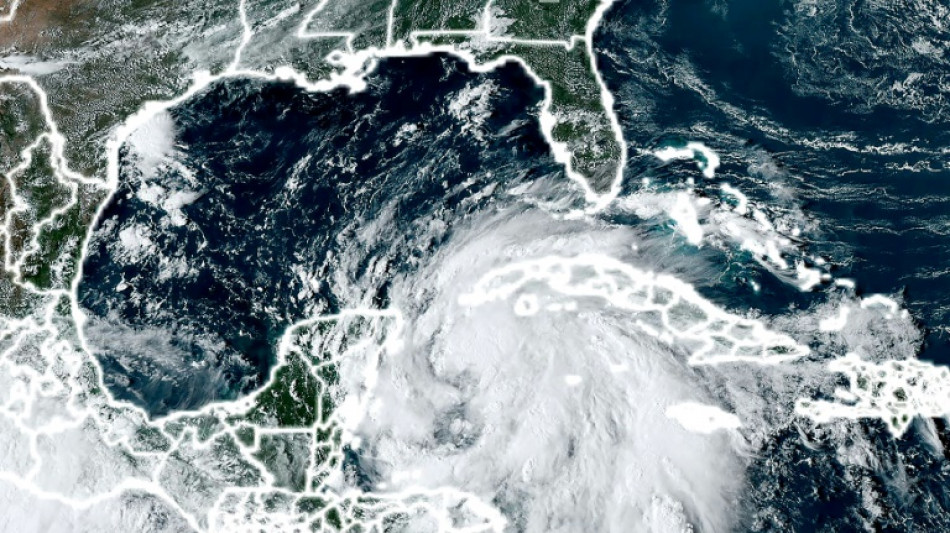
Climate change made deadly Hurricane Helene more intense: study / Photo: - - NOAA/AFP

 India's 'Tree Father' plants for a greener future
 Hopping mad: New health warning stirs up Belgian brewers

 Canadian capital to rename 'Trump Ave'

 Pope heads to France on first state visit in 18 years

 Bacteria suspected in deaths of hundreds of baby whales off Argentina

 US 'must choose' whether to end war: Iran president to Fox News

 UN approves resolution on dealing with rising sea levels

 Yalcouye makes dream debut as Ivory Coast beat Ghana in AFCON qualifier

 Chicago's White Sox and Cubs book MLB playoff berths

 Last-gasp Gakpo strike snatches Dutch draw to sour Klopp debut

 Global stocks mostly fall as oil prices and bond yields rise

 Israel's Netanyahu denounces enemies, allies in fiery UN speech

 Hollywood stars among arrests in NY anti-Netanyahu protest

 Losing start in AFCON qualifying for 78-year-old coach Le Roy

 Italy bans burqas in schools, caps numbers of foreign students per class

 Israel policies threaten 'life and existence' of Palestinians, Abbas says

 Paolini steers Italy past China in BJK

 Zidane admits emotion on eve of first game as France coach

 Breetzke and Maharaj sink Australia in first one-day international

 Zelensky broke confidentiality with North Korea POWs disclosure: South's president

 Former Liverpool star Carroll reveals he was sexually assaulted
 Dominican Republic calls for Haiti force to be strengthened

 Dolly Parton's nephew ordered to stay away from estate staff, properties

 Early exit for Philippine darling Eala at Singapore Open

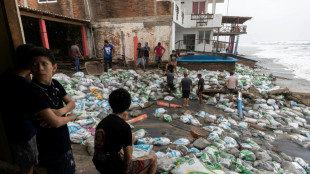 Hurricane Polo triggers huge waves in coastal Mexican city

Hurricane Helene's torrential rain and powerful winds were made about 10 percent more intense due to climate change, according to a study published Wednesday by the World Weather Attribution (WWA) group.
Although a 10 percent increase "might seem relatively small... that small change in the hazard really leads to big change in impacts and damage," said climate scientist Friederike Otto, who heads the research organization.
The study also found that fossil fuels -- the primary cause of climate change -- have made hurricanes like Helene 2.5 times more likely to occur.
In other words, storms of Helene's magnitude were formerly anticipated once every 130 years, but now the probability is closer to once every 53 years, on average.
To conduct the study, researchers focused on three aspects of Hurricane Helene: precipitation, winds and the water temperature of the Gulf of Mexico -- a key factor in its formation.
"All aspects of this event were amplified by climate change to different degrees," Ben Clarke, a co-author of the study and researcher at Imperial College London, told a press conference.
"And we'll see more of the same as the world continues to warm," he continued.
The research by WWA, an international group of scientists and meteorologists who study the role of climate change in extreme weather events, comes as the southeastern US state of Florida prepares for the arrival of another major hurricane, Milton, just 10 days after it was hit by Helene.
- Destruction -
Helene made landfall in northwestern Florida on September 26 as a Category 4 hurricane with winds up to 140 mph (225 kph).
The storm then moved north, causing heavy rain and devastating floods in several states, including North Carolina, where it claimed the highest death toll.
The authors of the study emphasized that the risk posed by hurricanes has increased in scope beyond coastal areas.
Bernadette Woods Placky, chief meteorologist at NGO Climate Central, said Helene "had so much intensity" that it would take time for it to lose strength, but the "storm was moving fast... so it could go farther inland pretty quickly."
This study utilized three methodologies to examine the three aspects of the storm, and was conducted by researchers from the US, the UK, Sweden and the Netherlands.
To study its rainfall, researchers used an approach based on both observation and climate models, depending on the two regions involved: one for coastal areas like Florida, and another for inland areas like the Appalachian mountains.
In both cases, the study found precipitation had increased by 10 percent because of global warming, which is currently at 1.3 degrees Celsius above pre-industrial levels.
To study Helene's winds, scientists looked at hurricane data dating back as far as 1900.
They determined Helene's winds were 11 percent stronger, or 13 mph (21 kph), as a result of climate change.
Lastly, the researchers examined the water temperature in the Gulf of Mexico, where Helene formed, finding it was around 2 degrees Celsius above normal.
This record temperature was made 200 to 500 times more likely due to climate change, the study asserts.
Warmer oceans release more water vapor, providing more energy for storms as they form.
"If humans continue to burn fossil fuels, the US will face even more destructive hurricanes," Clarke warned in a statement.
L.Henrique--PC