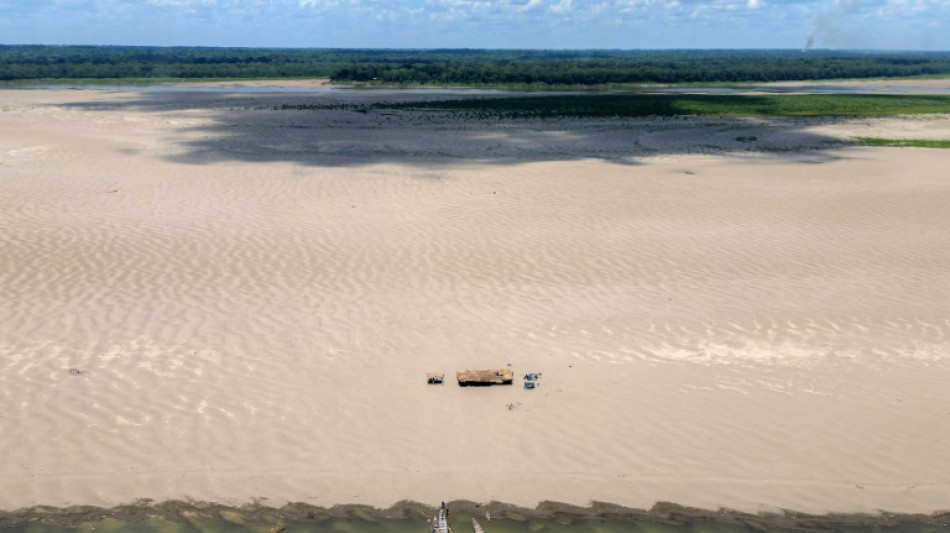
The long walk for water in the parched Colombian Amazon / Photo: Luis ACOSTA - AFP

 India's 'Tree Father' plants for a greener future
 Hopping mad: New health warning stirs up Belgian brewers

 Canadian capital to rename 'Trump Ave'

 Pope heads to France on first state visit in 18 years

 Bacteria suspected in deaths of hundreds of baby whales off Argentina

 US 'must choose' whether to end war: Iran president to Fox News

 UN approves resolution on dealing with rising sea levels

 Yalcouye makes dream debut as Ivory Coast beat Ghana in AFCON qualifier

 Chicago's White Sox and Cubs book MLB playoff berths

 Last-gasp Gakpo strike snatches Dutch draw to sour Klopp debut

 Global stocks mostly fall as oil prices and bond yields rise

 Israel's Netanyahu denounces enemies, allies in fiery UN speech
 Hollywood stars among arrests in NY anti-Netanyahu protest

 Losing start in AFCON qualifying for 78-year-old coach Le Roy

 Italy bans burqas in schools, caps numbers of foreign students per class

 Israel policies threaten 'life and existence' of Palestinians, Abbas says

 Paolini steers Italy past China in BJK

 Zidane admits emotion on eve of first game as France coach

 Breetzke and Maharaj sink Australia in first one-day international

 Zelensky broke confidentiality with North Korea POWs disclosure: South's president

 Former Liverpool star Carroll reveals he was sexually assaulted
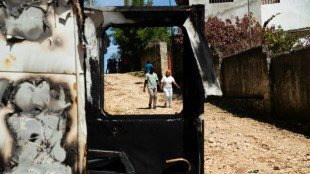 Dominican Republic calls for Haiti force to be strengthened

 Dolly Parton's nephew ordered to stay away from estate staff, properties

 Early exit for Philippine darling Eala at Singapore Open

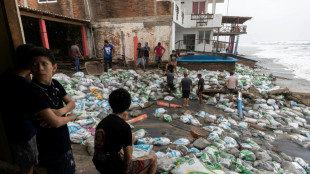 Hurricane Polo triggers huge waves in coastal Mexican city

Bearing six-liter bottles of water on their shoulders, members of Colombia's Indigenous Yagua community tramp along the dried-up riverbed of a branch of the mighty Amazon.
In the Three Frontiers region, where Colombia borders Brazil and Peru, the flow in some spots of the world's biggest river by volume has shrunk by 90 percent, leaving a desert of brown sand etched with ripples.
Near the Colombian border town of Leticia, the 600 inhabitants of a Yagua village have found themselves staring out over a kilometer-wide (.6-mile) pop-up beach.
Before the smaller of two branches of the Amazon that flow past Leticia started to dry up three months ago, it took the villagers only around 15 minutes to reach the shores of the river.
Now they have to walk for two hours under the baking sun to reach the docking point for boats that bring food, fuel and drinking water on the only route in and out of the jungle.
"This is a really difficult time," Victor Facelino, a 52-year-old Yagua man told AFP as he lugged home a water canister donated by the state to help quench the thirst of people living in the world's biggest rainforest.
"Sometimes we get bogged down in the sand," he said, panting.
Colombia's National Unit for Disaster Risk Management (UNGRD) blames the Amazon's worst drought in nearly 20 years for the dramatic shrinkage of the river in the Three Frontiers region.
"For many of these communities, the only means of transport is the river, and with the drying up of the tributaries, they are completely cut off," UNGRD director Carlos Carrillo said.
- 'Like before' -
The governor of the Colombian department of Amazonas, a 109,000-square-kilometer chunk of forest, said the drought was the "worst climate crisis" ever seen in the area.
It coincides with the worst wildfire season in the Amazon in nearly 20 years, according to Europe's Copernicus climate observatory.
On the Peruvian side of the border, several towns have reported food shortages.
On the Brazilian side, which is choking under fumes from fires, authorities have declared a "critical situation," with the low levels of water at a hydropower station that generates 11 percent of the country's electricity causing particular concern.
The logistical difficulties have caused the price of basic goods, including fuel, to rocket. Fishermen are forced to travel ever further upriver to cast their nets.
"If you look along the river, everywhere you go it's dry," Roel Pacaya, a 50-year-old fisherman in the town of Puerto Narino, complained.
Maria Soria, a Yagua woman who makes a living selling handicrafts on Monkey Island, a natural reserve in the Colombian Amazon, is worried that soon "all the river will start to dry up."
"I ask God to change it back to the way it was, so that we can live like before," said the 55-year-old, wearing a traditional blue-feathered headdress and chest covering of palm fiber to perform a dance for a small group of tourists.
- Going with the flow -
Even for those who still have river access, things aren’t easy.
Eudocia Moran, 59, said she feels imprisoned by the now stagnant waters of the Amazon that lie just a few meters from her home.
Shopping trips to Leticia, about 30 miles down the river have become rarer, with boat operators fearing getting stranded in the sand.
Moran, a leader of the Ticuna Indigenous community, is convinced that the solution is a return to the land.
Rather than relying on an ever slower trickle of tourists, she believes the only way to survive is to "immerse ourselves fully in agriculture."
In a garden irrigated by a sliver of the river she grows cassava, beans, corn and fruit.
"I tell everyone we have go with the flow of the times, because all we can do is learn to live."
T.Resende--PC