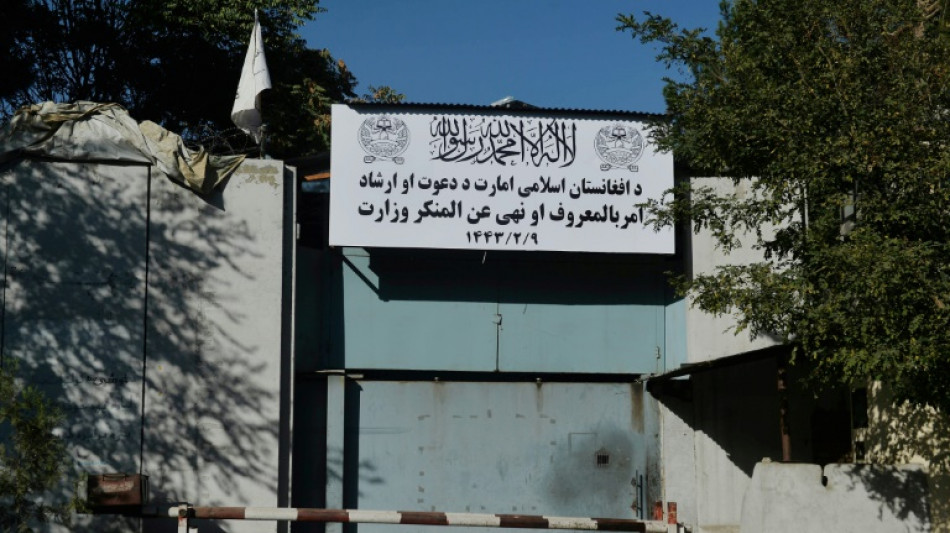
Afghan Taliban vow to implement media ban on images of living things / Photo: Hoshang Hashimi - AFP

 India's 'Tree Father' plants for a greener future
 Hopping mad: New health warning stirs up Belgian brewers
 Canadian capital to rename 'Trump Ave'
 Pope heads to France on first state visit in 18 years
 Bacteria suspected in deaths of hundreds of baby whales off Argentina
 US 'must choose' whether to end war: Iran president to Fox News

 UN approves resolution on dealing with rising sea levels

 Yalcouye makes dream debut as Ivory Coast beat Ghana in AFCON qualifier
 Chicago's White Sox and Cubs book MLB playoff berths

 Last-gasp Gakpo strike snatches Dutch draw to sour Klopp debut

 Global stocks mostly fall as oil prices and bond yields rise

 Israel's Netanyahu denounces enemies, allies in fiery UN speech
 Hollywood stars among arrests in NY anti-Netanyahu protest

 Losing start in AFCON qualifying for 78-year-old coach Le Roy
 Italy bans burqas in schools, caps numbers of foreign students per class
 Israel policies threaten 'life and existence' of Palestinians, Abbas says

 Paolini steers Italy past China in BJK
 Zidane admits emotion on eve of first game as France coach
 Breetzke and Maharaj sink Australia in first one-day international
 Zelensky broke confidentiality with North Korea POWs disclosure: South's president
 Former Liverpool star Carroll reveals he was sexually assaulted
 Dominican Republic calls for Haiti force to be strengthened

 Dolly Parton's nephew ordered to stay away from estate staff, properties

 Early exit for Philippine darling Eala at Singapore Open
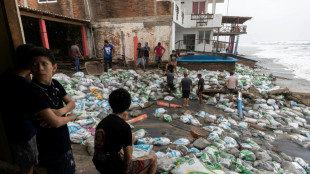 Hurricane Polo triggers huge waves in coastal Mexican city
Afghanistan's Taliban morality ministry pledged Monday to implement a law banning news media from publishing images of all living things, with journalists told the rule will be gradually enforced.
It comes after the Taliban government recently announced legislation formalising their strict interpretations of Islamic law that have been imposed since they swept to power in 2021.
"The law applies to all Afghanistan... and it will be implemented gradually," the spokesman for the Ministry for the Propagation of Virtue and the Prevention of Vice (PVPV) Saiful Islam Khyber told AFP, adding that officials would work to persuade people that images of living things are against Islamic law.
"Coercion has no place in the implementation of the law," he said.
"It's only advice, and convincing people these things are really contrary to sharia (law) and must be avoided."
The new law detailed several rules for news media, including banning the publication of images of all living things and ordering outlets not to mock or humiliate Islam, or contradict Islamic law.
Aspects of the new law have not yet been strictly enforced, including advise to the general public not to take or look at images of living things on phones and other devices.
Taliban officials continue to regularly post photos of people on social media and Afghan journalists have told AFP they received assurances from authorities after the law was announced that they would be able to continue their work.
The information ministry did not immediately respond to AFP's request for comment.
"Until now, regarding the articles of the law related to media, there are ongoing efforts in many provinces to implement it but that has not started in all provinces," Khyber said.
He added "work has started" in the southern Taliban stronghold of Kandahar and the neighbouring Helmand province, as well as northern Takhar.
Before the recent law was announced, Taliban officials in Kandahar were banned from taking photos and videos of living things but the rule did not include news media.
"Now it applies to everyone," Khyber said.
- Journalists summoned -
In central Ghazni province on Sunday, PVPV officials summoned local journalists and told them the morality police would start gradually implementing the law.
They advised visual journalists to take photos from further away and film fewer events "to get in the habit", a journalist who did not want to give his name for fear of reprisal told AFP.
Reporters in Maidan Wardak province were also told the rules would be implemented gradually in a similar meeting.
Television and pictures of living things were banned across the country under the previous Taliban rule from 1996 to 2001, but a similar edict has so far not been broadly imposed since their return to power.
Since 2021, however, officials have sporadically forced business owners to follow some censorship rules, such as crossing out the faces of men and women on adverts, covering the heads of shop mannequins with plastic bags, and blurring the eyes of fish pictured on restaurant menus.
When the Taliban authorities seized control of the country after a two-decade-long insurgency against foreign-backed governments, Afghanistan had 8,400 media employees.
Only 5,100 remain in the profession, according to media industry sources.
This figure includes 560 women, who have borne the brunt of restrictions the United Nations have called "gender apartheid", including being ordered to wear masks on television.
In Helmand, women's voices have been banned from television and radio.
Afghanistan has slipped from 122nd place to 178th out of 180 countries in a press freedom ranking compiled by Reporters Without Borders (RSF).
E.Paulino--PC