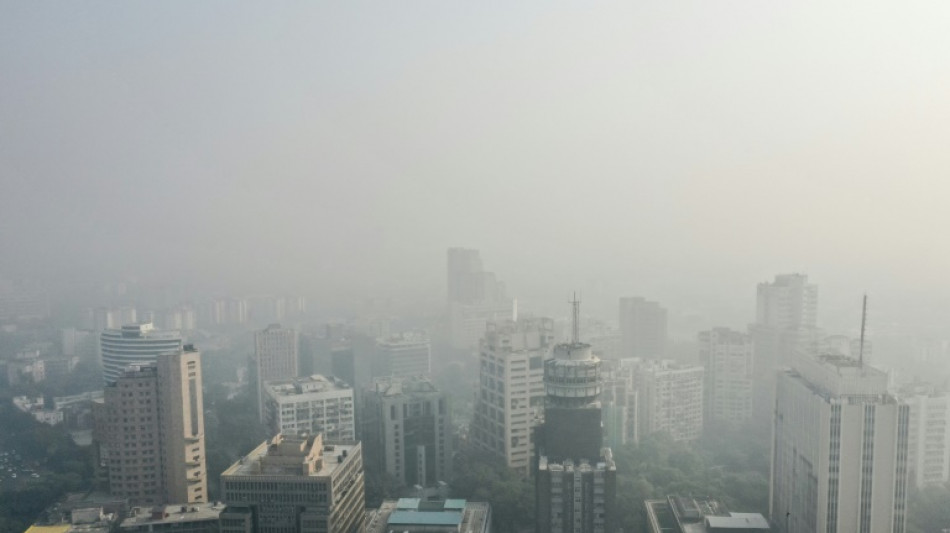
Indian capital chokes as 'hazardous' air pollution returns / Photo: Shubham KOUL - AFP

 Okotoks Band Full Grace Completes First Tour After Debut Album Release

 Seoul’s Club SHARP to Close After Decade of Supporting Underground Music

 Alavita Founder Anne Harles Outlines Organic Expansion Strategy

 Florida woman charged after deputies report finding cocaine and sales ledger

 Heat end Knicks’ NBA Cup defence with 108-105 victory

 Black Friday laptop promotions cover Apple, Lenovo, HP and gaming models

Acrid clouds engulfed India's capital on Wednesday as air pollution fuelled by fireworks and farm stubble burning was ranked "hazardous" by monitors for the first time this winter.
Commuters walking to work cough through poisonous smog that kills thousands each year, according to health experts, although few in the sprawling city wear masks.
The city's famous India Gate monument was wreathed in foul-smelling mist.
New Delhi is blanketed in acrid smog each year, primarily blamed on stubble burning by farmers in neighbouring regions to clear their fields for ploughing.
Air pollution is expected to worsen during the Hindu festival of lights, Diwali, which falls on November 1 this year when smoky fireworks spewing hazardous toxins are part of celebrations.
Levels of fine particulate matter -- cancer-causing microparticles known as PM2.5 pollutants that enter the bloodstream through the lungs -- surged to nearly 23 times the World Health Organization recommended daily maximum.
The pollutants topped 344 micrograms per cubic metre, according to monitoring firm IQAir on Wednesday, which listed air in the sprawling megacity of some 30 million people as "hazardous", ranking it as the world's worst.
New Delhi this month ordered a "complete ban" on all firecrackers -- both their manufacture and sale -- in view of the "public interest to curb high air pollution".
Previous restrictions were routinely ignored.
Police are often reluctant to act against violators, given the strong religious sentiments attached to the crackers by Hindu devotees.
Government efforts have so far failed to solve the country's air quality problem, and a study in the Lancet medical journal attributed 1.67 million premature deaths in 2019 to air pollution in the world's most populous country.
X.Matos--PC