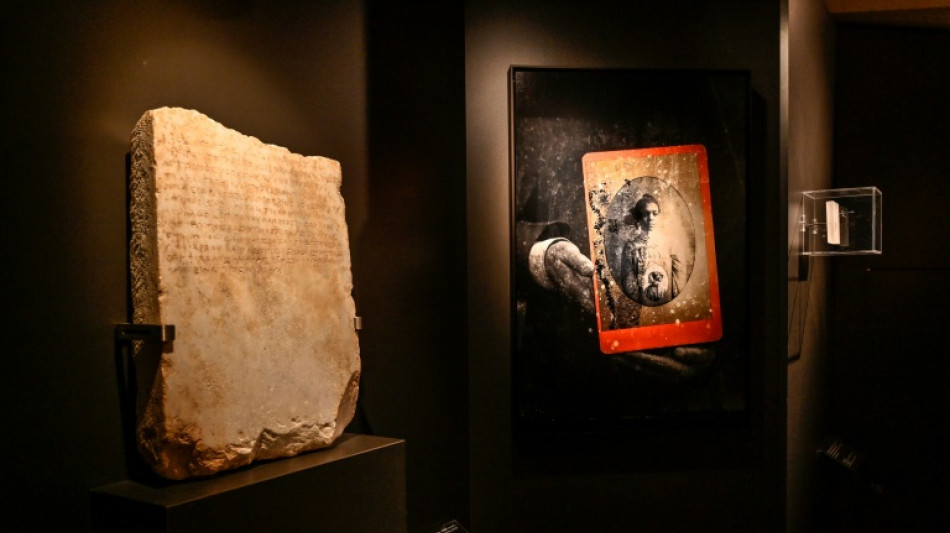
'Integral': New show reveals ancient Jewish roots in Greece / Photo: Louisa GOULIAMAKI - AFP

 Argentina to Return to World Rally Championship Calendar in 2028

 Newark Welfare Deficit Exceeds £140m Annually, Report Finds

 PUK Leader Declares Largest Political Crisis in Kurdistan Region History

 Digi Power X Reports Q3 2026 Revenue Up 85% and AI Revenue Up Over 400% Compared to Q2

 Ole Miss inquiry expands after video and monkey-noise allegations

 General Hospital actor Randall England dies at 75

 Boris Herrmann Claims Second Place in IMOCA Class at Route du Rhum

 Arlington sentinel rebukes Pete Hegseth entourage for laughter near memorial

 Kylie Jenner employee describes closet ordeal and pepper-spray incident

 Synchron Halts Clinical Trials of Second-Generation Brain Implant Due to Performance Issues

Little is known about the origins of Jews in Greece, but their presence dates back centuries and they were an "integral" part of ancient society, a new exhibit in Athens reveals.
The show is a treasure trove of ancient inscriptions unearthed during more than two decades of research by the Jewish Museum of Greece.
It is the first time that the Jewish presence in the country has been confirmed as early as the fourth century BC -- one of the oldest recorded religious and cultural settlements in Europe, according to the show's website.
Their existence proves the crucial role that Jews played in the social, religious, political and cultural life of ancient Greece, curators say.
"The Jewish community is an integral part of Greek identity, a fact that has been too often denied for centuries," Greece's chief rabbi Gabriel Negrin told AFP on Monday at the exhibition's inauguration.
"This history should be passed on to future generations in order to combat ignorance and prejudice".
- 'Vital' -
There are around 5,000 Jewish people living in Greece today, a small fraction of the Orthodox Christians who make up about 90 percent of the population.
An estimated 60,000 Greek Jews perished in the Holocaust -- around 83 percent of the pre-war community.
Anti-Semitism is deeply rooted in the country, existing even before World War II in Greece, though communities co-existed peacefully overall.
In Greece, anti-Semitic attitudes are linked to the powerful Orthodox Church, which has not officially absolved the Jews for the death of Jesus Christ.
A poll published last year by the Action and Protection League revealed that some 36 percent of Greeks surveyed have "negative feelings" towards Jews.
Close to 60 percent believed conspiracy theories about a "secret Jewish network that influences political and economic affairs".
Rabbi Negrin hopes the show will shed light on a little-known history -- one that is quickly fading as ageing Holocaust survivors around the world perish.
It's "vital", Negrin said.
- 'Inscriptions don't lie' -
The exhibition, which opened Tuesday, features a Greek inscription referring to Jews dated to between 300 and 250 BC.
The precious piece was discovered at the sanctuary of Amphiareion near Athens, and makes reference to a freed slave from Judea.
A total of 10 inscriptions are on display at the Jewish Museum, while another 29 are on display at the Epigraphical Museum, which is co-hosting the exhibition.
Curators say the show proves that Greek society was always multicultural, and not exclusively dominated by Greek Orthodox religion.
"Inscriptions do not lie," said archaeologist Eleni Zavou from the Epigraphical Museum.
Greek's ancient Jewish community, known as Romaniotes, settled mainly in the northwestern region of Epirus and the city of Ioannina.
They were followed by Sephardic Jews who arrived from Spain in the 15th century and mainly settled in Thessaloniki, which became known as "Jerusalem of the Balkans".
Until now, the earliest reference to Jewish synagogues was when the Apostle Paul visited Greece in the middle of the first century AD.
The exhibition's findings "demonstrate the political, artistic, religious and economic importance of Jewish communities" in ancient Greece, Zavou said.
The show, "Stone Paths -- Stories Set in Stone: Jewish Inscriptions in Greece", runs until February 2023.
J.Oliveira--PC