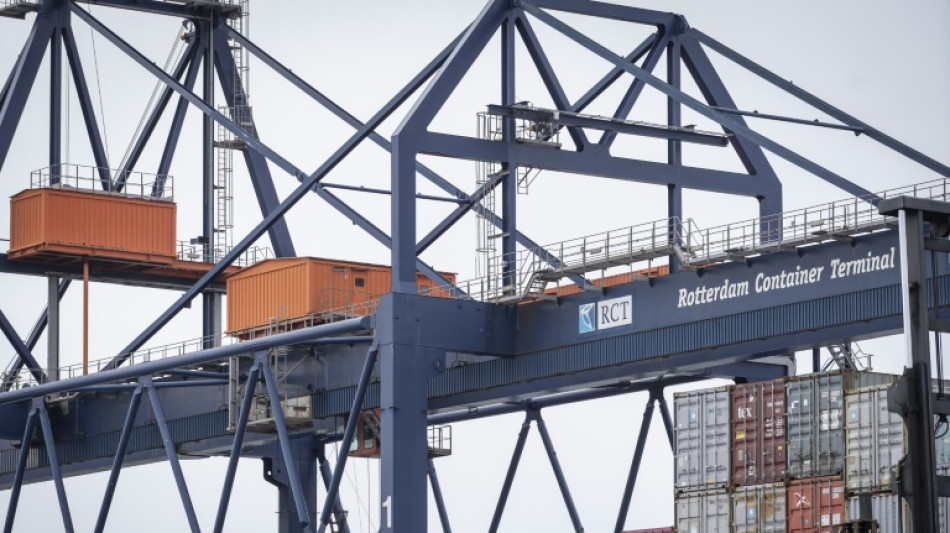
Cocaine seizures in Rotterdam down sharply / Photo: Simon Wohlfahrt - AFP

 Breytenbach confirms recommending Sibiya for Johannesburg post

 Celebrities mark Thanksgiving in turkey-themed photo gallery

 German fashion model Veruschka dies in Berlin at 87

 Thanksgiving storms disrupt thousands of US flights

 T.J. Lang criticises Aaron Rodgers over comments about Mike McCarthy

 Qatar Tourism and Uber Sign Five-Year Mobility Partnership

 U2 pays tribute to Dolly Parton during Thanksgiving Eve NFL show

 Rare yellow-bellied sea snake found on Southern California beach

 Second-generation Mini Cooper SE set for India launch with 402km range

 Filmasia 2026: 16 Films Across Prague, Brno, and České Budějovice

 Kojey Radical Launches Burger Collaboration at Dallas Burger Joint in Shoreditch

Europe's largest port Rotterdam saw a significant decrease in cocaine smuggled through its gates last year, Dutch law authorities said Thursday, citing increased security measures and stronger international cooperation.
Dutch customs and police said almost 26 tonnes of cocaine were seized last year, compared to 45.5 tonnes in 2023. Seizures in the southern harbour of Vlissingen however were up slightly from 11.3 tonnes to 12.6 tonnes.
The drugs had a total wholesale value of around 917 million euros ($954 million).
"For the third year in a row, fewer drugs were found in the Port of Rotterdam," said regional chief prosecutor Mariette Bode.
"Both in the Rotterdam and Vlissingen harbours, a lot of work is being done to stay one step ahead of criminal organisations," she told reporters in Rotterdam harbour, adding "this is a positive decrease".
The Dutch ports of Rotterdam and Vlissing, together with Antwerp in Belgium and Hamburg in Germany, are seen as some of the major gateways for narcotics entering Europe.
One of the measures taken was to curb the use of so-called "extractors" -- often teenagers used to retrieve cocaine shipments stashed in containers parked around the fast sprawling harbour.
"We reached a nadir in 2023 regarding these 'extractors', when 452 were arrested," Bode said.
"This year there was a significant decrease, with 266 arrests. Some 59 extractors were minors, the youngest aged 14," she said.
Increased security measures, including the use of drones, "have made the port far less attractive for these extractors", she said.
- 'Good cooperation' -
Rotterdam customs chief Peter van Buijtenen hailed international cooperation, especially with cocaine source countries in Latin America, as part of the reason numbers declined last year.
Although not the only reason, cooperation with countries including Colombia and Ecuador was a "very effective measure and substantially contributes" to bringing down numbers.
"Don't forget, a large amount of seizures here in the port is a result of good cooperation and information we receive," he told AFP.
Dutch customs already have a number of liasion officers in countries such as Brazil, Costa Rica, Panama and Suriname working with local law authorities.
Currently Dutch customs are also looking at placing a liaison in Peru.
But customs boss Van Buijtenen warned the significant drop in cocaine smuggling in Rotterdam also meant "that the harbour is being avoided" and that new smuggling methods were being used.
"There has been a significant increase in smaller amounts of illegal drugs through the Rotterdam harbour," chief prosecutor Bode added.
"One of the reasons could be that criminals are now spreading the risk," she said.
Customs and law officials last year discovered 189 drug hauls and conducted 80 criminal investigations.
Ports in neighbouring Belgium also announced a drop in cocaine seizures, which authorities there credited to better checks in source countries.
Belgium's customs agency said in early January it seized 44 tonnes of the drug in 2024, down from a record 116 tonnes the year before.
It was the first decline in seizures in more than a decade.
Dutch authorities in August 2023 intercepted more than eight tonnes of cocaine concealed in a banana shipment from Ecuador, one of the largest consignments to date.
Asked if he was content with the drop in cocaine smuggling figures, Van Buijtenen said: "As long as the cocaine trade exists, I will never be satisfied."
G.Teles--PC