Ex-judge fights Japan's 'unopenable door' retrial system / Photo: STR - JIJI Press/AFP

 Russia probes bear attacks, as official says town under 'siege'

 Robertson tells Spurs to 'forget' past woes
 Italy police find 3 million euros stashed in mobster's house

 Renard versus Queiroz in AFCON qualifying blockbuster
 Former Mexico boss Aguirre returns to Spain with Valencia
 China swimmer, 13, seals Games hat-trick as North Korea win first gold

 China's Xi heads to US for talks with Trump: state media

 Azerbaijan pardons Frenchman after EU lifts sanctions on oligarchs
 Hadjar extends Red Bull contract for 2027 F1 season
 Black Sea drone attacks spell terror for Turkish sailors

 Canada judge to decide prison term for suicide poison seller

 Weinstein faces resentencing in New York for 2006 sex assault

 Outgoing UN chief makes climate push at New York summit
 AI risks, Iran war to take center stage at UN

 Badminton no.1 An tells dad to keep it down at Asian Games
 Runaway leader Antonelli eyeing third straight win

 Schoolgirl Yu, 13, fastest again in bid for third Asian Games gold

 Oil prices fall after Trump hails 'good' talks with Iran

 AI political ads warp reality ahead of US midterms

 Kenneth Branagh embraces action hero role -- to get in shape

 'New one' Klopp promises fresh approach as Germany reign begins

 Milne returns to New Zealand squad for India T20 series

 Voting opens in Alaska's annual Fat Bear Week

 MLS coach axed for telling female ref 'It's a man's game'

 US refuses to give Sudan's de facto leader visa for UN
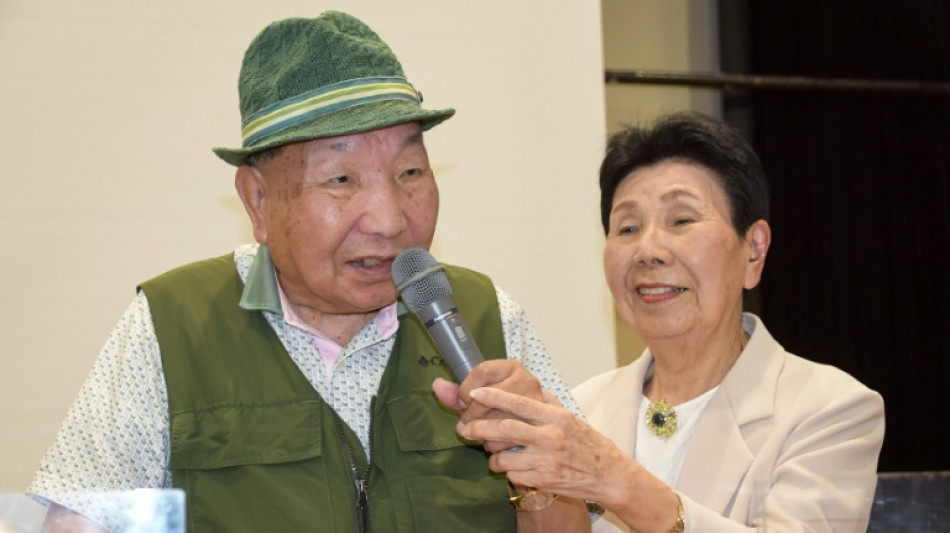
The world's longest-serving death row prisoner, Iwao Hakamada, won compensation from Japan this week after almost five decades in jail -- and he owes his freedom to a judge with steely determination.
The former boxer, now 89, was exonerated last year of a 1966 quadruple murder after a tireless campaign by his sister and others.
But he might still be behind bars if not for Hiroaki Murayama, the judge who in 2014 dared do something extremely rare in Japan's often intractable legal system: he ordered a retrial.
Prosecutors appealed the order andit took nine years for the retrial to open, something which Murayama partly blames himself for after not writing a "more airtight ruling".
But mostly it's because the system is haphazard, outdated and out of step with international standards, the 68-year-old now retired judge said.
"Retrial is supposed to be the last possible measure to save the wrongfully incarcerated, but the system is not functioning as it should," Murayama told AFP in an interview last month.
Lawyers first called for a retrial in 1981: it would take 42 years for that process to actually start.
This week the court that acquitted Hakamada in the retrial -- where it said police had tampered with evidence and carried out "inhumane interrogations" meant to force a confession -- awarded him $1.4 million for his wrongful detention between 1966 and 2014.
However, after decades in solitary confinement, he is now "living in a world of fantasy," his supporters say.
Softly-spoken Murayama, who ordered the retrial but was not involved in the acquittal or compensation order, was stung by the experience and wants change.
"I was once part of that system. And now that I learned what it's really like, it's my responsibility to fix it," he said.
"There can be no more Hakamadas".
- 'Disparities' -
The former judge's experience with one of the worst miscarriages of justice in post-war Japan has made him reflect on the death penalty itself.
Japan's retrial process was shaped a century ago and has since been left nearly untouched.
Critics label it the "Unopenable Door".
Just one percent of around 1,150 retrial applications from all convicts, processed in Japan between 2017 and 2021, won approval.
The justice minister is set this week to ask legal experts to scrutinise the system for possible revisions, but the process could take years.
Factors behind its slowness include the prosecution's power to appeal retrial orders, and some judges failing to push for new, exculpatory evidence.
This, Murayama says, creates "disparities" among applications, with progress dependent on the "work ethics" of each judge.
"Many judges prioritise efficiently solving ongoing criminal cases, because that's often a barometer of their competence", Murayama said.
"Does working hard on retrial applications help judges earn a good reputation? I'm not sure."
- 'Dependent on chance' -
Murayama said he had made it his "team's biggest priority to speed up deliberations" on Hakamada's case.
Decades of detention -- with the threat of execution constantly looming -- took a major toll on Hakamada's mental health.
Murayama said he had been "worried sick" that Hakamada might die while the legal process dragged out.
So he dived into reams of records and chivvied prosecutors.
"It's extremely unlikely that prosecutors give away evidence voluntarily", he said. "You really have to push them."
In the hands of another judge with less initiative, Hakamada's fortune might have turned out differently.
A system "so dependent on chance or luck, isn't a system at all," Murayama said.
Japan and the United States are the only major industrialised democracies with capital punishment, which has broad support from the Japanese public.
Murayama in 2011 sentenced Tomohiro Kato to death for the murder of seven people in a rampage in Tokyo in 2008.
He was hanged in 2022.
"I'm not the one who actually killed him, but I ordered his death nonetheless", Murayama said, adding that he "couldn't sleep for three days" after his hanging.
Murayama said it was a "gut-wrenching decision", but concedes that hanging would remain his only realistic option for Kato were he still a judge -- unless he can argue capital punishment itself is unconstitutional.
"The death penalty involves the state power murdering a defenceless human being. Should we really accept that as a society?", the judge-turned-lawyer said.
Hakamada was post-war Japan's fifth wrongfully convicted death-row inmate who avoided death through a retrial.
"Had they been executed, that would've been an irrevocable catastrophe," Murayama said.
"And don't you dare say it's been just four or five people. Not even one person should suffer this."
Ferreira--PC