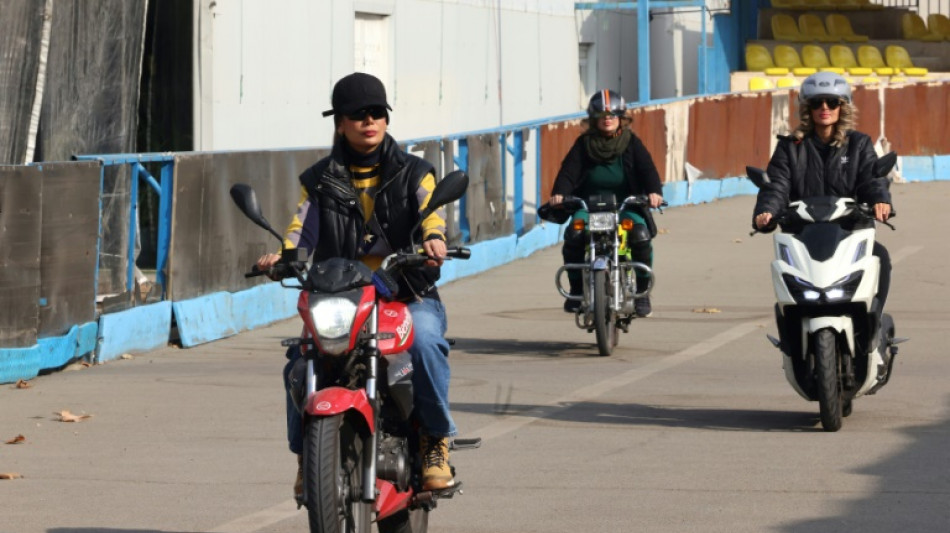
Iran's women bikers take the road despite legal, social obstacles / Photo: ATTA KENARE - AFP

 US judge weighing Trump's White House ban on media outlets
 At UN, OpenAI's Altman calls 'for extreme care' in AI
 Hamilton gives thumbs up to Gulf GPs despite Iran conflict
 Leclerc admits going 'too far' in Hamilton shunt in Italy
 Row engulfs Dolly Parton's estate as manager accuses nephew of making threats
 Mandela Digital Extends Early Access Programme to 11 February 2027 Following Strong Response

 US seeks 11th Presidents Cup win in a row over global foes

 McDonald's to boost franchisees as inflation weighs on consumers
 Trump invites Putin to G20 summit in Miami
 Archaelogical 'breakthrough' could confirm origins of Paris

 ILO financial crisis takes centre stage in leadership race
 Stocks dip, oil soars despite Trump hailing "productive" Iran talks
 China's Xi to get rare airport welcome from Trump
 Turkey reassures investors over investment fund crisis
 Saka says England still have 'scar' from World Cup semi-final loss
 アレックス・ボディ氏とシュテファン・ハウプト教授、ルーマニアの伝説的な美術コレクションをめぐり提携に合意

 亞歷克斯·博迪與史蒂芬·豪普特教授就羅馬尼亞傳奇藝術收藏達成合作協議
 Алекс Боди и проф. д-р Стефан Хаупт договорились о сотрудничестве в рамках легендарной коллекции произведений искусства в Румынии
 French foreign minister says Palestinians 'must' hold polls
 Fresh Russian strikes on Ukraine's infrastructure kill seven

 Eriksen to return to Denmark after parting ways with Wolfsburg

 Brad Pitt says working with dog co-star was 'really moving'

 Golan will remain Syrian, vows President al-Sharaa at UN

 Blueberry Strengthens MENA Presence with CMA Category 5 License and Dubai Office Launch
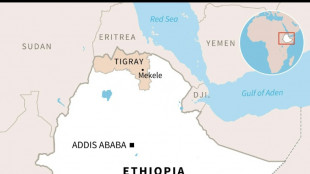
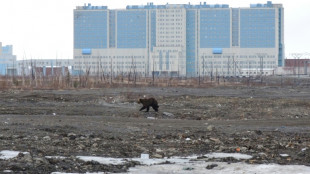 Russia probes bear attacks, as official says town under 'siege'

When she first started learning to ride a motorbike, Iranian Maryam Ghelich, now an instructor, would drive through Tehran's empty streets at night to avoid scrutiny over her clothing or lack of a licence.
Fifteen years on, Ghelich has trained hundreds of women, helping them navigate not only the capital's gridlocked streets but the barriers facing women motorcyclists in the conservative Islamic republic, with a marked surge in demand for lessons in recent months.
"This sport was one of my passions, and in Iran it had long been taken for granted that motorcycling was only for men," she told AFP at a training centre in northern Tehran.
On streets and at intersections across Iran, women on mopeds and motorbikes wearing colourful helmets have become an increasingly common sight, signalling a subtle but noticeable shift in social attitudes over a matter of months.
"I tried to prove that women can also have successful participation in this field," said 49-year-old Ghelich, a long-time member of Iran's Motorcycling and Automobile Federation.
Ghelich, who is a certified instructor with the federation, explained how she had watched the change unfold in real time after spending more than a decade as one of only a handful of women riders.
"People's perspectives in our society have really changed. It wasn't accepted at all before," she said, explaining there has been a sharp rise in women enrolling in her courses in recent months, whether for city riding or for racing.
"When I see the women we trained out riding on the streets, I really enjoy seeing that families are now accepting it," she added.
- Licensing issue -
Despite the progress, motorbike and scooter licensing for women remains a major hurdle in Iran and a legally grey area.
While traffic laws do not explicitly ban women from riding, authorities have never issued motorcycle licences to them in practice, with the issue gaining urgency with the noticeable rise in women riding.
Niloufar, a 43-year-old fashion designer who asked only to be identified by her first name and who recently joined Ghelich's city-riding course, said the lack of licences is of serious concern.
"Even if a woman rides very professionally, without a licence she will legally be blamed if she has an accident, even if she's the victim," she said.
Publicly, authorities have maintained that women can ride motorcycles. Government spokeswoman Fatemeh Mohajerani said there is "no legal prohibition".
And in September, the head of Iran's traffic police, Teymour Hosseini, said his officers did not have authorisation to give their own interpretation to the law on religious or any other grounds.
"The police enforce the law... whatever is issued, we are obliged to implement," he added.
But others have continued to refer to the Islamic republic's strict dress code, in place since shortly after the 1979 revolution and requiring women to wear loose clothing and cover their head and neck, as a block to women riding motorcycles.
"Some ride motorcycles with no hijab, improper hijab, or poor covering... such behaviour is against Sharia law," said Abdolhossein Khosropanah of the Supreme Council of the Cultural Revolution, a state body overseeing Islamic cultural and educational policy.
Ultraconservative lawmaker Mohammed Seraj has argued: "Women riding motorcycles is improper and not compatible with the society's culture."
- 'No reason to object' -
Ghelich said clothing restrictions have long posed challenges for women riders.
She recalled races years ago when women participants were required to wear "long overalls" over their leather suits -- a rule that she said "really restricted" riding.
But conditions for riding have eased over time, she said, and that even when police "seize motorcycles now, they let people go more easily, they give it back faster".
Women in Iran have more broadly pushed against social boundaries in recent years, increasingly defying the Islamic republic's strict rules, including the mandatory dress code.
The trend has accelerated after the September 2022 death in custody of Mahsa Amini, arrested for allegedly violating hijab rules.
Mona Nasehi, a 33-year-old beauty salon owner who began riding this year, said police once attempted to stop her -- possibly because she was riding alone -- but she was too afraid to pull over.
"I had heard from friends that police usually don't mistreat women riders, but we all still have that fear that they might insult us or take our bike," she said.
Nayereh Chitsazian, 53, who bought her motorbike last week, said that while her licence is the missing piece, all her other documentation is in place.
"The police have no reason to object," she said.
"The motorcycles are registered, insured, so there's no reason for them to stop us."
S.Pimentel--PC