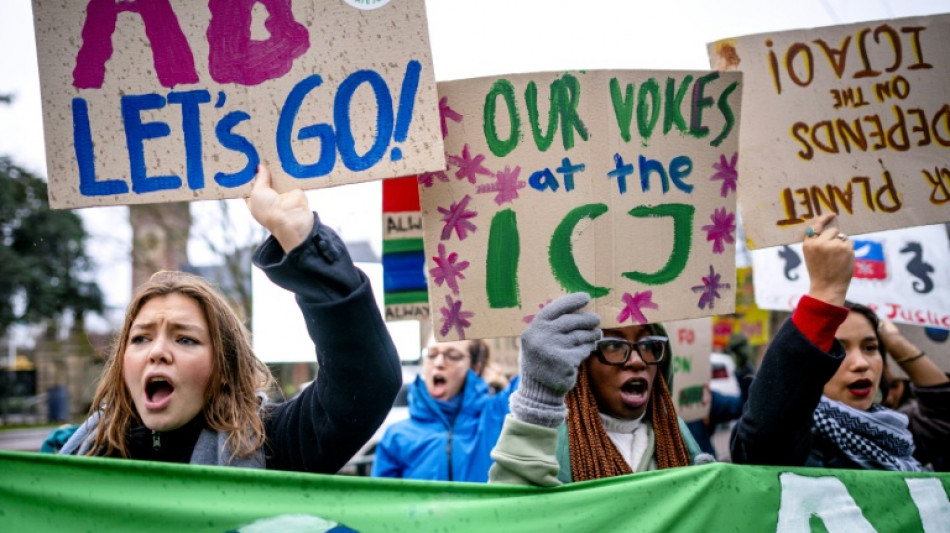
ICJ to hand down watershed climate opinion / Photo: Lina Selg - ANP/AFP

 Marchand 'stressed' about racing Japanese rivals at LA Olympics

 Mobile boat clinics bring healthcare to India's remote islands
 Former India paceman Zaheer Khan named Chennai coach in IPL

 Six-year-old Chinese girl sets world record with Rubik's Cube
 Swimming prodigy Yu, 13, says 'interviews way harder than racing'

 Star coaches make their bows as Nations League returns
 Rams bounce back as Giants reel from Dart injury

 In Bangladesh, Pakistan's Jinnah photo stirs anger

 Two New Zealand naval ships transit Taiwan Strait

 Zidane gets down to work as France start new era

 Inside the Venezuelan prison meant to 'drive you insane'
 UK king braces as memoir by Diana's brother goes on sale

 Akkodis and Hamburg Public Transport Association Showcase hvv mia at InnoTrans 2026, Demonstrating the Future of AI-Powered Mobility

 Macron says talks with Trump on Red Sea, Ukraine 'constructive'

 Green policies just good politics, says UK minister
 Bardot auction in Paris fetches nearly one million euros
 No timeline on Daniels injury return, says Commanders coach

 British Columbia sues OpenAI in US court over Canada school shooting

 French star Batum retires after 18-year NBA career

 Zidane leads first France training session
 Man shot by ICE agent in Texas detained with bullet inside him: lawyer
 California declares state of emergency ahead of El Nino

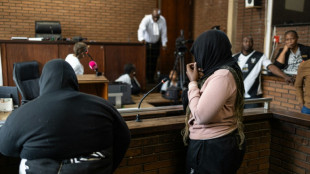 South Africa arrests three more suspects, after nine women murdered

 Carse needs time away from England, says captain Brook

 NOWPayments Releases Cross-Chain Payout Data Revealing Key Performance Benchmarks Across TRON, BNB Chain, and Solana

The world's top court will Wednesday deliver a seminal ruling laying out what legal obligations countries have to prevent climate change and whether polluters should pay up for the consequences.
It is the biggest case ever heard at the International Court of Justice and experts say judges' opinion could reshape climate justice forever, with major impacts on laws around the world.
The ICJ advisory opinion is "potentially one of the most consequential legal rulings of our times," said Joie Chowdhury, Senior Attorney at the Center for International Environmental Law, an advocacy group that backs the case.
It could "define a new era, where climate justice is not a distant aspiration, but a global mandate for the here and now," added Chowdhury.
The United Nations has tasked the 15 ICJ judges to answer two fundamental questions that, according to Chowdhury, "strike at the heart of climate justice."
First: what must states do under international law to protect the environment from greenhouse gas emissions "for present and future generations"?
Second: what are the consequences for states whose emissions have caused environmental harm, especially to vulnerable low-lying island states?
To help answer these questions, ICJ judges have pored over tens of thousands of pages of submissions from countries and organisations around the world.
Analysts say Wednesday's ruling is the most consequential of a string of recent rulings on climate change in international law.
Courts have become a battleground for climate action as frustration has grown over sluggish progress toward curbing planet-warming pollution from fossil fuels.
The Paris Agreement struck through the UN Framework Convention on Climate Change (UNFCCC) has rallied a global response to the crisis, but not at the speed necessary to protect the world from dangerous overheating.
- 'Disappear beneath the waves' -
In December, the iconic Peace Palace in the Hague hosted the court's biggest-ever hearings, with more than 100 nations and groups giving oral statements.
In what was billed a "David Vs Goliath" battle, the debate pitted major wealthy economies against smaller, less developed states most at the mercy of a warming planet.
Major polluters including the US and India warned the ICJ not to deliver a fresh legal blueprint for climate change, arguing the existing UNFCCC sufficed.
The US, which has since withdrawn from the Paris accord, said the UNFCCC contained legal provisions on climate change and urged the court to uphold this regime.
But smaller states said this framework was inadequate to mitigate climate change's devastating effects and that the ICJ's opinion should be broader.
These states also urged the ICJ to impose reparations on historic polluters.
"The cardinal principle is crystal clear. Responsible states are required to make full reparation for the injury they have caused," said Margaretha Wewerinke-Singh representing Vanuatu.
These states demanded a commitment and timeline to phasing out fossil fuels, monetary compensation when appropriate, and an acknowledgement of past wrongs.
Representatives from island states, many wearing traditional dress as they addressed the court for the first time in their country's history, made passionate pleas to the robed judges.
"Despite producing less than 0.01 percent of greenhouse gas emissions, on the current trajectory of GHG emissions, Tuvalu will disappear completely beneath the waves that have been lapping our shores for millennia," said Eselealofa Apinelu from Tuvalu.
The ICJ's advisory opinions are not binding upon states and critics say that top polluters will simply ignore what comes out of the court.
But others note the moral and legal clout enjoyed by the world's highest court and hope the opinion will make a tangible difference to national climate change policies.
"The impacts of climate change, absolutely dire right now, will become catastrophic as the years go by, if we do not course-correct," said Vishal Prasad, director of a campaign by Pacific Island students that pushed the issue before the court.
"The urgency of the matter, the seriousness of why we're here, and how important this is, is not lost upon all Pacific Islanders, all small island countries.
"That's why we're looking to the ICJ."
J.V.Jacinto--PC