Prosecution did not prove case in Canada hockey sex assault trial: judge / Photo: Peter POWER - AFP

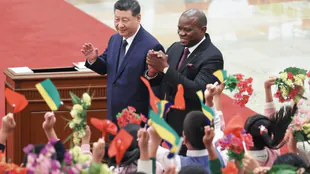 China and Gabon Elevate Ties to 'Shared Future' Amid State Visit

 World Golf Awards 2026 to be Hosted at Egypt’s Madinaty Golf Club

 12 Billion Gallons of Raw Sewage Discharged into Chicago River Despite Deep Tunnel Infrastructure

 Edmund Richardson Wins Baillie Gifford Prize for 'Alexander' Biography

 BYD Drops Rotating Screens in New Models Due to Tech Limits
Prosecutors did not prove that five Canadian professional hockey players committed sexual assault, a judge found Thursday, ruling that evidence provided by the female complainant was neither "credible or reliable."
The accused -- who all previously played in the National Hockey League -- stood trial over allegations they assaulted the woman in a hotel room following a June 2018 celebration for a national men's junior team.
Michael McLeod, Alex Formenton, Dillon Dube, Carter Hart and Callan Foote denied wrongdoing, insisting the accuser -- whose identity is protected -- consented to a variety of sex acts in a London, Ontario hotel room.
"Having found that I cannot rely upon the evidence of (the complainant) and then considering the evidence in this trial as a whole, I conclude that the crown cannot meet its onus as on any of the counts before me," Superior Court Justice Maria Carroccia told a packed court room.
"I do not find the evidence of EM to be either credible or reliable," the judge further said.
The complainant, 20 at the time, met McLeod at a bar in London before having sex with him.
That initial encounter was not at issue in the trial, which focused on events that occurred after McLeod messaged a team-wide group chat asking if anyone was interested in a "three-way."
Prosecutors argued the players engaged in sex acts with the complainant without taking steps to ensure her consent.
Defense lawyers said the woman willingly participated and only made the assault allegations after regretting her choices.
Criminal trials in Canada are often decided by a jury, but the case shifted to a judge-only trial after two juries were dismissed.
An initial police investigation into the allegations produced no charges.
But subsequent media probes revealed Hockey Canada, a governing body, used funds from subscription fees paid by ordinary families for a $3.55 million CAD ($2.6 million USD) out-of-court settlement with the woman, forcing the resignation of Hockey Canada's leadership.
London police re-opened the case, and brought charges against the players last year.
The case, which focused on the evolving definition of consent under the law has been one of the most closely-watched in recent Canadian history and sparked debate about culture in hockey, the cherished national sport.
S.Caetano--PC