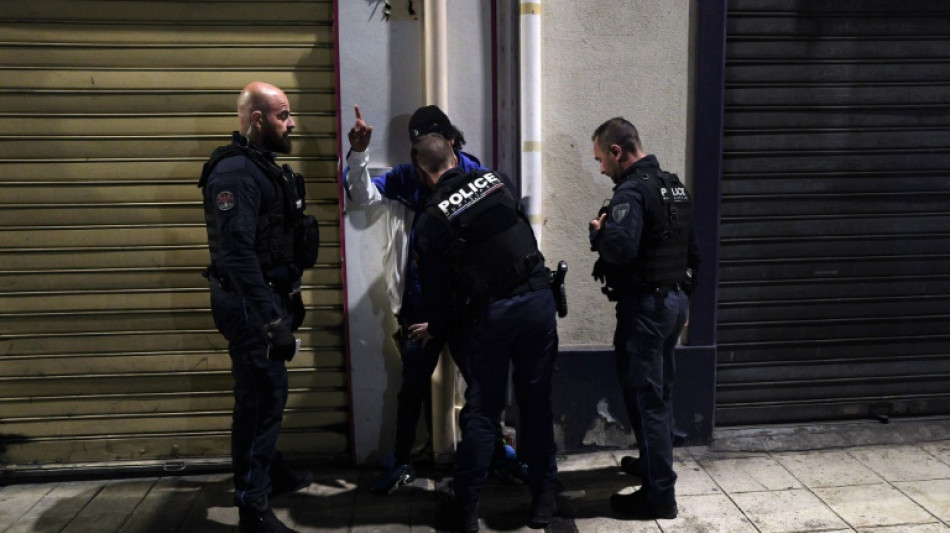
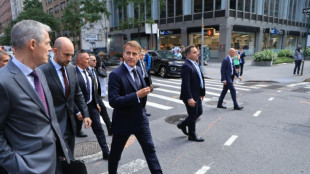
French cities impose curfews for teens to curb crime / Photo: Valery HACHE - AFP

 Typhoon Dujuan leaves four dead in Japan, 45,000 houses without power

 G7 leaders condemn Houthi strikes on Saudi Arabia

 Google data centre sparks protests in Austria

 Shin Ohashi: Junk food-loving teen and Japan's next big swimming hope

 Stocks rise on AI buzz, drop in oil prices

 China's robot dancers limber up for America's Got Talent final

 Despite military might, Saudi struggles to crush the Houthis
 Trump to tout deals, defend Iran war in UN speech
 Sri Lanka to issue verdict in landmark Easter attack trial

 No green light to lift EU sanctions on Russian oligarchs, talks to resume
 UK agrees support for Saudi in struggle with Houthis: reports

 EU foreign policy chief calls for continued sanctions on Russia

 Flights scrapped, evacuations urged as Typhoon Dujuan wallops Japan

 Fonseca to take break from tennis
 A Cuban zoo, and its animals, in epic battle for survival

 Infantino proposes consulting federations to reform FIFA

 El Nino weather pattern enters record territory: scientist
 OpenAI calls for US to lead global effort on AI standards
 South African ostriches plucked alive for luxury fashion: report
 US networks halt Trump coverage in revolt over White House ban

 Paramount settles with US states to clear Warner Bros. mega-merger

 Climate crisis a job for world leaders, not just activists: UK FM

 US networks halt Trump coverage over White House ban
 French singer accuses Miley Cyrus of plagiarism

 EU fines Google 403 mn euros for location data breach

Several French cities have this summer introduced a curfew for teenagers in a bid to curb youth violence, but even some mayors are not sure if the ban should be enforced.
While some experts say that curfews for minors do not reduce crime, one French mayor begs to disagree.
"It's become very quiet," said Cedric Aoun, the mayor of Triel-sur-Seine located 35 kilometres (21 miles) west of Paris.
The 11 pm to 5 am curfew has been introduced in Triel-sur-Seine for under-18s after a series of incidents involving damage of public property and theft.
Aoun said many families have started taking their parental responsibilities more seriously.
"Parents are much more careful," he said.
More towns in France are enforcing curfews for teenagers irrespective of their mayors' political leanings as authorities seek to respond to youth crime.
In the southern city of Nimes, a temporary curfew has been introduced for children under 16 after a spate of urban violence linked to drug trafficking.
The southern city of Beziers, Saint-Ouen-sur-Seine north of Paris and Villecresnes in the southeastern suburbs of the French capital have adopted similar bans.
Last year, six percent of crimes were suspected to have been carried out by teens aged between 13 to 17, according to the interior ministry. More than a third of violent robberies without a weapon were attributed to suspects in that age group.
- 'No business on the street' -
But it is difficult to assess the effectiveness of the curfews for minors in many places.
During a recent nighttime patrol in Triel-sur-Seine, police officers stopped a group of minors who huddled together in a square 45 minutes after the start of the curfew.
Some teenagers said they were unaware of the ban.
Still, the head of the town's municipal police praised the measure.
Anthony Rouet said the curfew "allows us to take preventive action before damage is done".
So far his team had mostly been talking to teens about the night-time ban on being in the streets, not issuing them with tickets, he added.
But he also acknowledged that, when police did report some teenagers to the judiciary, this had not deterred them from reoffending.
"They weren't punished and came back and started vandalising and stealing again," said Rouet.
Some parents support the ban.
"At 17, you have no business being out on the street" at night, said Mickael Chapparelli, 35.
But many think otherwise, another resident said.
"Here, parents of most of the children who hang around until 2 am say it's no problem," said the resident, speaking to AFP on condition of anonymity.
"And when they get into trouble, they say it's not their son."
The mayor of Villecresnes, Patrick Farcy, lamented police staffing shortages.
They do not respond to calls late at night except during the weekends, and street lighting is turned off in some areas to limit gatherings.
He said authorities had reported around 40 violations of the curfew since the beginning of the summer, but not all parents had received the related fines.
"Too much time passes between the offence being reported and the fine being issued," Farcy said.
- 'Psychological' -
The mayor of Pennes-Mirabeau outside the southern port city of Marseille said the effectiveness of the curfew was hard to estimate.
Last year, he temporarily ordered children under 13 off the streets between 11 pm and 6 am, but has not reintroduced the ban this year.
The mayor, Michel Amiel, said the effectiveness of the ban was "difficult to quantify."
"It is mainly psychological," he added.
Rights campaigners argue for more community engagement rather than bans.
Nathalie Tehio, head of the French Human Rights League, called for the development of "educational measures" rather than "repressive" bans.
Her group has taken legal action against the ban in Triel-sur-Seine.
"This is not an effective response," she said.
elt-jra-vxm-bdq-as/ah/ach
A.Santos--PC