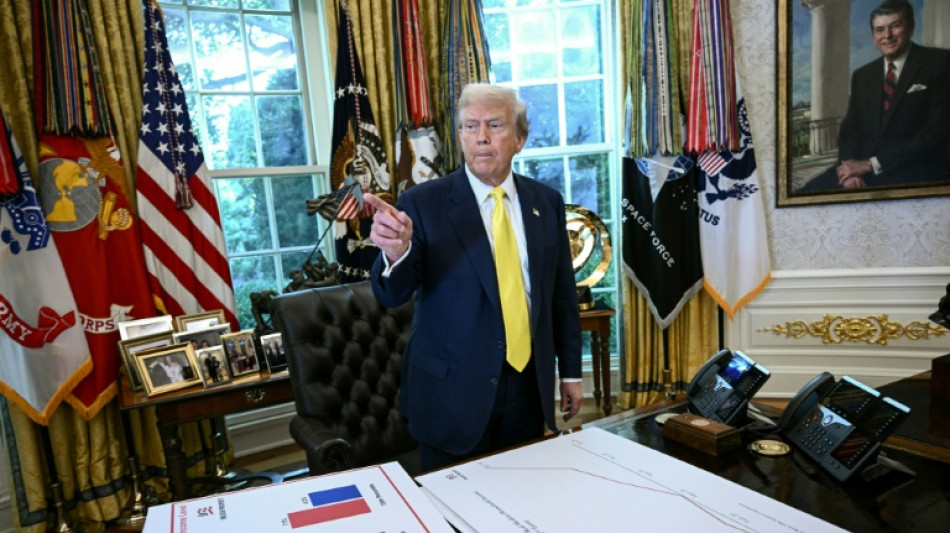
Trump says court halt of tariffs would cause 'Great Depression' / Photo: Brendan SMIALOWSKI - AFP

 Typhoon Dujuan leaves four dead in Japan, 45,000 houses without power

 G7 leaders condemn Houthi strikes on Saudi Arabia

 Google data centre sparks protests in Austria

 Shin Ohashi: Junk food-loving teen and Japan's next big swimming hope

 Stocks rise on AI buzz, drop in oil prices

 China's robot dancers limber up for America's Got Talent final

 Despite military might, Saudi struggles to crush the Houthis
 Trump to tout deals, defend Iran war in UN speech
 Sri Lanka to issue verdict in landmark Easter attack trial
 No green light to lift EU sanctions on Russian oligarchs, talks to resume

 UK agrees support for Saudi in struggle with Houthis: reports

 EU foreign policy chief calls for continued sanctions on Russia

 Flights scrapped, evacuations urged as Typhoon Dujuan wallops Japan

 Fonseca to take break from tennis

 A Cuban zoo, and its animals, in epic battle for survival

 Infantino proposes consulting federations to reform FIFA

 El Nino weather pattern enters record territory: scientist

 OpenAI calls for US to lead global effort on AI standards

 South African ostriches plucked alive for luxury fashion: report

 US networks halt Trump coverage in revolt over White House ban

 Paramount settles with US states to clear Warner Bros. mega-merger
 Climate crisis a job for world leaders, not just activists: UK FM

 US networks halt Trump coverage over White House ban
 French singer accuses Miley Cyrus of plagiarism

 EU fines Google 403 mn euros for location data breach

US President Donald Trump warned Friday of cataclysmic consequences on the US economy if a court rules that his imposition of sweeping tariffs constitutes an illegal power grab.
If a "Radical Left Court" strikes down the tariffs, "it would be impossible to ever recover, or pay back, these massive sums of money and honor," he wrote on his Truth Social platform.
"It would be 1929 all over again, a GREAT DEPRESSION!" he said.
Trump's hyperbolic statements come as a US appeals court weighs the legality of his broad use of emergency powers to enact sweeping tariffs on trading partners.
A lower court ruled against Trump in May, but the US Court of Appeals for the Federal Circuit put the ruling on hold as it considers the case.
Trump on Friday touted billions of dollars in tariff revenue "pouring" into the Treasury -- paid by US importers -- and recent stock market records, as proof his levies had created "the largest amount of money, wealth creation and influence the U.S.A. has ever seen."
Many economists meanwhile worry the tariffs are stoking inflation and see trade policy uncertainty as slowing investment.
Since returning to the White House in January, Trump has announced a slew of new tariffs, seeking to force a reordering of global trade that he has long claimed is biased against the United States.
In addition to sweeping tariffs invoked under declarations of economic emergencies, he has also instituted sectoral tariffs of between 25 percent and 50 percent on steel and other items.
Those levies have generally followed government investigations and are not at issue in the pending litigation.
At a July 31 hearing, members of the appeals court appeared skeptical of the Trump administration's arguments that it had broad discretion to declare national economic emergencies and invoke tariffs as a remedy.
To invoke his so-called "reciprocal" tariffs on many US trade partners, Trump declared a national emergency over "large and persistent annual US goods trade deficits."
Opponents to the White House policy have argued that such a reason does not qualify under the law Trump has cited for the tariffs, the International Emergency Economic Powers Act.
They also argue that levying blanket tariffs on imports requires the consent of Congress under the US Constitution.
The case is likely to end up in the Supreme Court, where conservatives enjoy a 6-3 majority, though analysts say the outcome is uncertain.
J.Oliveira--PC