One man, his dog, and ChatGPT: Australia's AI vaccine saga / Photo: SEBASTIEN BOZON - AFP

 Germans vote in elections threatening fresh blow to Merz

 US fears rapid escalation in Mideast after Houthis attack Riyadh

 Japan triathlete Hojo wins first gold of Asian Games

 IOC president impressed by 'beautiful' Asian Games wooden huts

 First Asian Games gold goes to Japan as China's 13-year-old Yu lights up pool

 Data centre command hub keeps AI up and running

 Pope Leo in France: the issues on the table

 Packing for a pope: behind the scenes on foreign trips

 Republicans find transgender issues a powerful political weapon in midterm campaigning

 German state elections threaten new shock waves for Merz

 Chile's Bachelet quits race to be next UN chief

 Raphinha treble fires perfect Barca to win at Sevilla

 Thiam makes winning heptathlon return at Decastar meet

 Czechs beat USA to qualify for Davis Cup finals

 Dortmund sink Stuttgart to climb to Bundesliga summit

 Trump says will not tolerate attempts to slow AI growth

 'It has to stop': runners protest women's murders in S.Africa district

 Fire erupts near Riyadh airport as Houthis claim strikes

 Cuba works to restore power after another blackout

 England thrash Sri Lanka again to return to top of T20 rankings

 Arsenal thrashed by Brighton, sorry Spurs lose again
 South Korea, Austria qualify for Davis Cup finals
 Seare shocks Ingebrigtsen to win world 5km gold

 Brigitte Bardot widower slams sale of star's belongings

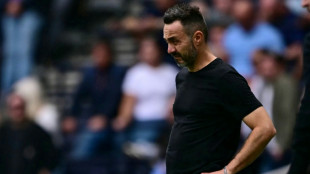 Aston Villa compound Tottenham's misery despite late rally

Desperate to help his sick dog, one Australian man went down the ultimate ChatGPT research hole, using artificial intelligence to design a personalised experimental treatment and finding top scientists to administer it.
Paul Conyngham's months-long quest to fight his rescue mutt Rosie's cancer has grabbed the attention of OpenAI boss Sam Altman, who called it an "amazing story" in an X post on Friday.
Sydney-based AI consultant Conyngham told AFP that eight-year-old Rosie's mast cell cancer is now in partial remission and her biggest tumour has shrunk dramatically.
"She regained a lot of mobility and function" after receiving a custom mRNA vaccine along with powerful immunotherapy in December, he said.
Conyngham does not call his findings a cure -- but experts unrelated to the dogged endeavours said they highlight AI's potential to accelerate medical research.
"I would have conversations and just keep them going non-stop" with ChatGPT, Gemini and Grok to study cancer therapies in-depth, Conyngham said.
Following the chatbots' advice, he paid $3,000 to have Rosie's genome sequenced, and used the same online tools to analyse her DNA data.
Next he turned to AlphaFold, a scientific AI model that won 2024's chemistry Nobel, to better understand one of the mutated doggy genes.
Conyngham sought the help of a University of New South Wales (UNSW) team -- also thanks to a ChatGPT recommendation -- and other academics in Australia who made his research a reality.
- 'Just a rash' -
Rosie's cancer was misdiagnosed for nearly a year, Conyngham said on the phone during one of the long daily walks the pair have resumed.
"I took her to the vet three times. And two times, the vet said, don't worry about it, it's just a rash," he said.
But Rosie got sicker and a biopsy showed in 2024 that she did have terminal cancer.
Having tried chemotherapy, standard immunotherapy and surgery, costs were mounting and Conyngham wanted more options.
So he used AI to delve deep into the world of emerging treatments including mRNA vaccines, which train the body's immune system and were widely used during the Covid pandemic.
"This was not a clinical trial by any means" and "it's not that AI cured cancer", said UNSW professor Martin Smith, who sequenced Rosie's genome for Paul.
"It was really driven by his determination to help his dog."
The combination of "three different disruptive technologies: genome sequencing, artificial intelligence, and RNA therapeutics... offers new possibilities and challenges", Smith said.
- AI promise -
Chatbots also assisted Conyngham in navigating the reams of paperwork for ethical approval.
And through his new scientific network, he met a professor at the University of Queensland able to administer the fine-tuned treatment.
Not all the tumours responded as well as the largest one, however. Rosie has had to have another operation since, and it's unclear how long she has left to live.
The "short answer is we don't know for sure" what actually led to the reduction in size of Rosie's biggest tumour, said Pall Thordarson, director of UNSW's RNA institute which created the vaccine.
"He used the AI program... to design the actual mRNA sequence. And then he gave that information to us," Thordarson explained.
"AI holds lots of promise to improve and accelerate our research strategies," Nick Semenkovich at the Medical College of Wisconsin, unrelated to the Rosie saga, told AFP.
But UNSW and Conyngham "haven't published scientific details outside of their press release and interviews, so we don't know enough about the vaccine to understand how much AI helped in its development -- or if the vaccine worked the way it was designed", Semenkovich said.
Patrick Tang Ming-kuen, a professor from The Chinese University of Hong Kong, said AI-powered research could help pets and humans survive, although the risk of errors is real.
"AI transforms a 'needle-in-a-haystack' search into a data-driven selection process, drastically shortening the timeframe between diagnosis and vaccine construction," he said.
Since Conyngham's story went global, Smith said his team have been fielding various new requests.
"You know: my cat's got a disease, my dog's got a disease, my aunt has got a disease."
But "it's hard for us to be able to help", he said. "There's a lot of things that have to align."
X.Brito--PC