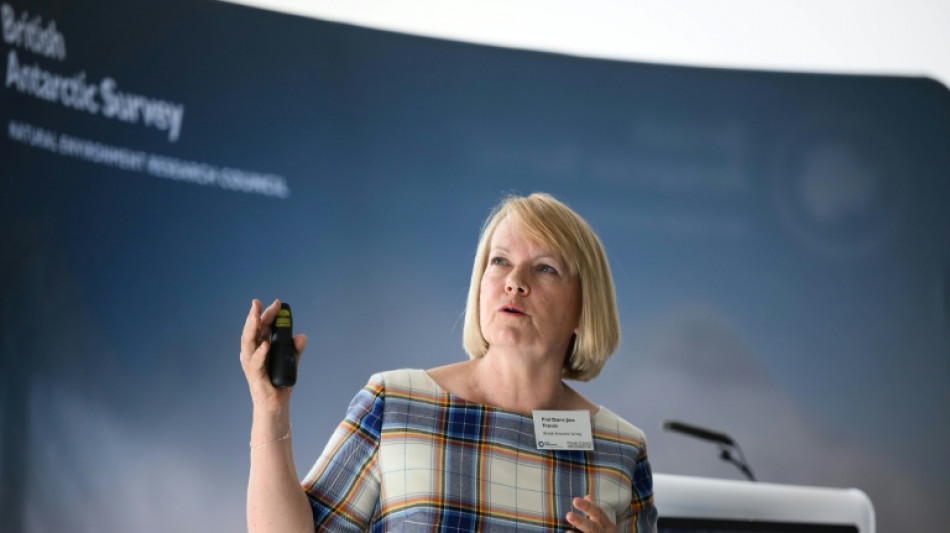
UK scientist's remains found on Antarctic glacier 66 years on / Photo: Daniel LEAL - AFP

 Google data centre sparks protests in Austria

 Shin Ohashi: Junk food-loving teen and Japan's next big swimming hope

 Stocks rise on AI buzz, drop in oil prices
 China's robot dancers limber up for America's Got Talent final

 Despite military might, Saudi struggles to crush the Houthis

 Trump to tout deals, defend Iran war in UN speech
 Sri Lanka to issue verdict in landmark Easter attack trial

 Macron says talks with Trump on Red Sea, Ukraine 'constructive'

 Green policies just good politics, says UK minister

 Bardot auction in Paris fetches nearly one million euros
 No timeline on Daniels injury return, says Commanders coach

 British Columbia sues OpenAI in US court over Canada school shooting

 French star Batum retires after 18-year NBA career

 Zidane leads first France training session
 Man shot by ICE agent in Texas detained with bullet inside him: lawyer

 California declares state of emergency ahead of El Nino

 South Africa arrests three more suspects, after nine women murdered

 Carse needs time away from England, says captain Brook

 NOWPayments Releases Cross-Chain Payout Data Revealing Key Performance Benchmarks Across TRON, BNB Chain, and Solana

 British Museum bans photos of Bayeux Tapestry as crowds linger
 COP31 host says AI climate footprint to be a summit priority

 Berlin's far-left vote winners reject anti-semitism charges

 Mancini eager for 'new adventure' on Italy return

 Mbappe says having Zidane as France coach 'like a film'

 Palmer, Rice out of England Nations League squad

The remains of a British meteorologist who died in an Antarctic expedition in 1959 have been recovered six decades later from a glacier, the British Antarctic Survey said Monday.
They were identified by DNA-testing as those of Dennis "Tink" Bell, who died aged 25 when he was working for the Falkland Islands Dependencies Survey, which became the British Antarctic Survey (BAS), the UK's polar research institute.
Bell died on Admiralty Bay on King George Island, located 120 kilometres (75 miles) off the coast of Antarctica on July 26, 1959.
He was stationed on the island for a two-year assignment at a small UK research base.
Bell and three other men had set out to climb and survey a glacier, when he fell through a crevasse -- a deep chasm in the ice. His body was never recovered.
The remains, which were exposed by a receding glacier, were found on January 19 by a team from the Henryk Arctowski Polish Antarctic Station.
"This discovery brings closure to a decades-long mystery and reminds us of the human stories embedded in the history of Antarctic science," said BAS director Jane Francis.
The bone fragments were carried to the Falkland Islands by the BAS Royal Research Ship Sir David Attenborough, and then brought to London for DNA testing.
Alongside his remains, the Polish team also found over 200 personal items including radio equipment, a flashlight, ski poles, an inscribed wristwatch and a Swedish-brand knife.
Bell's brother David Bell, who lives in Australia, said the discovery after 66 years left him and his sister "shocked and amazed".
"Dennis was the oldest of three siblings and was my hero as he seemed to be able to turn his hand to anything," said his brother.
Francis said the confirmation of the remains "is both a poignant and profound moment for all of us at British Antarctic Survey".
Bell "was one of the many brave ... personnel who contributed to the early science and exploration of Antarctica under extraordinarily harsh conditions," she added.
P.Sousa--PC