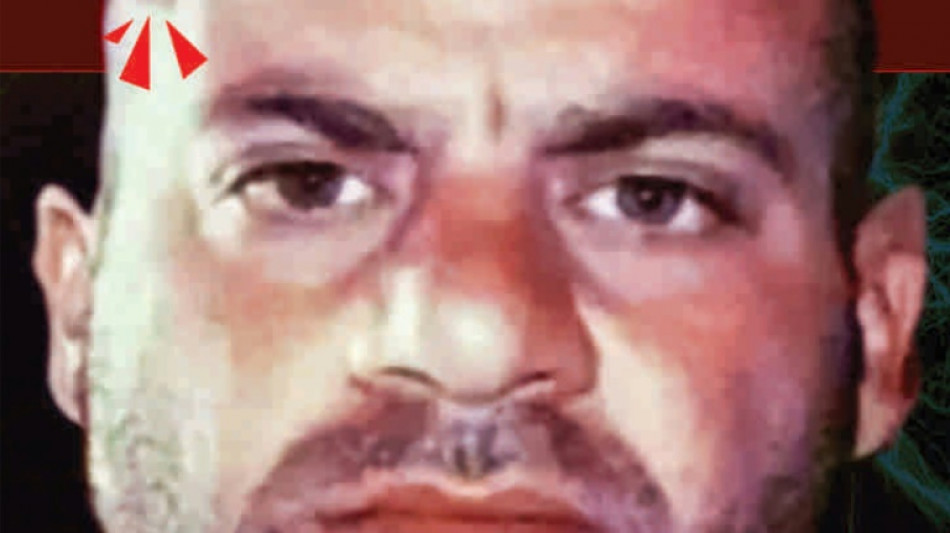
Dead IS chief was Iraqi ex-officer nicknamed 'Destroyer'

 Germans vote in elections threatening fresh blow to Merz

 US fears rapid escalation in Mideast after Houthis attack Riyadh

 Japan triathlete Hojo wins first gold of Asian Games

 IOC president impressed by 'beautiful' Asian Games wooden huts

 First Asian Games gold goes to Japan as China's 13-year-old Yu lights up pool

 Data centre command hub keeps AI up and running

 Pope Leo in France: the issues on the table

 Packing for a pope: behind the scenes on foreign trips

 Republicans find transgender issues a powerful political weapon in midterm campaigning

 German state elections threaten new shock waves for Merz

 Chile's Bachelet quits race to be next UN chief

 Raphinha treble fires perfect Barca to win at Sevilla

 Thiam makes winning heptathlon return at Decastar meet

 Czechs beat USA to qualify for Davis Cup finals

 Dortmund sink Stuttgart to climb to Bundesliga summit

 Trump says will not tolerate attempts to slow AI growth

 'It has to stop': runners protest women's murders in S.Africa district

 Fire erupts near Riyadh airport as Houthis claim strikes

 Cuba works to restore power after another blackout
 England thrash Sri Lanka again to return to top of T20 rankings
 Arsenal thrashed by Brighton, sorry Spurs lose again
 South Korea, Austria qualify for Davis Cup finals
 Seare shocks Ingebrigtsen to win world 5km gold
 Brigitte Bardot widower slams sale of star's belongings

 Aston Villa compound Tottenham's misery despite late rally

The head of Islamic State group, whom the US declared dead in a special-forces raid Thursday, was nicknamed the "Destroyer" and presided over massacres of Yazidis before assuming the leadership.
Abu Ibrahim al-Hashimi al-Qurashi, also known as Amir Mohammed Said Abd al-Rahman al-Mawla, took over the jihadist network two years ago after founder Abu Bakr al-Baghdadi blew himself up in a US special forces raid in October 2019.
Considered a low-profile but brutal operator, Qurashi had largely flown under the radar of Iraqi and US intelligence until that point.
He took over at a time when IS had been weakened by years of US-led assaults and the loss of its self-proclaimed "caliphate" in Syria and northern Iraq.
The US State Department slapped a $10 million bounty on his head and placed him on its "Specially Designated Global Terrorist" list.
Born in the northern Iraq town of Tal Afar and thought to be in his mid-40s, his ascension in the ranks of the extremist group was rare for a non-Arab, born into a Turkmen family.
Serving in the Iraqi army under Saddam Hussein, the late dictator toppled by the US-led invasion of Iraq in 2003, Qurashi joined the ranks of Al-Qaeda after Hussein was captured by US troops in 2003, according to the Counter Extremism Project (CEP) think-tank.
In 2004, he was detained by US forces at the infamous Camp Bucca prison in southern Iraq, where Baghdadi and host of future Islamic State figures met.
- 'Brutal policymaker' -
After both men were freed, Qurashi remained at Baghdadi's side as he took the reins of the Iraqi branch of Al-Qaeda in 2010, then defected to create the Islamic State of Iraq (ISI), later the Islamic State of Iraq and Syria (ISIS).
In 2014, Qurashi helped Baghdadi take control of the northern city of Mosul, the CEP said.
The think-tank said Qurashi "quickly established himself among the insurgency's senior ranks and was nicknamed the 'Professor' and the 'Destroyer'".
He was well respected among IS members as a "brutal policymaker" and was responsible for "eliminating those who opposed Baghdadi's leadership", it said.
He is probably best known for playing "a major role in the jihadist campaign of liquidation of the Yazidi minority (of Iraq) through massacres, expulsion and sexual slavery," said Jean-Pierre Filiu, a jihadism analyst at the Sciences Po university in Paris.
On Thursday, US President Joe Biden said that a global "terrorist threat" had been removed when Qurashi blew himself up after US special forces swooped on his Syrian hideout in an "incredibly challenging" night-time helicopter raid.
Hans-Jakob Schindler, a former UN official and director of CEP, called his death a "a major setback for ISIS" in terms of losing a second leader, but doubted it would be a game changer.
IS is thought to prepare for the killings of its leaders with plans for who will take over.
- Global spread -
Schindler said Quraishi "was not a very transformational leader" because IS had already started to shift from a group that controlled territory in Iraq and Syria to an international network of jihadist organisations under Baghdadi.
But Filiu argued that Qurashi's assassination could be "harder to overcome" than Baghdadi's.
He was "a genuine operational chief whose elimination risks preventing the resurgence of the jihadist group, at least temporarily."
Damien Ferre, director of the Jihad Analytics consultancy, said that Qurashi's legacy would be the reinforcement of the Afghan branch of IS, which has been increasingly active since the United States agreed in 2020 to withdraw its troops from the country.
Other researchers also see the rise of an IS branch around Lake Chad in west Africa as significant, with the group managing to draw fighters from the ranks of the Nigerian terror group Boko Haram.
"On the operational front during his time, Islamic State regained momentum in 2020 before seeing the quality and the quantity of its attacks fall last year," said Ferre.
On January 20, IS fighters launched their biggest assault since the loss of their caliphate nearly three years ago, attacking the Ghwayran prison in the Kurdish-controlled northeast Syrian city of Hasakeh to free fellow jihadists, sparking battles that left over 370 dead.
F.Carias--PC
