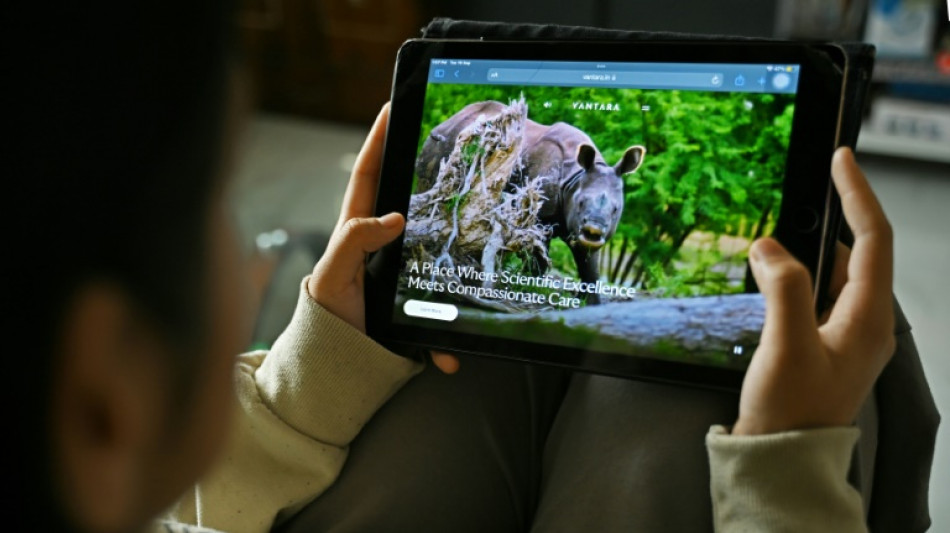
How did an Indian zoo get the world's most endangered great ape? / Photo: Idrees MOHAMMED - AFP

 Braves clinch division title as Red Sox reach MLB playoffs

 Bordeaux-Begles hammer Stade Francais despite Jalibert injury

 Milan and Juventus end blips with home wins

 Bridgeman wins PGA Biltmore title with sizzling 61

 Williams injured as Bears shut down by Vikings

 US warns of rapid escalation in Middle East war

 Germany's far-right AfD celebrates another state election win

 Russia vows revenge for election-day attacks as poll shows ruling party win

 Spaun late shows snatches PGA Championship win

 Conceicao strikes as Juventus beat Atalanta

 Britain, Zverev-inspired Germany, Spain complete Davis Cup finals

 Man Utd salvage Fulham draw as pressure mounts on Carrick

 Spanish civil war drama 'The Black Ball' wins at Toronto festival

 Germany's Merz shaken by far-right and far-left gains in state votes

 Macron welcomes Canada's Carney to French Atlantic territory

 Fiorentina frustrate Napoli with Serie A draw, Como upset

 Five-star Man City top Premier League after Sunderland thriller

 Ukrainian drones hit Moscow on last day of Russian elections

 Multi-Asset Trading Venue Monochrome Exchange Announces IEO of Its Native Token, $MCR

 South Korea break Japan hearts to win Asian Games basketball gold

 Acosta takes first victory at Austrian MotoGP

 PSG president Nasser al-Khelaifi under investigation in France for conflict of interest

 China swim sensation, 13, sets Games record after Japan win early

 Drones hit Moscow as Russians go to the polls

 New England boss Fleming says 'wrong' to ask Stokes to end retirement

Tapanuli orangutans are the world's most endangered great ape. Fewer than 800 remain, all previously thought to be in their native Indonesia. But now an Indian zoo says it has one.
An Indian court cleared the 3,500-acre wildlife facility known as Vantara on Monday of allegations including unlawful acquisition of animals and financial wrongdoing.
But the decision is unlikely to quiet questions about how Vantara, which describes itself as a wildlife rehabilitation and conservation centre, has stocked its enclosures.
Vantara, run by Anant Ambani, the son of Asia's richest man, says it houses 150,000 animals of 2,000 species, far exceeding populations at well-known zoos in New York, London or Berlin.
AFP spoke to seven experts on conservation and the wildlife trade to understand concerns about Vantara.
Several declined to speak on the record, citing Vantara's previous legal actions against critics.
They called Vantara's collection unprecedented.
"We've never seen anything on this scale," said one longtime conservation expert from a wildlife protection group.
"It's hoovering up animals from all over the world."
Some of those acquisitions are more noteworthy than others, such as the single tapanuli that arrived in Vantara between 2023 and 2024, according to the facility's submissions to India's Central Zoo Authority.
Only officially described in 2017, tapanulis are incredibly rare, said Serge Wich, an orangutan specialist at Liverpool John Moores University.
They are confined to a small range in Indonesia and are in "dire straits" because of threats including mining and deforestation, he told AFP.
- 'Surprised and shocked' -
Trade in the world's most endangered species is prohibited by the Convention on International Trade in Endangered Species of Wild Fauna and Flora (CITES).
But there are exceptions, including for "captive-bred" animals -- individuals born in captivity to captive parents.
There is only one CITES record of a tapanuli orangutan ever being transferred internationally.
It left Indonesia in 2023, bound for the United Arab Emirates, where Vantara says its tapanuli came from.
The transfer record describes the animal as "captive-bred".
However, multiple experts said that description was implausible.
"There are no captive breeding programmes for orangutans in Indonesia," said Panut Hadisiswoyo, founder and chairman of the Orangutan Information Centre in Indonesia.
Only a handful are known to be in captivity at all, at rehabilitation facilities in Indonesia, he said.
A conservationist for more than two decades, Panut said he was "surprised and shocked" to learn from AFP about Vantara's tapanuli orangutan.
"We do everything to protect them," he said. "So it's really, really distressing information."
There is no information on where in Indonesia the animal originated. The country's CITES authorities did not respond to a request for comment.
Experts said it was possible the orangutan is not a tapanuli at all. They look similar enough to Bornean and Sumatran orangutans that DNA testing would be needed for confirmation.
It could also be a mix of tapanuli and another species, perhaps discovered by a zoo in its collection -- although experts questioned why a facility would hand off such a rare animal.
But if the animal is a tapanuli, "it's almost inevitable that it would have to be illegal", said orangutan conservation expert Erik Meijaard.
"It would be super sad."
- 'Pure nonsense' -
Vantara did not respond to AFP's request for comment on the orangutan and how it acquires animals.
The tapanuli is not the first highly endangered animal to arrive at Vantara.
Spix's macaws, a vibrant blue species native to Brazil, were extinct in the wild until recently.
Brazil has sought to prevent all trade and transfer of the birds.
It allowed a breeding facility in Germany to acquire some on condition they would not be sold or moved without Brazilian permission, according to documents submitted to CITES.
Yet in 2023, 26 Spix's macaws from the German facility arrived in Vantara.
Vantara says it is working "to ensure that the calls of these rare birds are never lost from their native habitats".
The case has rankled Brazil, which raised it repeatedly at CITES meetings.
Asked about Vantara's tapanuli, the CITES secretariat told AFP "this matter is under review", adding it was "not in a position to provide information".
In public documents, CITES has acknowledged receiving "multiple reports" about imports of endangered animals into India.
India has said it will invite CITES officials for a visit but has yet to provide "detailed information on the matter", the secretariat noted.
If Vantara does own a single tapanuli orangutan, its conservation value would be limited, said Panut, who urged the animal's return to Indonesia.
For Meijaard, conservation in their natural habitat in Indonesia provides "the only chance for this species' survival".
"Trying to breed orangutans outside Indonesia with some kind of long-term hope that they are going to contribute to the population is just pure nonsense."
M.Gameiro--PC
