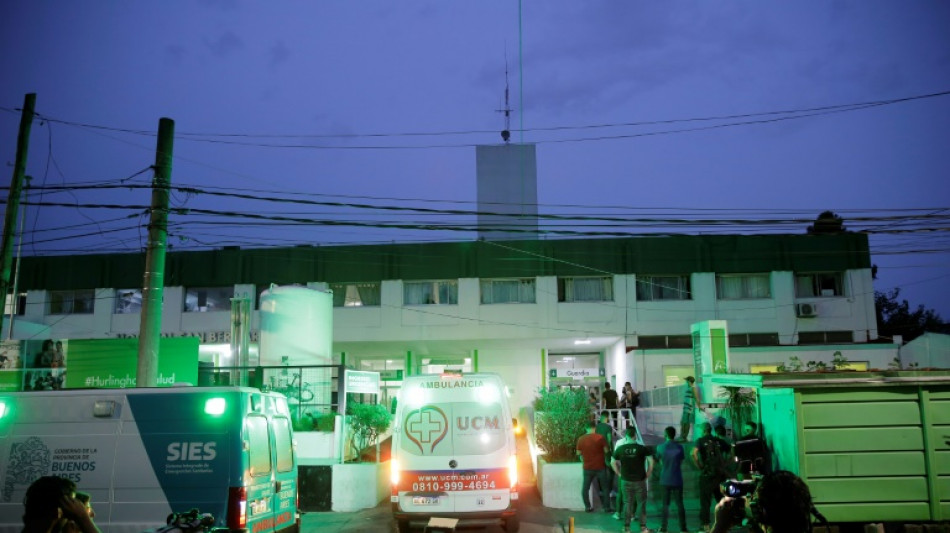
Argentine police race to eradicate laced cocaine that killed 22

 Germans vote in elections threatening fresh blow to Merz

 US fears rapid escalation in Mideast after Houthis attack Riyadh

 Japan triathlete Hojo wins first gold of Asian Games

 IOC president impressed by 'beautiful' Asian Games wooden huts

 First Asian Games gold goes to Japan as China's 13-year-old Yu lights up pool

 Data centre command hub keeps AI up and running

 Pope Leo in France: the issues on the table

 Packing for a pope: behind the scenes on foreign trips

 Republicans find transgender issues a powerful political weapon in midterm campaigning

 German state elections threaten new shock waves for Merz

 Chile's Bachelet quits race to be next UN chief

 Raphinha treble fires perfect Barca to win at Sevilla

 Thiam makes winning heptathlon return at Decastar meet

 Czechs beat USA to qualify for Davis Cup finals

 Dortmund sink Stuttgart to climb to Bundesliga summit

 Trump says will not tolerate attempts to slow AI growth

 'It has to stop': runners protest women's murders in S.Africa district

 Fire erupts near Riyadh airport as Houthis claim strikes

 Cuba works to restore power after another blackout
 England thrash Sri Lanka again to return to top of T20 rankings
 Arsenal thrashed by Brighton, sorry Spurs lose again
 South Korea, Austria qualify for Davis Cup finals

 Seare shocks Ingebrigtsen to win world 5km gold

 Brigitte Bardot widower slams sale of star's belongings

 Aston Villa compound Tottenham's misery despite late rally
Argentine police on Thursday seized vast quantities of cocaine likely laced with opioids and made several arrests after 22 people died and dozens ended up in hospital poisoned in Buenos Aires.
Officials said the incident, which highlighted the dangers of illegal drug use, had been brought under control -- but recent buyers of cocaine in and around the capital city were nevertheless urged to throw it away.
"It could have been a worse tragedy," said provincial government official Carlos Bianco, had officials not seized "a large quantity" of cocaine after the mass hospitalization event and taken it off the streets.
Provincial health minister Nicolas Kreplak said 20,000 doses of the adulterated substance were confiscated from the area of Buenos Aires where it had been sold.
Health authorities issued an "epidemiological alert" Wednesday after a flurry of deaths in three poor, western suburbs of Buenos Aires among people who had taken what they thought was cocaine.
More than 80 were admitted to 10 hospitals, some in critical condition, and 20 remained on mechanical ventilation on Thursday.
Police arrested three members of a drug gang in the poor suburb of San Martin accused of having distributed the drug mix.
- Hoping for a 'miracle' -
Buenos Aires provincial security chief Sergio Berni said the lethal additive, still being analyzed, was likely an opioid as many of the patients had reacted well to treatment for opioid poisoning.
Beatriz Mercado, who lives in the suburb of Hurlingham, told AFP she had found her 31-year-old son lying on the kitchen floor in the dark.
"He was almost not breathing, his eyes were rolling back," she said. She took him to the hospital, where he was put on life support.
"I hope for a miracle," said Mercado.
Some of the victims, several of them men in their 30s and 40s, suffered violent convulsions and heart attacks.
The alarm was first raised when four people arrived at a hospital together, saying they had taken cocaine at the same event. All four died.
"We are desperate, we want to know why one person is dying after another here," Maria Morales told AFP outside the hospital where her brother-in-law was on life support.
A friend who had taken cocaine at the same gathering is dead.
At a house in the precarious suburb of Tres de Febrero, where the drug was allegedly sold, police found packets of the substance similar to those described by the victims' families.
- 'No precedent' -
Berni told the Telefe channel the as-yet unknown additive was "attacking the central nervous system" of users.
"Every dealer that buys cocaine cuts it. Some do it with non-toxic substances such as starch. Others put hallucinogens in it, and if there is no form of control, this kind of thing happens," said Berni.
He said the adulteration was unlikely the result of gang warfare -- a lab mixup was the more probable cause.
San Martin public prosecutor Marcelo Lapargo said what happened was "absolutely exceptional" and there was "no precedent" in Argentina.
The priority, he added, was "to communicate so that those who are in possession of this poison know that they should not consume it."
But Kreplak told the TN channel that three people already discharged from hospital "returned on Thursday because they started consuming again."
For his part, Security Minister Anibal Fernandez, blamed "over-production and over-supply" of low-cost, low-quality drugs.
- Drug use rising -
Berni said that in Buenos Aires province, home to some 40 percent of the Argentine population of 45 million and with high poverty rates, about 250,000 doses of cocaine are sold daily.
Illegal drug use has been on the rise in Argentina. In the mid-1980s, half a ton of cocaine was seized every year -- a decade later it was four times that, official data showed.
In 2017, a record 12.1 tons of cocaine were seized in the country, but in 2020, the number fell to about 2.7 tons as consumption dropped during the pandemic.
A.Silveira--PC
