Bolivia says US drug agency to return to aid cocaine battle / Photo: Aizar RALDES - AFP

 Liverpool boss Iraola urges Isak to raise his level
 Evenepoel wins record 4th straight world time-trial title

 France's Macron, Canada's Carney announce closer ties
 Carrick defends troubled Man Utd after Fulham escape

 Horror movie 'Resident Evil' tops N. American box office

 Germany's Merz vows to stay course despite new vote losses

 Man City outgun Sunderland despite Brobbey hat-trick, Man Utd rescue Fulham draw

 Mourinho blames ref committee for Real Madrid derby defeat

 Maresca craves a 1-0 win after eight-goal Man City thriller
 Atletico Madrid beat Real Madrid in tense derby clash
 Reusser retains world time-trial title

 Man City outgun Sunderland despite Brobbey hat-trick, Liverpool win at Bournemouth

 Top US, Chinese economic officials meet ahead of Trump-Xi summit
 Erdogan's LGBTQ crackdown 'first step of election campaign': activist

 Mass drone barrage on Moscow kills two

 82-year-old dies after beach fight in Greece over sun lounger

 US warns of rapid escalation in Mideast war

 Iran 'put hearts on the court' to win Asian Games basketball bronze

 School girl Yu helps China dominate in Asian Games swimming openers

 Myanmar win first Asian Games teqball gold as Spain great Puyol watches

 China's 13-year-old Yu scorches to first major gold at Asian Games

 Russians vote on last day of parliamentary elections

 Hong Kong pays final respects to former city leader Tung

 Typhoon put people off Asian Games opening ceremony, official says

 China's 13-year-old Yu cruises as Asian Games swimming begins

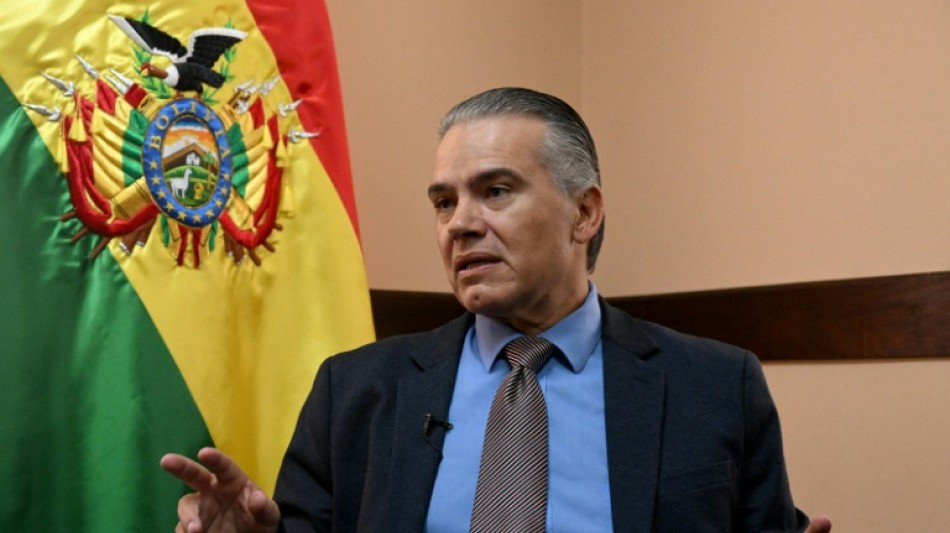
Bolivia's brand-new narcotics czar, Ernesto Justiniano, told AFP Friday the US Drug Enforcement Administration, expelled in 2008, will be returning to bolster the South American country's anti-cocaine campaigns.
Justiniano is part of the new administration of President Rodrigo Paz, a pro-business conservative who took office on November 8 after two decades of leftist rule.
Paz, 58, is aiming for a sharp political, economic, social and diplomatic shift away from the policies of leftist leaders blamed by many for Bolivia's economic collapse, with dollars in short supply and annual inflation over 20 percent.
In an interview with AFP Friday, Justiniano said "there is a political commitment" for the DEA to return to Bolivia, where he said cocaine production has spiraled out of control.
"International cooperation is fundamental," he added. "We will no longer be an isolated country, a country that is self-absorbed and acts solely out of political necessity."
The new government has set for itself the tasks of eradicating coca leaves -- the raw material for cocaine production -- and going after drug cartels.
According to United Nations data, Bolivia is the world's third-largest producer of coca and cocaine, after Colombia and Peru.
Ties with the United States were severed under former socialist leader Evo Morales, in office from 2006 to 2019.
Bolivia took a sharp turn to the left under Morales, nationalizing energy resources and making alliances with China, Russia and fellow leftists in Cuba, Venezuela and elsewhere in Latin America.
In 2008, Morales expelled the US ambassador and DEA officials, accusing them of interference in Bolivia's affairs. USAID officials followed in 2013.
Washington expelled Bolivia's ambassador in retaliation, and the envoys were never replaced.
Paz, an economist-turned-senator, vowed the day after his election victory to renew ties with Washington.
- No money for eradication -
Justiniano -- whose official title is deputy minister of social defense and controlled substances -- said Bolivia's cocaine production levels were alarming, with estimated annual production of about 300 tons.
The UN says Bolivia has 31,000 hectares of coca crops. Of these, about 22,000 hectares are legal -- grown to be chewed as a stimulant, brewed into a tea thought to combat altitude sickness or used in religious rituals.
Justiniano, 56, said modern processes had reduced the amount of coca required to make one kilogram (2.2 pounds) of cocaine by about half.
"With one hectare of illegal coca, I can produce more than double the cocaine than twenty years ago," he told AFP.
He added that Bolivia's ability to address the problem was limited, with helicopters and planes grounded due to a lack of money for insurance or spare parts.
"All incursions... are conducted by land," he stated.
"And once on site, they must travel on foot, even lacking fuel for vehicles."
Bolivia's economy is in recession, according to the World Bank.
P.Cavaco--PC