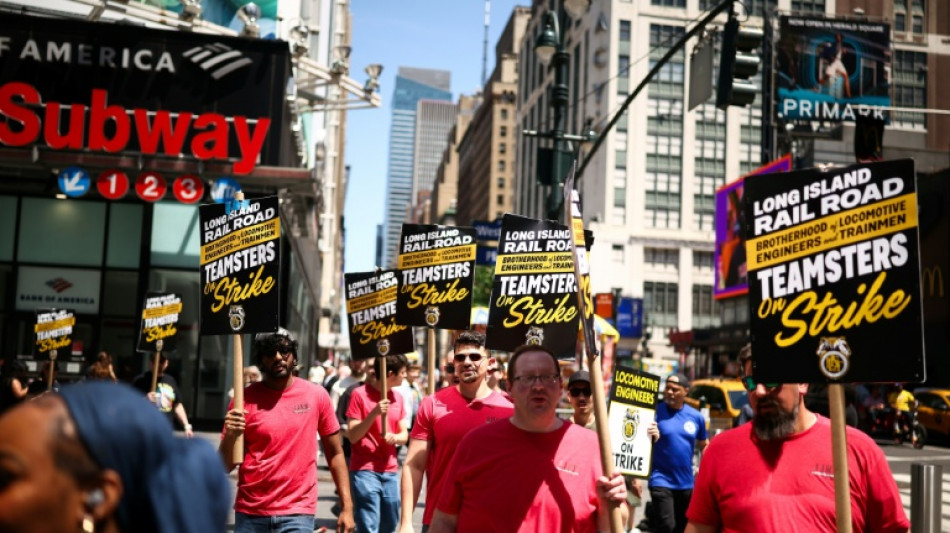
Top UN court says right to strike protected in key labour treaty / Photo: CHARLY TRIBALLEAU - AFP

 Asian allies stress 'critical cooperation' as Trump slashes Korea drills

 Williams sisters fall at Cincinnati while Zverev advances
 Transylvania's fortified churches face fragile future
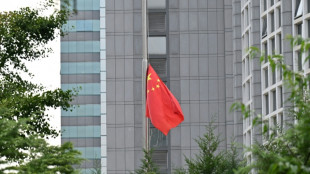 China mourns former premier Zhu Rongji with flags lowered, funeral
 Philippine student killed in rare school shooting
 Arsenal primed for Premier League title defence as rivals face questions
 Zverev advances at Cincinnati while Williams sisters fall
 Copper powers profit rise at mining giant BHP
 Whales spark joy in New York but face threats from boat traffic
 Premier League's new bosses brace for battle
 Zambia's Hichilema: 'cattle boy' and two-time president

 Elderly far more at risk from rising heat than thought: study

 Brazil's Lula hails new oil find as 'passport to the future'
 Rybakina slogs through double rain delays in Cincinnati win
 Two largest US reservoirs hit record lows amid western drought

 Colombian minister under fire over beach holiday post-quake

 Lamour leaves key FIFA position after criticising Infantino
 Buss family sells 17.8% stake in Lakers to Iger group

 Mangione state murder trial postponed after federal guilty plea
 Trump envoy says Hamas disarmament could begin within 30 days
 US pauses construction of border project in Texas national park

 Thousands mourn dead black academic in London vigil
 South Africa Test series a lot tougher than a World Cup says All Blacks coach Rennie
 Coventry sign Nigeria striker Awoniyi from Forest
 TripleDart tops $7 million ARR with AI-led growth, reports 50 per cent EBIT margin

The top United Nations court ruled Thursday that the right to strike was protected in a key treaty of the International Labour Organisation (ILO), a decision that could have profound implications for global labour relations.
The International Court of Justice had been asked to deliver a so-called advisory opinion on whether an ILO treaty from 1948, known as Convention 87, implicitly enshrined workers' right to strike.
ICJ president Yuji Iwasawa said the court was "of the opinion that the right to strike of workers and their organisations is protected" under that convention.
However, judges said their opinion, which is not binding, should not be understood as laying out any other ground rules for strike action.
The conclusion "does not entail any determination on the precise content, scope or conditions for the exercise of that right", said Iwasawa.
ILO Convention 87 is an agreement between unions and employers including the right "in full freedom, to organise their administration and activities".
- Heated legal battle -
Unions at the ILO had argued that this by extension enshrined the right to industrial action, but employers disagreed, so they took the fight to the ICJ.
Behind the dry legal interpretation of a decades-old treaty lay a heated battle between unions and employer groups at the ILO, which played out in hearings in October 2025.
"This case is about more than legal abstractions," Harold Koh, representing the International Trade Union Confederation (ITUC), told the judges.
"It will affect the real rights of tens of millions of working people around the world," he added.
Koh warned that if the ICJ ruled the right to strike was not inherent in the Convention, companies and governments could start to unpick labour deals around the world.
"National employer groups would contest the right to strike country by country, focusing first on nations with compliant courts, weak civil societies and ineffective media," said Koh.
- 'Inflammatory and alarmist' -
On the other side of the argument, Roberto Suarez Santos, from the International Organisation of Employers, said the 1948 convention "neither explicitly nor implicitly covers the right to strike."
Santos noted that the rules surrounding industrial action varied widely from country to country -- whether emergency services were excluded, for example.
These differences "cannot be resolved by simply reading an abstract right to strike into Convention No.87 and trying to impose it on employers, workers and governments", said Santos.
Rita Yip, also representing the employers' groups, dismissed the union arguments as "inflammatory and alarmist".
The right to strike is still protected in national laws, argued Yip, and does not need to be enshrined in "boilerplate norms, imposed at the highest level".
Urging the court to answer "no" to the question before it, Yip said the case "goes to the credibility of the entire international labour system".
Both sides at least agreed on the importance of the case for labour relations.
"At first blush, this case may not seem momentous," said Koh from the trade union confederation.
"But your decision here will affect every worker in the world," he told the judges.
M.Gameiro--PC