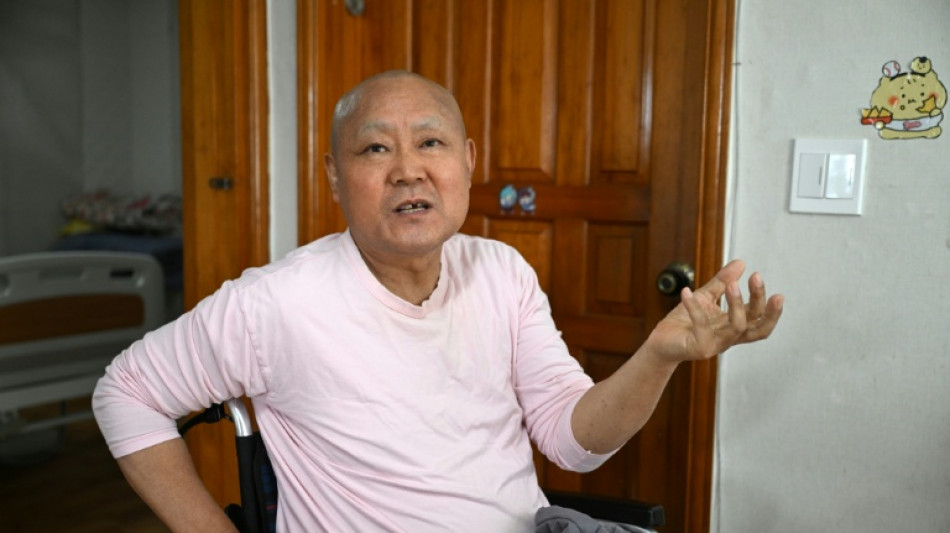
Pain-riddled South Korean man fights for right to die / Photo: Jung Yeon-je - AFP

 Arteta coy over Lewis-Skelly's Arsenal future after 'emotional' celebration

 Romania shuts down nuclear plant as Danube drops

 German steel giant Thyssenkrupp weighs options as Rhine drops

 US ambassador denounces settler siege as Israel dispatches troops
 Hasan takes 6-55 as Bangladesh claim opening day of Australia Test

 Taiwan says AI agents used in cyberattacks targeting island

 Japan protests Putin's first visit to disputed islands

 Kiss wants fit-again Wallabies playmaker Gordon to 'open up' Japan

 British eccentrics push humble garden shed to new heights

 Zambia votes with president's economic record on the line

 Germany's dry rivers spark battle on engineering vs restoration

 Senators demand inquiry into conditions aboard USS Abraham Lincoln

 All Blacks' Proctor out of South Africa series, Mo'unga called up

 Bangladesh quick Hasan reduces Australia to 74-4 at lunch

 Seoul tech leads Asian stock gains as traders cheer US inflation

 Farage and Count Binface go head-to-head in snap UK poll

 Afghan students divided over smartphone ban at universities
 Japan go back to school for second Australia Test
 Matthew McConaughey on his sweet return to the big screen

 President's economic record on the line as Zambia votes

 U.S. Polo Assn. Takes No. 1 Spot for All Sports Brands and Climbs to No. 22 Overall on License Global's 2026 'Top Global Licensors' Ranking

 Trump 'low-key' bets on economic pressure against Iran

 Pitch invaders take selfies with Fernandes during Man Utd friendly

 No-stress Sabalenka won't fret over lackluster 2026 results

 Hometown hero Hudson-Smith basks in Euro glory

In excruciating pain from a debilitating neurological condition, South Korean Lee Myung-shik had reluctantly given up on assisted death in Switzerland when he learned his daughter risked prison time if she helped him.
Now the 65-year-old is looking to South Korea's Constitutional Court for help in what is the first known legal challenge to the country's assisted dying ban, according to his lawyer.
Despite strong opioid pain medication, wheelchair-bound Lee has endured constant discomfort since his 2020 diagnosis with acute myelitis, a rare condition that has no known cure.
His urine is drained through a catheter, and a carer manually removes his stool.
The pain, Lee said, feels like "my thighs are being crushed by a heavy press, as though my lower body were pinned beneath a dump truck".
"I am not really living. I am merely surviving," Lee, who also contends with pressure sores and skin necrosis, told AFP.
He has long come to see death as the only escape.
In 2022, Lee was planning to travel to Switzerland with the help of Dignitas, a Swiss non-profit that supports people seeking an assisted death.
As he cannot travel alone, his daughter was to accompany him.
But "joy turned to sorrow", Lee said, when he realised she could face up to 10 years in prison back home under a ban on assisted suicide in South Korea's Criminal Act.
"While preparing the paperwork, I halted the process because I could not bring myself to list a companion," he said, dashing his "only hope".
In 2023, Lee filed a petition with the Constitutional Court, arguing that when medicine offers no cure and life entails only physical and mental suffering, a person's "right to decide on their own death" should be protected by the state.
"Incurable, persistent and excruciating pain is the most brutal form of torture on Earth," he said.
- 'Cautiously optimistic' -
Dignitas said it had helped 11 South Koreans with assisted deaths by December 2025.
None of those who accompanied them have been prosecuted, according to Lee's lawyer, Kim Jae-ryon.
"It appears people travelled there secretly and no one reported them to the police," Lee said.
It is a risk he was not willing to take, nor should anyone have to, insisted Lee.
"If the constitutional complaint succeeds, the legal interpretation of aiding and abetting suicide could shift, allowing people in similar circumstances to avoid criminal punishment," he said.
Lawyer Kim said a public hearing may be held later this year, nearly three years after Lee's petition was filed.
Rulings usually take several months.
Kim said she was "cautiously optimistic" of a positive outcome, citing a global trend toward allowing assisted dying and growing demand in South Korea.
A total of 144 South Koreans had applied for Dignitas's services by the end of last year -- the 14th-highest national figure, according to the Swiss non-profit.
- Public debate -
A December 2024 survey by the Korea Institute for Health and Social Affairs found 82 percent of South Korean respondents supported assisted dying.
But under the law as it stands, doctors or others who help another person die risk between one and 10 years in jail.
Lee argues the provision is unconstitutional.
A lawmaker introduced a bill to legalise medically assisted dying in 2024, but the initiative stalled in the face of fierce resistance from religious groups and the Korean Medical Association.
Countries including Austria, Switzerland, the Netherlands, Belgium, Luxembourg, Canada, Spain, Uruguay and some US states allow assisted dying.
In most cases, years of court rulings, civil society debate and patient advocacy paved the way, said Park Hye-yoon, a physician at Seoul National University Hospital.
Such discussions "have yet to fully mature in South Korea", she said, and could take years to bear fruit.
According to Lee, he had an assurance from Dignitas "that they would accept me at any time".
J.Oliveira--PC