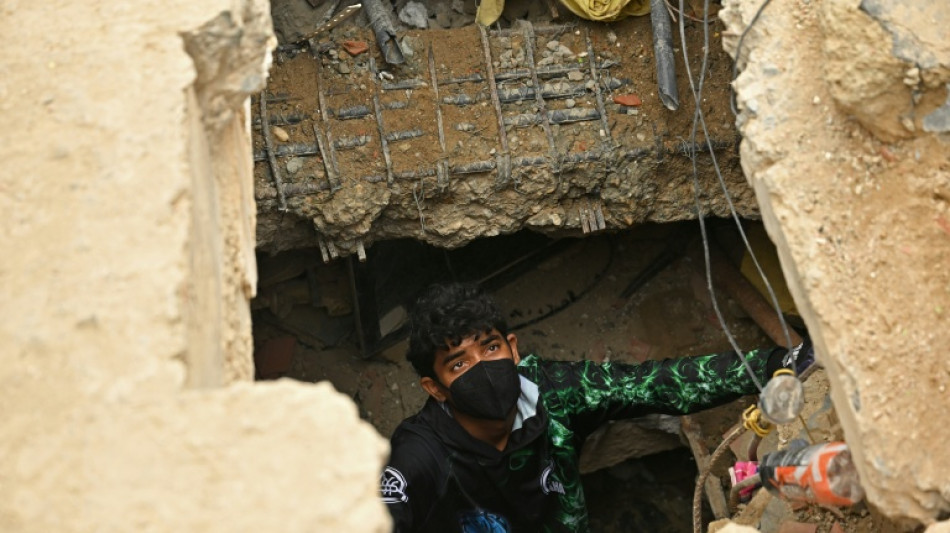
Families demand help with recovering Venezuela's quake victims / Photo: MARTIN BERNETTI - AFP

 US warns of rapid escalation in Mideast war
 Iran 'put hearts on the court' to win Asian Games basketball bronze

 School girl Yu helps China dominate in Asian Games swimming openers

 Myanmar win first Asian Games teqball gold as Spain great Puyol watches

 China's 13-year-old Yu scorches to first major gold at Asian Games

 Russians vote on last day of parliamentary elections

 Hong Kong pays final respects to former city leader Tung

 Typhoon put people off Asian Games opening ceremony, official says

 China's 13-year-old Yu cruises as Asian Games swimming begins

 AI 'warning shots' focus Beijing on national security risks

 Philippine tribe in limbo over US-led tech hub

 Leo XIV, first US pope transcends his restrained style

 Singer Ed Sheeran says Gaza situation 'unjustifiable' following controversy

 In 'Tenzing', a Sherpa mountaineer gets his due

 Ed Sheeran set to return to stage after Palestinian controversy

 Toulouse edge Vannes, Lyon beat Pau to take Top 14 summit

 Germans arrested for Louvre stunt in Mona Lisa hall

 Saudi-led coalition says Houthis fired ballistic missile at Riyadh

 France's debt climbs to highest since 1978: ministry

 McIlroy two shots off the lead at Wentworth after eagle on 18

 Martinez brace saves Inter in Serie A top-two clash with Roma

 Rosenior abused but guides Paris FC past old club Strasbourg

 Seven-try Lyon beat Pau, climb to Top 14 summit

 Brighton defeat a 'big lesson' against complacency for Arsenal, says Arteta

 Thousands protest inaction over climate crisis in Switzerland

With little hope of finding loved ones alive, frustrated families of those affected by Venezuela's double earthquakes clamored for help to recover their loved one's bodies Friday as uncertainty grew over the death toll from the tragedy.
Authorities on Friday reported a total of 2,645 deaths and more than 12,000 wounded from the 7.2 and 7.5 magnitude earthquakes that struck the country last week, with most fatalities in the coastal town of La Guaira, where scores of residential complexes were flattened.
Officials have avoided estimating the number of missing, though the UN has put that figure at as many as 50,000.
Many survivors who were left homeless meanwhile are sleeping in the streets or in makeshift shelters set up in parks and public spaces.
Nine days after one of Latin America's worst earthquake disasters, rescue teams were beginning to wind down search operations for survivors, although many relatives still clinged desperately to any sound from the rubble as a sign of life.
In front of the Tahiti building in the Caraballeda sector of La Guaira, one rescuer reported hearing shouts from an adult in the early morning hours Friday.
Reports also emerged that a 9-year-old boy had been found alive, but foreign rescuers told AFP there was no trace of any survivors.
Outside the Tahiti, frustrations boiled over as families trying to recover bodies shouted at others wanting to clear the way for a potential rescue.
"Until I recover the bodies, I won't be at peace," said Jose Francisco Liendo, who was trying to dig out the remains of his father and sister.
"Don't let the machines come and take them away like garbage."
- Stabilizing presence -
Venezuela's interim President Delcy Rodriguez has suggested there is still a possibility of finding survivors, but after nine days, that scenario is remote.
The critical window for rescues in such disasters usually closes after 72 hours, though a few people have miraculously been found alive this week.
Rodriguez assumed interim power after the capture of Nicoles Maduro in a US military operation six months ago.
The government's response to the tragedy has been the target of harsh criticism from many in La Guaira, who denounced the absence of rescuers until the arrival of international brigades.
Many residents in La Guaira said neighbors, family members, and volunteers were the first to remove rubble and search for people by hand.
AFP witnessed one volunteer urging soldiers to put down their rifles and help with the rubble removal.
Rodriguez has defended the official response and denounced the backlash as media manipulation.
"Anyone who wants to audit the reality is welcome," she said in her first formal press conference as president on Thursday.
The interim president currently has the support of US President Donald Trump's administration. The United States is helping coordinate international rescue efforts in Venezuela.
But exiled opposition leader and Nobel Peace Prize winner Maria Corina Machado, who wants to return to the country, criticized the government response.
"The total absence of the state has become evident; the country needs figures it can trust," she told correspondents in Venezuela via Zoom, arguing she would be a stabilizing presence there.
- 'Dead inside' -
Rodriguez has ruled out the possibility of the dead ending up in mass graves and ordered their proper identification.
A makeshift morgue is operating outdoors in the port of La Guaira, where long lines formed to receive the bodies of loved ones and their death certificates.
La Guaira State Governor Jose Alejandro Teran told AFP that more than 170 buildings had been completed destroyed and more than 700 damaged by the earthquakes.
Authorities were supplying between 40 to 50 tons of humanitarian aid a day to those staying in temporary camps, he said.
But many families are denouncing a lack of support and heavy machinery needed in the recovery of bodies from collapsed buildings.
"They tell us no, that they're looking for the living, but what about the dead? Aren't they human beings too?" said Dalimer Diaz, 43.
"Nobody wants to remove the dead; we have to retrieve the bodies ourselves. We need machinery to help us."
Soldiers later arrived at the Tahiti building where residents had been arguing. A Spanish brigade also came with a crane to begin removing rubble.
Aloa Gonzalez was waiting for her sister's body, buried under blocks and concrete.
"I just came from burying my father and mother, and I came here to rescue my sister," she said.
"How do I feel? Dead inside," she said. "I can't believe it. I don't want to stop because I don't want to face the reality of what's happening."
O.Gaspar--PC