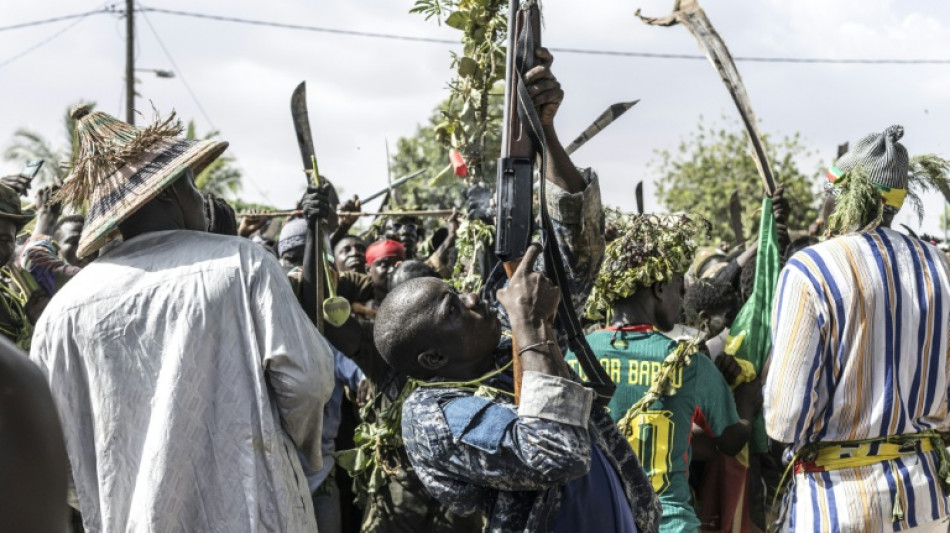
In Senegal, a feverish ancestral hunt beckons the rain / Photo: PATRICK MEINHARDT - AFP

 Drones hit Moscow as Russians go to the polls

 New England boss Fleming says 'wrong' to ask Stokes to end retirement

 Germans vote in elections threatening fresh blow to Merz

 US fears rapid escalation in Mideast after Houthis attack Riyadh

 Japan triathlete Hojo wins first gold of Asian Games

 IOC president impressed by 'beautiful' Asian Games wooden huts

 First Asian Games gold goes to Japan as China's 13-year-old Yu lights up pool

 Data centre command hub keeps AI up and running

 Pope Leo in France: the issues on the table

 Packing for a pope: behind the scenes on foreign trips

 Republicans find transgender issues a powerful political weapon in midterm campaigning

 German state elections threaten new shock waves for Merz

 Chile's Bachelet quits race to be next UN chief

 Raphinha treble fires perfect Barca to win at Sevilla

 Thiam makes winning heptathlon return at Decastar meet

 Czechs beat USA to qualify for Davis Cup finals

 Dortmund sink Stuttgart to climb to Bundesliga summit

 Trump says will not tolerate attempts to slow AI growth

 'It has to stop': runners protest women's murders in S.Africa district

 Fire erupts near Riyadh airport as Houthis claim strikes

 Cuba works to restore power after another blackout

 England thrash Sri Lanka again to return to top of T20 rankings

 Arsenal thrashed by Brighton, sorry Spurs lose again

 South Korea, Austria qualify for Davis Cup finals

 Seare shocks Ingebrigtsen to win world 5km gold

Against a frenzy of drums, chanting and gunfire, a few hundred Serer men parade about in a trance-like state, brandishing the day's hunt -- jackals, monitor lizards, monkeys and birds -- in hopes of hastening Senegal's rainy season.
Ndiaye Ndiaye, a district in the western city of Fatick, on Monday hosted the 723rd edition of its annual hunt, known as the Miss de Diobaye, a centuries-old tradition believed to bring rain and protect the community.
The ritual, which belongs to the country's Serer ethnic minority, also heralds the start of the farming season.
However it has been disrupted in recent years by deforestation, modernisation and climate change that is causing the rains to arrive later.
Wearing a camouflage vest, Ousseynou Laye Dione returns on his motorbike from his seventh Diobaye hunt alongside eight other young men in scorching heat.
"We chase the animals on motorbikes", the 26-year-old firefighter said, explaining that "when we're 100 metres (330 feet) from the animal, we shoot at it and sometimes we hit it head-on".
The hunters share the catch by hacking off pieces with machetes and hanging them from their belts.
Only Serer men who have undergone initiation rites are allowed to take part in the mystical hunt.
The day before the event, a traditional seer, known as a saltigue, predicts which animal must be killed in order to trigger abundant rain. The secret is shared only among the initiates.
Legend has it that the practice began seven centuries ago during a terrible drought, when a seer foretold the return of rain only if a specific animal was killed.
On the evening when that animal was hunted down, heavy rain fell on Ndiaye Ndiaye, bringing a bountiful harvest -- and a tradition was born.
- Martial parade -
The young men's return to the district is marked by a spirited martial procession, accompanied by drums and chanting.
Adorned with protective vines and eyes rolled back in ecstatic trances, the hunters bash their machetes and fire their rifles and pistols to ward off evil spirits.
"The Miss is a moment of catharsis, a violent purification of space, entrusted to the youngest men", said Sobel Dione, an anthropologist specialised in Serer culture.
From a safe distance, women and children, generally in high spirits but sometimes startled by the gunfire, watched the frenetic procession.
"It's a celebration", exclaimed various members of a group of women.
As the parade drew to a close, hunters gathered by family to dance before traditional and religious leaders as well as state officials, brandishing their weapons.
"It's a source of pride for me to represent my community and take part in the culture", said 19-year-old Mamour Diaw, his face painted white. "Our millet fields need it".
- Climate change and deforestation -
Over the centuries, the Miss de Diobaye has had to adapt to the changing physical environment and times.
Dressed in an elegant suit with a rifle slung over his shoulder, 56-year-old Ousseynou Ndour has seen the tradition evolve.
"Hunting methods have shifted with the introduction of motorbikes. In the past we walked barefoot through the bush, without guns", he told AFP.
The once vast forest of Diobaye has been reduced to a sprawling plain dotted with sparse trees, depleted by human-driven deforestation and soil salinisation.
Antelopes and rhinos once hunted by ancestors no longer exist in the region.
Today, climate change has further modified the tradition, with rains arriving increasingly later and over shorter periods.
Sitor Ndour, secretary-general of the Miss organising committee, noted that the timing of the hunt has shifted over the decades.
"We used to hold it in May, because the rainy season was already setting in", he said.
Peanut and millet farming practices have also changed, with new seed varieties that mature more quickly.
"These traditions have the capacity to evolve," Dione, the anthropologist said.
"They safeguard both practical knowledge and a collective bond with the land, making climate adaptation more robust and more human."
History will record that in 2026, the day after the Miss de Diobaye, western Senegal received the season's first major rainfall.
A.Aguiar--PC