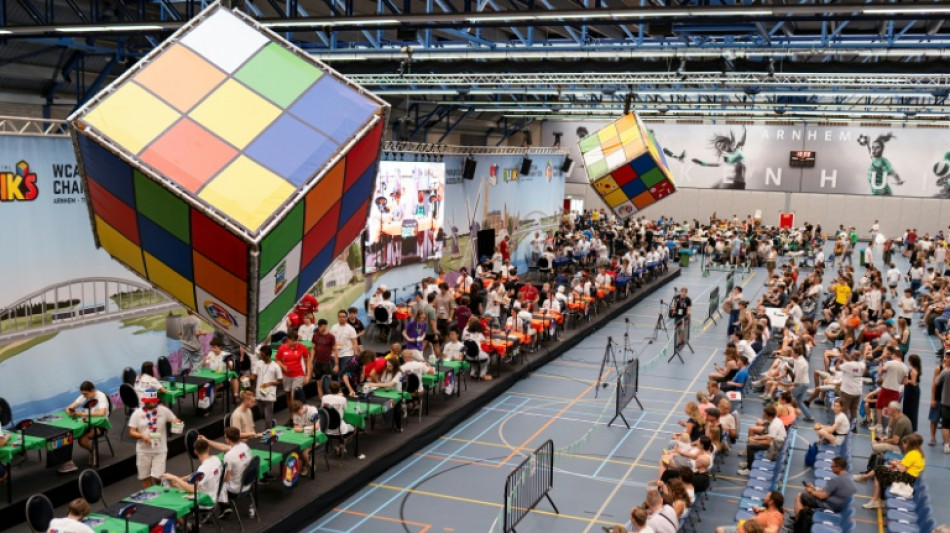
Cubes and lubes: Europe's 'Speedcubers' twist for glory / Photo: Lina Selg - AFP

 Drones hit Moscow as Russians go to the polls

 New England boss Fleming says 'wrong' to ask Stokes to end retirement

 Germans vote in elections threatening fresh blow to Merz

 US fears rapid escalation in Mideast after Houthis attack Riyadh

 Japan triathlete Hojo wins first gold of Asian Games

 IOC president impressed by 'beautiful' Asian Games wooden huts

 First Asian Games gold goes to Japan as China's 13-year-old Yu lights up pool

 Data centre command hub keeps AI up and running

 Pope Leo in France: the issues on the table

 Packing for a pope: behind the scenes on foreign trips

 Republicans find transgender issues a powerful political weapon in midterm campaigning

 German state elections threaten new shock waves for Merz

 Chile's Bachelet quits race to be next UN chief

 Raphinha treble fires perfect Barca to win at Sevilla

 Thiam makes winning heptathlon return at Decastar meet

 Czechs beat USA to qualify for Davis Cup finals

 Dortmund sink Stuttgart to climb to Bundesliga summit

 Trump says will not tolerate attempts to slow AI growth

 'It has to stop': runners protest women's murders in S.Africa district

 Fire erupts near Riyadh airport as Houthis claim strikes

 Cuba works to restore power after another blackout

 England thrash Sri Lanka again to return to top of T20 rankings

 Arsenal thrashed by Brighton, sorry Spurs lose again

 South Korea, Austria qualify for Davis Cup finals

 Seare shocks Ingebrigtsen to win world 5km gold

Brows knitted with concentration, Juliette Sebastien clasps her trusty Rubik's Cube, her fingers moving at a head-spinning speed before flipping the solved puzzle onto her table in just 25.03 seconds.
Welcome to the world of competitive Rubik's Cube solving -- "speedcubing" for those in the know -- where players compete in disciplines ranging from the blindfold challenge to solving cubes with oven gloves on their hands.
French national champion Sebastien is pitting her skills against 1,200 competitors from 53 countries in the 11th European speedcubing championships in Arnhem, eastern Netherlands.
She trains for at least an hour a day, but has been putting in three or four hours daily in the run-up to the competition, her preparation marred by an unfortunate wasp sting to the hand.
"I do training blocks of 100, 200, sometimes 300 solves," the 25-year-old student told AFP. "There are always new techniques that you can learn."
Her time in the 4x4 event -- slightly bigger and harder to solve than a standard Rubik's cube -- is respectable, but the speeds in the fastest disciplines are mind-bending.
Chinese speedcuber Ziyu Ye holds the 2x2 world record at a staggering 0.39 seconds.
The clacking of cubes echoes through the five cavernous sports halls hosting the championships.
Competitors in national speedcubing uniforms wander the corridors absent-mindedly solving puzzles without looking, often one-handed.
"There are more cubes here than people," quipped one competitor, 31-year-old programmer Jeroen Plug from the Netherlands.
But this is serious business: the competition is closely regulated and run with military precision.
Before stepping out onto stage, competitors hand over their precious cubes to the "scramblers", who secretly set them to exactly the same position for everyone, ensuring a level playing field.
Two players sit side by side, each under the eagle eye of a referee and with a camera tracking their every move, as a digital clock records their time to the hundredth of a second.
The freshly scrambled cube arrives concealed in a box. When the box is overturned, competitors have 15 seconds to examine the state of the cube before placing their hands on a sensor to start the clock and begin their solve.
The speedcubing world was recently rocked by the "Sliding Scandal", a cheating technique where players would surreptitiously slide their hands from the sensor to the cube, gaining critical tenths of seconds.
World records were erased from the history books in the wake of the scandal, which was still being whispered about in hushed tones on the sidelines in Arnhem.
- 'Sandy' feeling -
The surprising secret to a prize-winning cube? Lube.
Each player applies a precise amount of lubrication to their cube to ensure it moves at exactly the speed they prefer, explained Loes Wentink, staffing the lubrication stand.
"It makes a big difference to the competition," said the 21-year-old electrical engineering student.
Some lubes actually increase the friction because "some cubes are very fast out of the box."
"Sometimes you can't control it... and if you can't control it, then your solve won't be as good," she told AFP.
Other lubes are used to get rid of the dreaded "sandy" feeling, when the cube feels "rough" when turning in the hands, said Wentink.
The cube/lube set-up is as personal as the tension on a tennis racket or the weight of a cricket bat or snooker cue.
Recent technological advances have enhanced the sport: many players wear GoPro cameras on their heads so they can watch back their "solves" and improve technique.
"Smartcubes" with a Bluetooth sensor track every move in an app and suggest improvements -- these are illegal in competition.
Technology is no help however in the blindfold competition -- one of the most popular of the 17 disciplines.
Players have one hour to memorise as many cubes as possible before solving them, blindfolded. The record is 63 cubes correctly solved.
Keeping the tournament on track along with 250 volunteers and officials is organiser Yinte Dik, a 25-year-old accountant who has been competing since 2017.
The competition has attracted players ranging in age from eight to 71, Dik told AFP. At European level, the Poles are the team to beat, but the United States and China are the strongest globally.
"Everyone can train, so it's not that you have to have big brains or something, everyone can do it," said Dik.
"You just have to practise a lot and you can make it."
M.Gameiro--PC