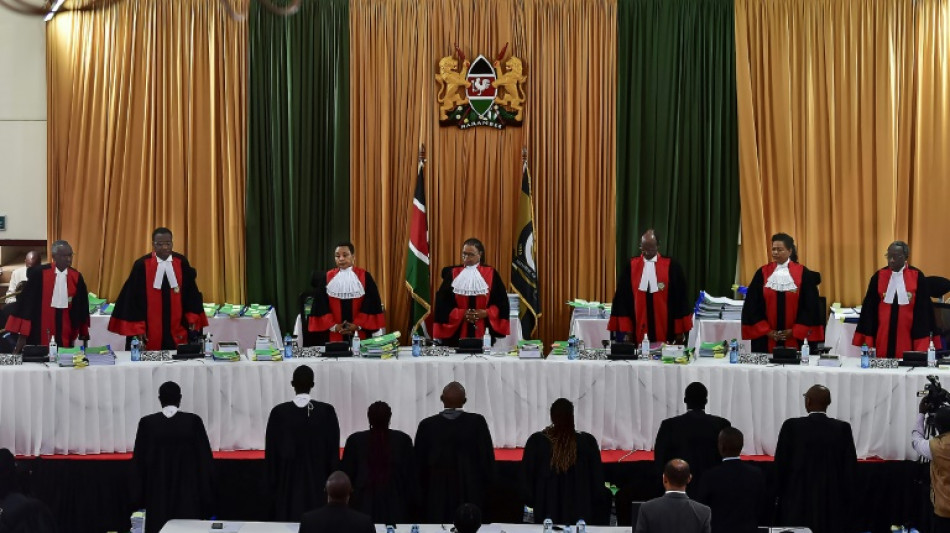
Four things to know about Kenya's vote dispute / Photo: Tony KARUMBA - AFP

 Liverpool boss Iraola urges Isak to raise his level

 Evenepoel wins record 4th straight world time-trial title

 France's Macron, Canada's Carney announce closer ties
 Carrick defends troubled Man Utd after Fulham escape

 Horror movie 'Resident Evil' tops N. American box office

 Germany's Merz vows to stay course despite new vote losses

 Man City outgun Sunderland despite Brobbey hat-trick, Man Utd rescue Fulham draw

 Mourinho blames ref committee for Real Madrid derby defeat

 Maresca craves a 1-0 win after eight-goal Man City thriller
 Atletico Madrid beat Real Madrid in tense derby clash

 Reusser retains world time-trial title

 Man City outgun Sunderland despite Brobbey hat-trick, Liverpool win at Bournemouth

 Top US, Chinese economic officials meet ahead of Trump-Xi summit
 Erdogan's LGBTQ crackdown 'first step of election campaign': activist

 Mass drone barrage on Moscow kills two

 82-year-old dies after beach fight in Greece over sun lounger

 US warns of rapid escalation in Mideast war

 Iran 'put hearts on the court' to win Asian Games basketball bronze

 School girl Yu helps China dominate in Asian Games swimming openers

 Myanmar win first Asian Games teqball gold as Spain great Puyol watches

 China's 13-year-old Yu scorches to first major gold at Asian Games

 Russians vote on last day of parliamentary elections

 Hong Kong pays final respects to former city leader Tung

 Typhoon put people off Asian Games opening ceremony, official says

 China's 13-year-old Yu cruises as Asian Games swimming begins

Kenya's Supreme Court on Friday wrapped up hearing three days of oral arguments in the case challenging the validity of the August 9 presidential election won by Deputy President William Ruto.
His 77-year-old opponent Raila Odinga, who lost his fifth stab at the presidency, insists the election results were manipulated and claims to have "enough evidence" to prove his case.
With the seven-judge bench set to hand down its decision on Monday -- the constitutional deadline -- here are some key questions about the case and its potential implications for the country.
- How did we get here? -
The Independent Election and Boundaries Commission (IEBC) proclaimed 55-year-old Ruto president-elect on August 15 after a nail-biting wait for results.
Odinga lost by a wafer-thin margin of around 230,000 votes despite the support of his old foe and outgoing President Uhuru Kenyatta, and the weight of the ruling party machinery behind him.
The former prime minister cried foul over the outcome, which also triggered turmoil within the IEBC.
No presidential poll outcome has gone uncontested in Kenya since 2002, and Odinga himself has been down this road before, petitioning the court in 2013 and 2017.
In August 2017, the Supreme Court annulled the election after Odinga rejected Kenyatta's victory.
The IEBC was under intense pressure to produce a transparent vote after facing stinging criticism over its handling of the 2017 election.
- What are the complaints? -
Seven petitioners -- whose cases have been collapsed into one -- have alleged that there were massive irregularities that compromised the integrity of the vote.
Odinga's 72-page petition claims that hackers broke into the IEBC servers and "converted, manipulated and unlawfully" dumped forms used to tabulate results from polling stations.
He alleges that the IEBC released contradictory figures on voter turnout and failed to tally results from at least 27 of the 290 constituencies, arguing that Ruto did not therefore meet the constitutional threshold of 50 percent plus 1 of the valid votes cast.
The court, led by Chief Justice Martha Koome, said it had identified nine issues to consider before arriving at a verdict.
Judges will attempt to figure out whether the IEBC website was hacked and if there was any interference with the transmission of result forms.
They will also scrutinise the IEBC's servers to ascertain if the election technology -- a hot-button issue that led to the nullification of the August 2017 vote -- met the "standards of integrity, verifiability, security and transparency".
IEBC chairman Wafula Chebukati has denied the allegations, insisting he carried out his duties according to the law of the land despite facing "intimidation and harassment".
- What next? -
There are three possible outcomes.
If the court finds substantial irregularities that could have seriously affected the results announced by the IEBC, it can nullify the election and order a new vote within 60 days.
Alternatively, it can criticise the electoral process but conclude that the irregularities do not merit an annulment.
If it nonetheless finds that the president-elect did not secure 50 percent plus 1 of valid votes, it will order a runoff, which must be held within 30 days, marking a first for Kenya.
Finally, it can uphold Ruto's victory, allowing him to be sworn in on September 13.
The court's ruling will be decided by a majority vote.
The Supreme Court is the highest in the land, created under Kenya's 2010 constitution "as the final arbiter and interpreter of the constitution".
Its rulings are final and binding.
- What's at stake for Kenya? -
Plenty.
The aftermath of the poll and court decision is being keenly watched as a test of democratic maturity in the East African powerhouse.
While Kenya is considered a pillar of stability in a volatile region, there are fears a drawn-out dispute may trigger violence in a country with a history of post-poll unrest.
Kenya's worst electoral violence occurred after the 2007 vote, when more than 1,100 people died in politically motivated bloodletting between rival tribes.
A prolonged electioneering period will also exacerbate already difficult economic conditions, with business likely to slow down in the midst of political uncertainty.
The country is struggling with soaring prices, a crippling drought that has left millions hungry, endemic corruption and disenchantment with the political elite.
J.Pereira--PC

