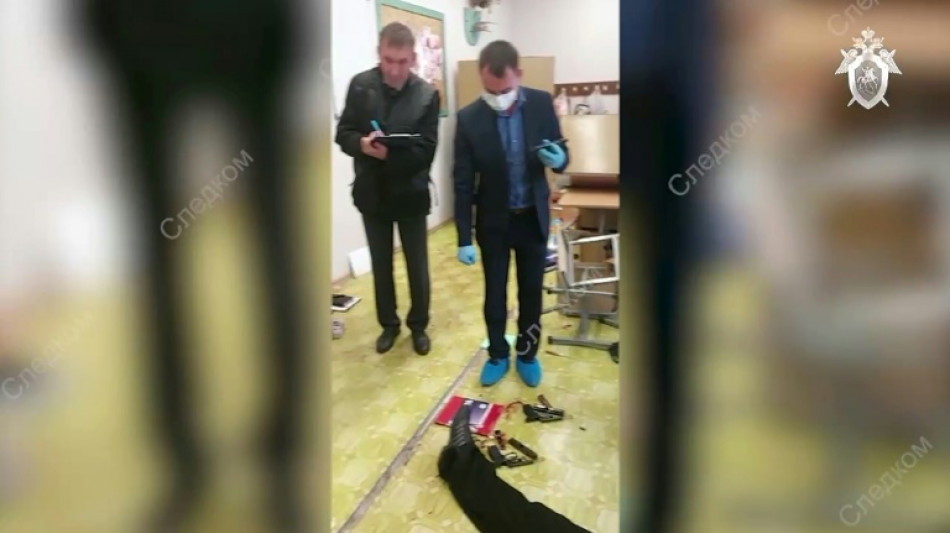
Russia school shooting leaves 13 dead, including children / Photo: - - Investigative Committee of Russia/AFP

 French Economy Shrinks 0.1% as Consumer Confidence Slumps

 Wall Street Ends Turbulent Week Higher Despite Inflation and AI Jitters

 Kansas City Fed Chief Says Inflation Is Still Running Too Hot

 Oil Heads for Second Weekly Loss as Supply Surplus Emerges

 Middletown High School Football Team Ends Legal Battle After Playoff Forfeit

 Canada Signals Openness to Chinese Automakers if US Trade Talks Fail

 US Mortgage Rate Falls for Fourth Week but Remains Above 7%

 US Jobless Claims Rise to 200,000 but Layoffs Remain Historically Low

 Euro-Area Growth Slows to 0.4% While Employment Stalls

 US Wholesale Inflation Eases Monthly but Hits a Four-Year Annual High

 India's Wholesale Inflation Jumps to 12.29% as Fuel Costs Surge

 Japan's Economy Edges Into Contraction as Costly Oil Weighs on Demand

 Kuwait and Egypt Sign Eight Agreements to Expand Strategic Partnership

 OBI Pharma Signs Collaboration and License Agreement with Novartis

The death toll has risen to 13 people, including seven children, after a man opened fire Monday at his former school in central Russia, authorities said.
The attack was the latest in a series of school shootings that have shaken Russia in recent years and came with the country on edge over efforts to mobilise tens of thousands of men to fight in Ukraine.
Russian President Vladimir Putin denounced the "inhuman terrorist attack" in the city of Izhevsk, the Kremlin said, adding that the shooter "apparently belongs to a neo-fascist group".
According to investigators, the attacker "was wearing a black top with Nazi symbols and a balaclava" when his body was discovered.
He was later identified as a local man born in 1988, who graduated from this school.
Investigators have said two security guards and two teachers were among the victims, while the attacker "committed suicide".
Authorities previously announced a death toll of nine people but did not specify if that included the suspected shooter.
Investigators said they were conducting a search in his home and looking into his "adherence to neo-fascist views and Nazi ideology".
The region's governor Alexander Brechalov confirmed there were "casualties and wounded among children", speaking in a video statement outside school No88 in Izhevsk.
Rescue and medical workers could be seen in the background, some running inside the school with stretchers.
Russia's health ministry said "14 ambulance teams" were working at the scene to help the injured, news agencies reported.
Brechalov declared a period of mourning in the region to last until Thursday.
A city of around 630,000 people, Izhevsk is the regional capital of Russia's Udmurt Republic, located around 1,000 kilometres (620 miles) east of Moscow.
The attack came just hours after a man had opened fire and severely wounded a recruitment officer at an enlistment centre in Siberia.
Russia's last major school shooting was in April, when an armed man opened fire in a kindergarten in the central Ulyanovsk region, leaving a teacher and two children dead.
The shooter, described as "mentally ill", was later found dead, with officials saying he had shot himself.
- Tightening gun laws -
Mass shootings at schools and universities in Russia were rare until 2021, when the country was rocked by two separate killing sprees in the central Russian cities of Kazan and Perm that spurred lawmakers to tighten laws regulating access to guns.
In September 2021, a student dressed in black tactical clothing and helmet armed with a hunting rifle swept through Perm State University buildings killing six people, mostly women, and injuring two dozen others.
The gunman resisted arrest and was shot by law enforcement as he was apprehended and moved to a medical facility for treatment.
It was the second such attack that year, after a 19-year-old former student shot dead nine people at his old school in the Kazan in May.
Investigators said that the gunman suffered from a brain disorder, but was deemed fit to receive a license for the semi-automatic shotgun that he used.
On the day of that attack Putin called for a review of gun control laws and the age to acquire hunting rifles was increased from 18 to 21 and medical checks were strengthened.
Authorities have blamed foreign influence for previous school shootings, saying young Russians have been exposed online and on television to similar attacks in the United States and elsewhere.
Other high-profile shooting cases have taken place in Russia's army, putting the issue of hazing in the spotlight in the country were military service is compulsory for men aged between 18 and 27.
In November 2020, a 20-year-old soldier killed three fellow servicemen at a military base near the city of Voronezh. In a similar attack in 2019, a young recruit shot dead eight servicemen, saying he faced bullying and harassment in the army.
V.F.Barreira--PC