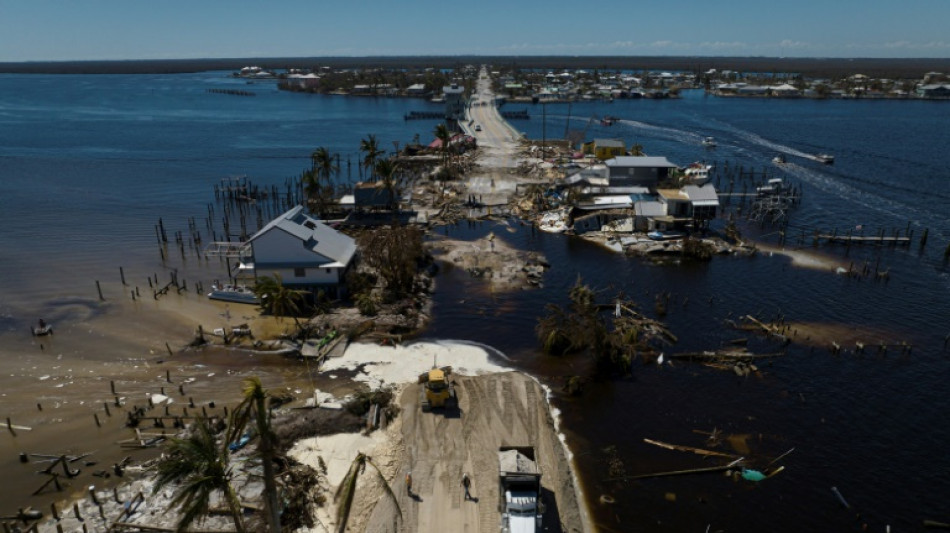
US hurricane rebuilding rules must adapt to 'era of climate change': expert / Photo: Ricardo ARDUENGO - AFP

 Liverpool boss Iraola urges Isak to raise his level

 Evenepoel wins record 4th straight world time-trial title

 France's Macron, Canada's Carney announce closer ties
 Carrick defends troubled Man Utd after Fulham escape

 Horror movie 'Resident Evil' tops N. American box office

 Germany's Merz vows to stay course despite new vote losses

 Man City outgun Sunderland despite Brobbey hat-trick, Man Utd rescue Fulham draw

 Mourinho blames ref committee for Real Madrid derby defeat

 Maresca craves a 1-0 win after eight-goal Man City thriller

 Atletico Madrid beat Real Madrid in tense derby clash

 Reusser retains world time-trial title

 Man City outgun Sunderland despite Brobbey hat-trick, Liverpool win at Bournemouth

 Top US, Chinese economic officials meet ahead of Trump-Xi summit
 Erdogan's LGBTQ crackdown 'first step of election campaign': activist

 Mass drone barrage on Moscow kills two

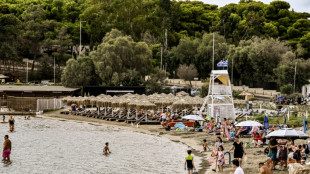 82-year-old dies after beach fight in Greece over sun lounger

 US warns of rapid escalation in Mideast war

 Iran 'put hearts on the court' to win Asian Games basketball bronze

 School girl Yu helps China dominate in Asian Games swimming openers

 Myanmar win first Asian Games teqball gold as Spain great Puyol watches

 China's 13-year-old Yu scorches to first major gold at Asian Games

 Russians vote on last day of parliamentary elections

 Hong Kong pays final respects to former city leader Tung

 Typhoon put people off Asian Games opening ceremony, official says

 China's 13-year-old Yu cruises as Asian Games swimming begins

After an extreme weather event, such as Hurricane Ian which devastated parts of Florida last month, most Americans choose to rebuild rather than move to less hazardous areas.
But as climate change increases the frequency and scale of natural disasters, does US policy need to adapt?
Gavin Smith, a professor of environmental planning at the University of North Carolina, worked for several states following major hurricanes, including Katrina in Mississippi (2005) and Matthew in North Carolina (2016).
According to him, current reconstruction standards are not up to the challenges posed by climate change, but correcting them will require real "political will."
Smith's responses to AFP have been lightly edited and condensed for clarity.
- Current reconstruction rules -
Q: What are the rules for re-construction after a hurricane, and are they adapted to climate change?
A: Communities must comply with the local codes and standards in place in their jurisdiction before the storm struck.
In the US, we have the National Flood Insurance Program (NFIP), which has historically been subsidized by the federal government.
For a community to join the program, it has to adopt certain flood risk reduction standards. They include building codes as well as land use plans.
Then, if a home is damaged in the storm more than 50 percent of their value, it must be built back to the most recent code and standards in place.
Our standard for flood is rebuilding largely back to the "100 year flood," more accurately termed the one percent annual chance flood event. But in an era of climate change, that "100 year" flood is happening more and more often.
Most risk reduction codes and standards often reflect a climate of the past.
For example, we spent $14 billion rebuilding the levee system in New Orleans after hurricane Katrina. That levee system was built back to the "100 year flood."
So you could make the argument that in the era of climate change, that levee system is already out of date.
- Political will -
Q: What do you expect from government officials?
A: Disasters can present opportunities to rebuild communities safer.
What I'm suggesting is that if we're going to spend hundreds of millions of dollars building these communities back, we need to require communities to adopt higher codes and standards.
But that takes political will of both members of Congress and local elected officials.
These are really difficult trillion dollar questions.
You'll also have builders and the private sector saying, "We should limit those kinds of regulations, as we need to quickly rebuild."
It takes a lot of political will for a mayor or for a governor to say "No, we've got to do what's right in the long run.:
Unfortunately, people don't get elected by saying "I am going to require higher standards."
That's not a winning slogan. It takes political will to say, enough is enough, we need to adopt higher standards, it's going to take time, cost more, and people may have to pay more to do it.
That said, we also need to make sure we include equity in processes adopted to develop those standards.
The shrimpers and the crabbers that live in a very modest house on the water, if we make them adopt higher standards, can they afford it?
- Rules for resilience -
Q: Concretely, what would be these better standards?
A: A really simple way to think about it is "where" and "how" you build in relation to natural hazards, including those exacerbated by climate change.
The "how" include elevating structures, more stringent standards for wind performance, like better roof shingles, hardening our infrastructure -- communication systems, bridges, roads, levees... We can also do this by protecting natural systems like dunes and wetlands.
The "where" is what we would often refer to as land use planning.
Should we be putting a hospital, or a school, in an area subject to storm surge? Probably not.
A community may choose to say, we're not going to build a house within 200 meters of the beach.
Or adopt a gradual disinvestment strategy in extremely risky areas (managed retreat). It's very difficult to do politically, but it's happening on a small scale.
Resilience is really about a series of protective measures or choices. It's not just one. A levee, if that's your only protection and it fails, to me that's not resilience.
R.Veloso--PC

